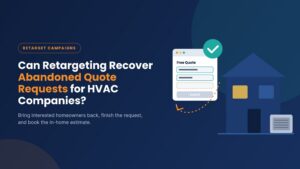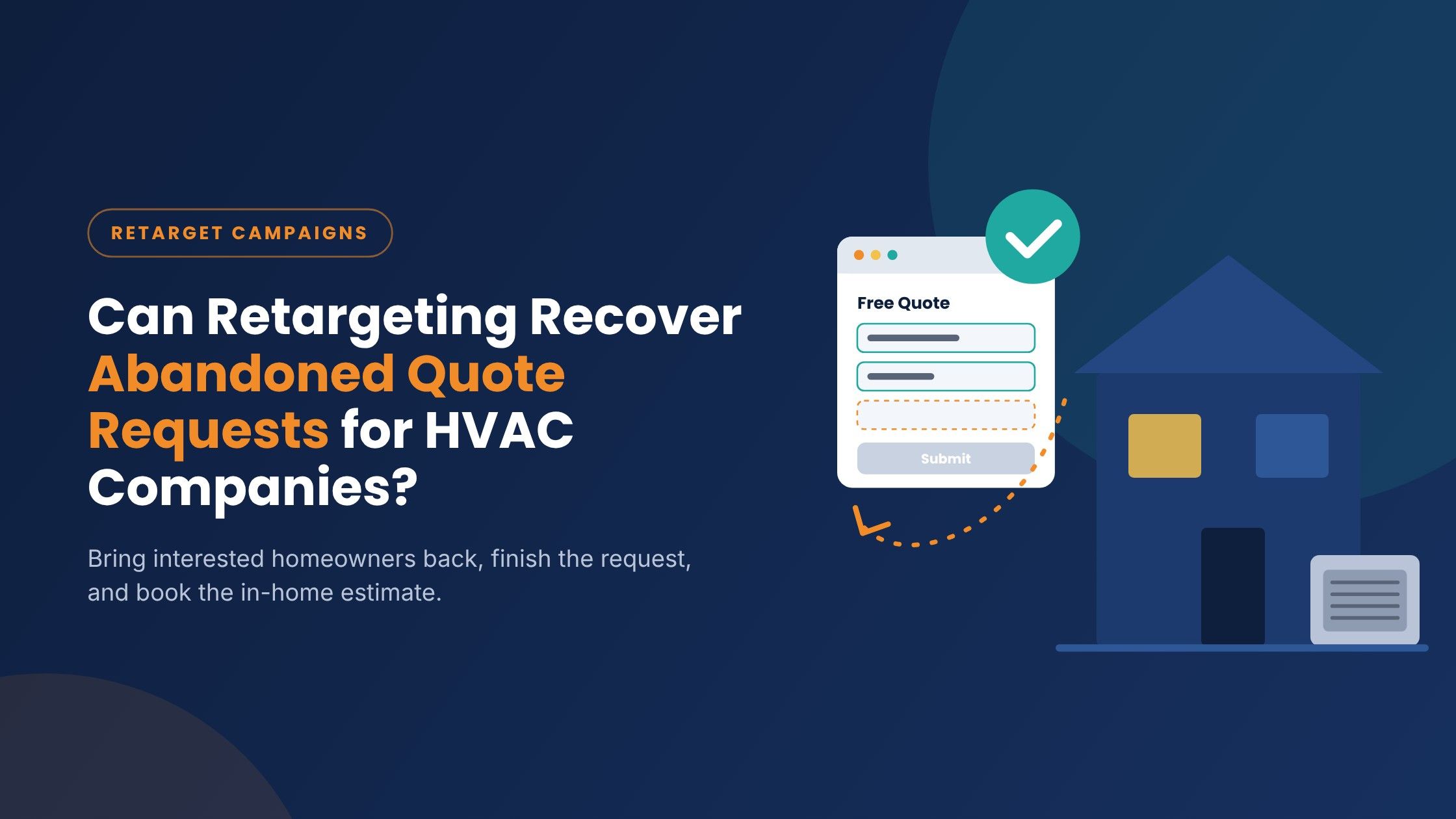
Can retargeting campaigns recover abandoned quote requests for HVAC companies when homeowners compare several contractors, get distracted halfway through a form, and often leave without ever calling back?
For HVAC companies, a quote request is one of the most valuable actions a website visitor can take. A homeowner researching a new furnace, a central air system, or a heat pump is often weeks away from a purchase worth thousands of dollars.
Yet many of these visitors never finish the request. They open the form, start entering details, and leave. Some are interrupted. Some hesitate at the phone number field. Some want to compare prices first. Others simply forget, then book whichever contractor reaches them next.
These lost requests are expensive. Each one represents a homeowner who already showed buying intent, often after the company paid for the click that brought them to the site.
The problem is measurable. Form analytics provider Zuko reports that about one in three people who start an online form do not complete it. For contact forms, only 38% of users who interact with the form go on to submit it.
Retargeting for HVAC companies helps bring these homeowners back by showing relevant ads, sending reminders to known contacts, and making it easier to finish the request or book a call.
The result is more completed quote requests from people who were already interested, without paying again to find them.
Direct Answer
Yes. HVAC retargeting campaigns can recover abandoned quote requests by reminding interested homeowners to come back, addressing the concerns that stopped them, and giving them an easier way to book an estimate.
A typical retargeting workflow for abandoned quote requests looks like this:
Quote page visit → Form started but not submitted → Visitor added to retargeting audience → Reminder ads and follow-ups → Return visit → Quote request or call → In-home estimate
Each stage has a clear trigger. A visitor who views the quote page but does not submit is added to an audience. If they return and submit, they are removed from it. If they still do not convert, the message changes to answer a different objection.
Retargeting does not guarantee that homeowners will book. They may have already chosen another contractor, decided to repair rather than replace, or postponed the project. However, it keeps your company visible during the days when a homeowner is comparing options and deciding who to call.
The objective is to bring back homeowners who were already interested, while showing them a reason to choose your company over the next contractor they find.
Step-by-Step Breakdown
1. Track quote page visits and form starts
Retargeting depends on knowing who showed interest.
Install the Google tag and Meta Pixel on the website, and set up events for key actions: viewing the quote page, starting the form, submitting the form, and clicking the phone number.
The most valuable audience is not everyone who visited the site. It is the homeowner who reached the quote page, or started the form, but did not finish.
Make sure tracking follows applicable privacy laws and that the website’s cookie notice and privacy policy explain how visitor data is used for advertising.
2. Build separate audiences by intent
Not every visitor deserves the same message or budget.
Useful retargeting audiences for HVAC companies include:
- Form abandoners: Started the quote form but did not submit it.
- Quote page visitors: Viewed the quote or estimate page but never started the form.
- Service page visitors: Viewed AC replacement, furnace installation, or heat pump pages.
- Financing page visitors: Checked financing options, which often signals a replacement decision.
- Past submitters: Completed a request, to be excluded from reminder ads.
Form abandoners usually deserve the highest bids and most frequent reminders, because they were closest to converting.
3. Exclude people who already converted
Nothing wastes budget or annoys homeowners faster than showing “Request your free quote” to someone who already booked an estimate.
Exclude form submitters, callers, and existing customers from reminder campaigns. Connect the CRM or call-tracking platform so these lists update automatically.
Past customers can still be targeted separately with maintenance plans or seasonal tune-up offers, using different creative.
4. Match the message to the reason they left
Homeowners abandon quote requests for different reasons. Retargeting works better when each ad addresses a likely objection.
For example:
- Price uncertainty: Highlight financing options, rebates, or a free in-home estimate.
- Trust: Show reviews, licensing, years in business, and warranties.
- Timing: Mention same-day or next-day appointments.
- Effort: Offer a quick call-back or one-click booking instead of a long form.
Rotating these angles over several days helps reach homeowners who were hesitating for different reasons.
5. Use the right channels
Homeowners spend time across many platforms, and one channel rarely reaches them all.
Google display and YouTube remarketing can reach visitors as they browse the web or watch videos. Meta ads can reach them on Facebook and Instagram. Remarketing lists for search ads can raise bids when a previous visitor searches for “AC replacement near me” again.
Note that Google requires a minimum audience size before some remarketing lists can serve, so smaller HVAC websites may need to combine audiences or extend the membership window.
6. Recover known contacts with email and text
If the homeowner entered a name, email, or phone number before abandoning the form, the company may be able to follow up directly.
Some form tools capture partial entries. Where the homeowner has given permission to be contacted, an automated sequence can send a short reminder:
“Hi Mark, looks like your AC replacement quote request wasn’t finished. Would you like us to call you to schedule a free estimate?”
Text messages require explicit consent under regulations such as the TCPA, so review the form’s consent language with legal counsel before sending.
7. Shorten and simplify the quote form
Retargeting can bring homeowners back, but a difficult form will lose them again.
Zuko’s field-level data puts abandonment at the phone number field at 6.3%, one of the highest of any common field. Every unnecessary question gives a homeowner another reason to leave.
Ask only for the information needed to schedule an estimate, such as name, phone, ZIP code, and service type. Collect system details later, during the call or visit. Make the form fast on mobile, where many homeowners start their search.
8. Give returning visitors a faster path
When a homeowner clicks a retargeting ad, send them to a focused landing page rather than the homepage.
The page should repeat the offer from the ad, show reviews and service areas, and offer several ways to convert: a short form, a click-to-call button, and online booking.
Some homeowners who abandoned a form would rather talk to a person. Making the phone number prominent can recover requests the form never would.
9. Control frequency and timing
Retargeting should feel helpful, not intrusive.
HVAC replacement decisions usually happen within days or a few weeks. A sensible approach is to show ads more often in the first 7 days after abandonment, then reduce frequency through day 30.
Emergency repair visitors may need a much shorter window, often 24 to 72 hours, because the need is urgent.
Cap how many times each person sees an ad per day, and refresh creative regularly so the campaign does not become background noise.
10. Measure recovered requests, not impressions
HVAC companies should judge retargeting by booked estimates and revenue, not clicks or impressions.
Useful metrics include:
- Form start-to-submit rate before and after changes
- Recovered quote requests from retargeting audiences
- Calls from retargeting landing pages
- Cost per recovered request
- Estimate-to-sale close rate for recovered leads
- Average job value
- Return on ad spend by audience
Compare results by audience and offer. If form abandoners convert well but service page visitors do not, shift budget toward the higher-intent audience.
Supporting Statistics and Real-World Examples
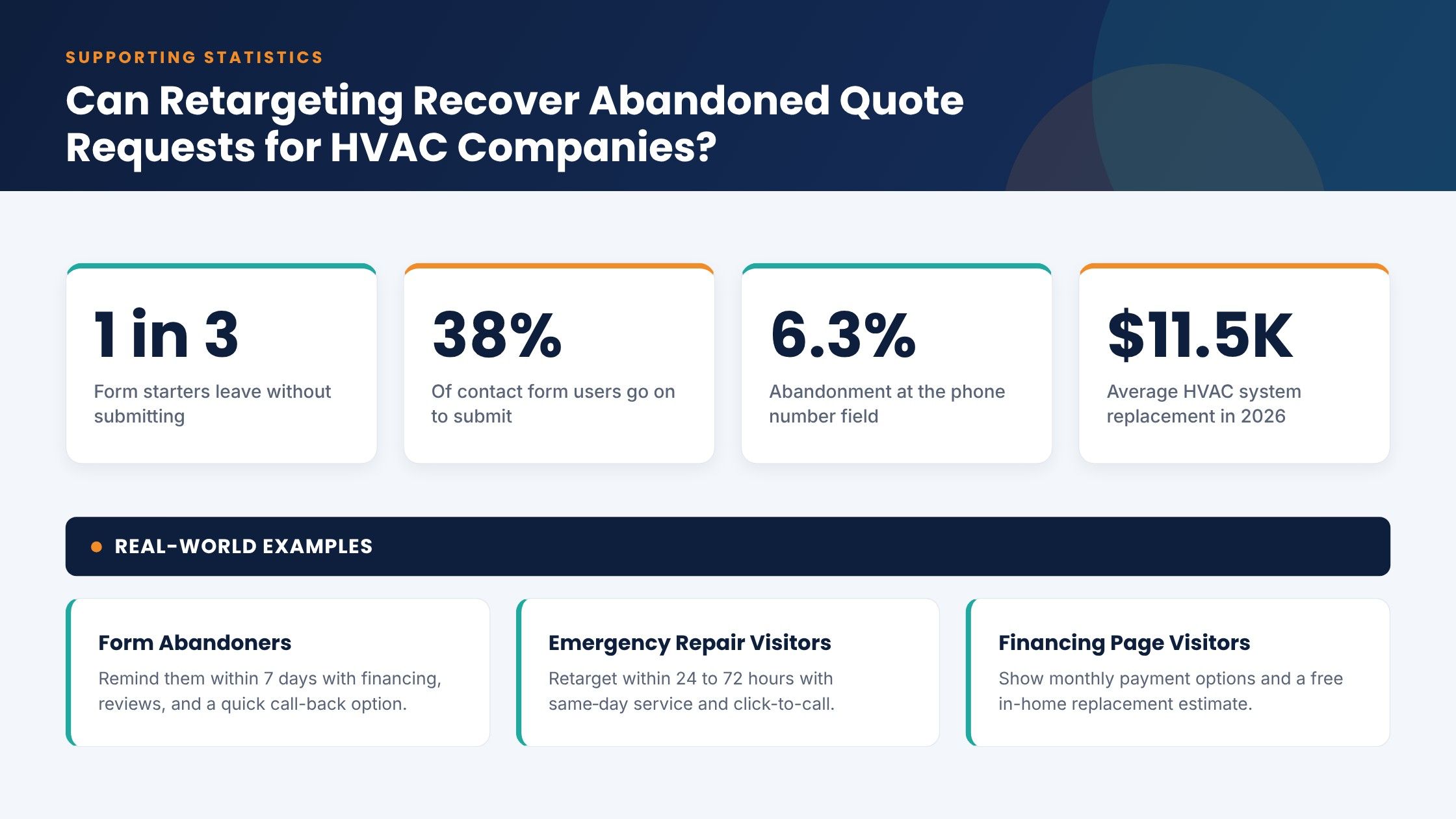
Research shows that HVAC companies have a clear reason to pay attention to people who start a quote request but do not finish.
Zuko’s 2026 form benchmarks found that about 66% of people who start an online form complete it, which means roughly one in three starters leaves without submitting. Contact forms perform worse: only 38% of users who interact with one go on to submit it. These figures cover many industries, not HVAC alone, but they show how many interested visitors are lost at the final step.
The same data shows that individual fields create friction. The phone number field had a 6.3% abandonment rate, a reminder that every required question has a cost. Retargeting can bring homeowners back, but a shorter form helps keep them.
The value of each recovered request is also high. According to ConsumerAffairs, replacing a standard split HVAC system typically costs between $8,000 and $15,000, with an average of around $11,500 in 2026. A central AC replacement alone typically costs $4,000 to $7,500.
These findings do not prove that retargeting will recover a specific percentage of abandoned requests. They show that form abandonment is common, that friction is measurable, and that a single recovered replacement job can be worth far more than the cost of the campaign.
Practical HVAC Company Example
Consider an HVAC company whose quote form is started by 300 homeowners each month.
Suppose one-third abandon the form before submitting.
300 form starters × 33% = about 100 abandoned quote requests per month.
The company launches a retargeting campaign aimed at those 100 homeowners, using reminder ads, a simpler landing page, and click-to-call options.
Suppose the campaign recovers 10% of them.
100 abandoned requests × 10% = 10 recovered quote requests.
Now suppose the company closes 4 of those 10 estimates as system replacements.
If each replacement is worth $11,500:
4 jobs × $11,500 = $46,000 in monthly revenue from recovered requests.
Even if the campaign costs $1,500 a month in ad spend and management, the return can be substantial.
These figures are illustrative, not industry benchmarks. Actual results depend on traffic volume, audience size, offer, seasonality, local competition, close rate, and the mix of repair and replacement jobs.
The lesson is that HVAC retargeting does not need to recover many requests to pay off. A handful of recovered replacement jobs can cover the campaign many times over, provided results are tracked through to booked revenue.
Quick Tactical Setup for HVAC Retargeting Campaigns
Start with one high-value service, such as AC or furnace replacement, and focus on homeowners who started the quote form but did not submit it.
Install the Google tag and Meta Pixel, track form starts, submissions, and phone clicks, and build an audience of form abandoners with past submitters excluded.
Create three or four ad variations that address price, trust, timing, and effort. Send clicks to a focused landing page with a short form, click-to-call, and online booking.
Connect the campaign to the CRM or call-tracking platform so recovered requests, booked estimates, and closed jobs can be traced back to retargeting.
After the first month, review cost per recovered request and revenue from closed jobs. Improve the form and messaging before expanding to service page visitors, financing page visitors, or seasonal maintenance campaigns.
Conclusion
Can retargeting campaigns recover abandoned quote requests for HVAC companies?
Yes. Retargeting campaigns can help HVAC companies bring back homeowners who showed buying intent, address the concerns that stopped them, and turn unfinished quote requests into booked estimates.
The most valuable improvements include:
- More completed quote requests from existing traffic
- Lower cost per booked estimate
- Messaging matched to price, trust, and timing concerns
- Stronger visibility while homeowners compare contractors
- Faster paths to book through calls and online scheduling
- Less wasted spend on people who already converted
- Clear tracking from ad to closed job
- Better return on the advertising that brought visitors in
Retargeting cannot compensate for slow call-backs, unclear pricing, or poor service. Its value comes from giving interested homeowners a second chance to act, so your sales team can do the rest.
When homeowners see a timely, relevant reminder and can book an estimate in a few seconds, they have a strong reason to come back and finish what they started.