How can lead nurture sequences convert website inquiries for custom home builders when prospects may take months to buy land, secure financing, and decide whether they are ready to build?
For custom home builders, a website inquiry is rarely a ready-to-sign customer. It is usually the start of a long decision. The prospect may still be searching for a lot, comparing builders, talking to a lender, collecting design ideas, or waiting to sell their current home.
That creates a gap. A homeowner submits an inquiry, the builder calls once or twice, and the conversation stalls because the timing is not right. Months later, the same prospect is ready to build, but they sign with whichever builder stayed in touch.
The stakes are high. According to the National Association of Home Builders, the average sales price of a new single-family home in its 2024 Cost of Constructing a Home survey was $665,298. A single lost project can be worth more than many smaller service jobs combined.
Lead nurture for custom home builders closes this gap. Automated, well-timed emails and texts keep the builder in front of the prospect, answer common questions, build trust, and invite the next step when the prospect is ready.
The result is fewer inquiries lost to silence and more prospects who arrive at the first meeting already informed and confident.
Direct Answer
Lead nurture sequences convert website inquiries for custom home builders by staying in touch through the long planning period, answering the questions that delay decisions, and inviting prospects to the next step when their land, budget, and timing come together.
A typical lead nurture workflow for custom home builders looks like this:
Website inquiry → Instant acknowledgment → Qualification questions → Segmented email and text sequence → Educational content and project examples → Discovery call or model home visit → Design consultation → Contract
Each stage has a clear trigger. A new inquiry starts the sequence. Answers about land, budget, and timeline decide which track the prospect follows. A reply, a booked call, or a visit to the pricing page alerts the sales team to step in personally.
Nurture sequences do not replace the builder’s reputation, design quality, or sales conversations. Prospects may still choose another builder, buy an existing home, or delay the project. However, a well-built sequence keeps the builder relevant through months of indecision, so the company is already trusted when the prospect is ready to move forward.
The objective is to stay helpful and visible until timing aligns, without pressuring prospects who are not ready yet.
Step-by-Step Breakdown
1. Respond to every inquiry immediately
The nurture sequence should start the moment a prospect submits a form.
An automated acknowledgment can thank them for reaching out, introduce the person who will follow up, explain what happens next, and share one useful resource, such as a guide to the custom building process.
This prevents the silence that makes prospects wonder whether anyone received their message. It also sets expectations before the first call.
The automated message should never replace a personal follow-up. It buys time and builds confidence until a team member reaches out.
2. Ask a few qualification questions
Custom home inquiries vary widely. One prospect owns land and has financing approved. Another is just starting to explore whether building is realistic.
Ask a few simple questions, either on the form or in the first email:
- Do you already own a lot or land?
- What is your approximate budget range?
- When would you like to start building?
- Are you working with a lender yet?
- What type of home are you considering?
Keep the questions short and optional. The goal is to understand where the prospect stands, not to screen them out before a conversation.
3. Segment prospects by readiness
The answers to those questions should decide which sequence a prospect receives.
Useful segments for custom home builders include:
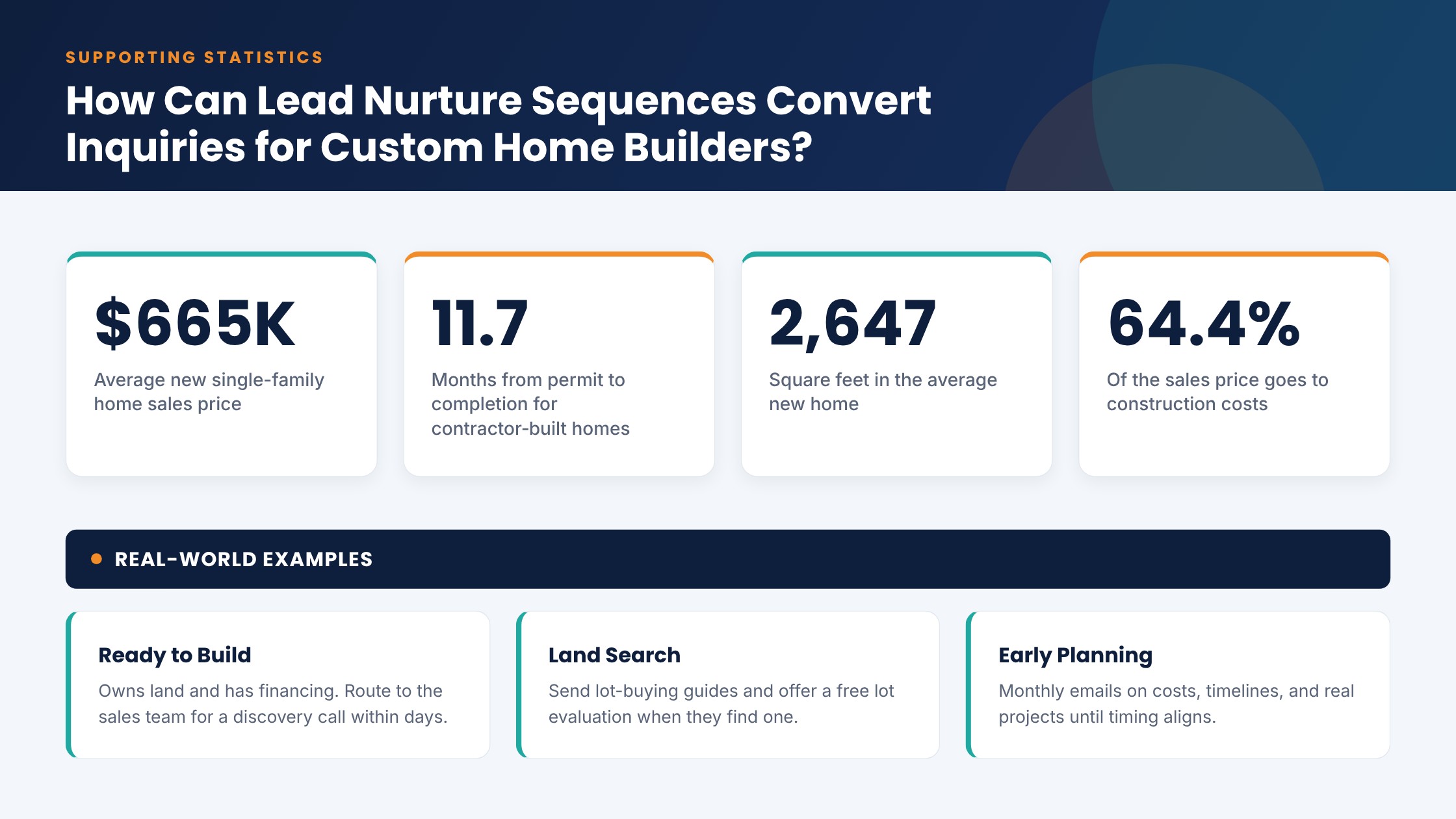
- Ready to build: Owns land, has financing, and wants to start within six months.
- Land search: Wants to build but still needs a lot.
- Early planning: Exploring ideas, budgets, and timelines for the next year or two.
- Selling first: Needs to sell a current home before building.
- Outside service area or budget: Politely redirected, with a resource or referral.
Ready prospects should go to the sales team quickly. Early-stage prospects need education and patience.
4. Educate before you sell
Most first-time custom home buyers do not understand the process. Uncertainty causes delays, and delays cause prospects to drift away.
A nurture sequence can explain the process step by step:
- How the custom home building process works from land to move-in
- What affects the cost per square foot
- How construction loans differ from traditional mortgages
- What to look for when buying a building lot
- How long design, permitting, and construction usually take
- What questions to ask when comparing builders
Each email should answer one question clearly and invite a reply if the prospect wants to discuss their situation.
5. Show proof through real projects
Custom home buyers are making one of the largest purchases of their lives. They want evidence that the builder can deliver.
Include completed project photos, short case stories, client testimonials, and examples of homes in similar styles or price ranges. A story about a family that built on a sloped lot or managed a tight budget can answer concerns better than a list of features.
Use only genuine projects and testimonials with client permission.
6. Use realistic timing and frequency
Custom home decisions can take many months. A nurture sequence should match that pace.
A practical approach is to send more frequent messages in the first two weeks after an inquiry, then move to every two to four weeks for early-stage prospects.
Too many emails can push prospects to unsubscribe. Too few allow them to forget the builder. Watch open rates, replies, and unsubscribes to adjust the cadence.
7. Combine email, text, and personal outreach
Email is ideal for longer content such as guides, project stories, and process explanations. Text messages work well for short reminders, such as confirming a call or inviting the prospect to an open house.
Personal outreach should remain part of the process. A short phone call or personal email from the sales lead at key moments often does more than another automated message.
Text messaging requires explicit consent under regulations such as the TCPA, so review consent language on inquiry forms.
8. Trigger sales follow-up from engagement
Not every prospect needs a call every week. But certain actions signal growing interest.
Workflow automation can alert the sales team when a prospect:
- Replies to an email
- Clicks a link to the pricing or financing page
- Downloads a floor plan or design guide
- Registers for a model home tour or open house
- Updates their timeline or budget
These signals help the team prioritize prospects who are moving closer to a decision.
9. Invite clear next steps
Every stage of the sequence should offer one appropriate next step.
For early-stage prospects, it might be downloading a planning guide or attending an open house. For land searchers, it might be a lot evaluation. For ready prospects, it should be a discovery call or design consultation.
Making the next step specific and low-pressure helps prospects move forward at their own pace.
10. Measure conversions, not just opens
Custom home builders should measure whether nurture sequences produce consultations and contracts.
Useful metrics include:
- Inquiry-to-first-call rate
- Discovery call and consultation bookings
- Email replies and engagement by segment
- Time from inquiry to consultation
- Consultation-to-contract conversion rate
- Average contract value
- Revenue from nurtured inquiries
Compare results by segment. If early-planning prospects rarely convert within a year, they may still become valuable buyers later and should remain in a long-term sequence.
Supporting Statistics and Real-World Examples
Industry data explains why custom home builders need a follow-up system that lasts longer than a few phone calls.
The NAHB’s 2024 Cost of Constructing a Home survey found an average new single-family home sales price of $665,298, with construction costs averaging $428,215, or 64.4% of the sales price. The average finished home in the survey measured 2,647 square feet. These figures cover new homes built by NAHB member builders, not custom homes alone, but they show the size of the decision a prospect is weighing.
The project timeline is also long. According to NAHB analysis of Census Bureau data, contractor-built homes, the category that includes custom homes built on the owner’s land, took an average of 11.7 months from permit authorization to completion in 2025. Owner-built homes took 14.3 months, while homes built for sale took 7.4 months.
That timeline begins only after a permit is issued. Before that, prospects may spend months finding land, arranging financing, and finalizing designs. A builder who calls once and moves on may miss the prospect entirely when they are ready.
These findings do not prove that nurture sequences will convert a specific percentage of inquiries. They show that custom home decisions involve large budgets and long timelines, which is exactly where consistent, helpful follow-up has the most value.
Practical Custom Home Builder Example
Consider a custom home builder that receives 40 website inquiries each month.
40 inquiries × 12 months = 480 inquiries per year.
Without a structured follow-up system, the sales team calls each new inquiry once or twice. Prospects who are not ready are rarely contacted again.
The builder introduces segmented nurture sequences: an instant acknowledgment, qualification questions, educational emails about land, financing, and costs, project stories, and alerts when prospects show renewed interest.
Suppose this helps the builder sign 3 additional contracts in the first year, mostly from prospects who would otherwise have gone quiet.
If each contract is worth $650,000:
3 contracts × $650,000 = $1,950,000 in additional contract value.
These figures are illustrative, not industry benchmarks. Actual results depend on inquiry quality, local market conditions, price range, sales follow-up, financing conditions, and how long prospects take to decide.
The lesson is that custom home builders do not need many additional conversions for nurture sequences to pay off. A small number of recovered projects can justify the setup many times over.
Quick Tactical Setup for Home Builder Lead Nurture
Start with one inquiry source, such as the main contact or “Start Your Build” form on the website.
Set up an instant acknowledgment email, add three to five qualification questions, and create two segments to begin: prospects ready to build within six months and prospects still planning.
Write a six- to eight-email sequence for each segment, covering the building process, costs, land, financing, timelines, and real project stories. Connect the sequence to the CRM so replies and key page visits alert the sales team.
After three months, review consultation bookings, replies, unsubscribes, and contracts by segment. Refine the content and timing before adding segments for land searchers, prospects selling a home first, or past inquiries that went quiet.
Conclusion
How can lead nurture sequences convert website inquiries for custom home builders?
They keep the builder present through the long months between a first inquiry and a signed contract. A strong home builder lead nurture system answers prospects’ questions, builds trust with real projects, and alerts the sales team when interest grows. Marketing automation makes this consistent without adding hours to the sales team’s week.
The most valuable improvements include:
- Instant, consistent responses to every inquiry
- Clear segmentation by land, budget, and timeline
- Education that removes uncertainty and delay
- Proof through real projects and client stories
- Timely alerts when prospects show renewed interest
- Fewer prospects lost to silence
- Better-prepared prospects at the first consultation
- More contracts from existing website traffic
Nurture sequences cannot compensate for poor craftsmanship, unclear pricing, or slow personal follow-up. Their value comes from staying helpful and visible until the prospect is ready.
When prospects feel informed, remembered, and supported throughout their planning, they have a strong reason to build with the company that stayed with them from the first inquiry.