
Can a fractional CMO lower patient acquisition costs for multi-location dental practices when each office runs its own ads, competes in its own local market, and reports results in a different way?
For growing dental groups, marketing often expands faster than the strategy behind it. A second location gets its own Google Ads account. A third hires a local agency. A fourth relies on the front desk to post on social media. Before long, the group is paying for overlapping campaigns, inconsistent branding, and reports that cannot be compared.
The result is a rising cost to win each new patient, with no clear view of which channel or location is actually working.
The pressure is also increasing. According to the ADA Health Policy Institute, 16% of U.S. dentists were affiliated with a dental support organization in 2024, and the share of dentists who own their practice fell from 84.7% in 2005 to 72.5% in 2023. As dentistry consolidates, independent and multi-location groups compete with larger organizations that have dedicated marketing leadership.
A fractional CMO for dentists gives multi-location groups that same senior marketing leadership on a part-time basis. Instead of adding another agency or campaign, the fractional CMO sets strategy across all locations, fixes tracking, reallocates budget, and holds every channel accountable for new patients.
The result is a clearer, more efficient marketing system, without the cost of a full-time executive.
Direct Answer
Yes. A fractional CMO can lower patient acquisition costs for multi-location dental practices by unifying marketing strategy, fixing tracking, cutting wasted spend, and shifting budget toward the channels and locations that produce new patients most efficiently.
A typical fractional CMO process for a dental group looks like this:
Marketing audit → Unified tracking → Cost per new patient by channel and location → Budget reallocation → Front desk conversion improvements → Monthly reporting → Ongoing optimization
Each stage builds on the one before. The audit shows where money is going. Tracking connects spend to booked appointments. Reporting by location shows which offices need more support and which campaigns should be cut.
A fractional CMO does not guarantee lower costs. Results depend on local competition, the services each office promotes, insurance mix, staffing, and how well the front desk converts calls into appointments. However, a single accountable leader across all locations can remove duplication and waste that individual offices rarely see on their own.
The objective is to make every marketing dollar traceable to a new patient, so the group can invest with confidence as it grows.
Step-by-Step Breakdown
1. Audit marketing across every location
The first task is to see the full picture.
A fractional CMO reviews every active channel at each office: Google Ads, Meta ads, search engine optimization, Google Business Profiles, the website, review platforms, direct mail, referral programs, and any agencies or vendors.
The audit usually reveals problems that are invisible from inside a single office, such as two locations bidding against each other on the same keywords, outdated listings, duplicate software subscriptions, or agencies reporting clicks instead of booked patients.
This creates a baseline: what each location spends, where the money goes, and what it produces.
2. Define patient acquisition cost consistently
Multi-location groups often cannot compare results because each office measures differently.
A fractional CMO sets one definition for the whole group. A common formula is total marketing spend divided by the number of new patients who complete a first visit, measured by location and by channel.
The key is consistency. Counting form fills at one office and completed appointments at another makes the numbers meaningless.
3. Fix call and appointment tracking
In dentistry, many new patients call rather than book online. If calls are not tracked, the channels driving them look weaker than they are.
Call tracking numbers by channel and location, form tracking, and online booking data should all connect to the practice management system or CRM, so marketing results can be matched to scheduled and completed appointments.
Any tracking that touches patient information must be set up with HIPAA in mind, using vendors willing to sign business associate agreements where required.
4. Remove duplicate and wasted spend
Once tracking shows real results, waste becomes easy to find.
Common examples include:
- Paid search campaigns from different locations competing for the same searches
- Broad keywords that attract job seekers or people looking for free care
- Agencies or tools paid separately by each office for the same service
- Campaigns promoting services an office does not offer or cannot schedule quickly
- Spend continuing in areas outside a location’s realistic patient radius
Redirecting this money is often the fastest way to lower cost per new patient without increasing the budget.
5. Allocate budget by location and service
Not every office needs the same budget. A new location in a competitive suburb may need heavier investment, while an established office with strong referrals may need much less.
A fractional CMO allocates budget based on each location’s capacity, competition, and the value of the services it promotes. Higher-value services such as implants, clear aligners, or cosmetic dentistry may justify a higher acquisition cost than routine hygiene appointments.
Budget should also follow chair availability. Spending to attract new patients when an office is booked for weeks wastes money and frustrates patients.
6. Strengthen local search for each office
For dental practices, local search is often one of the most cost-efficient channels.
Each location should have a complete, accurate Google Business Profile, a dedicated location page on the website, consistent name, address, and phone details across directories, and a steady flow of recent patient reviews.
These improvements build over time and can reduce dependence on paid ads, lowering the blended cost per new patient across the group.
7. Improve front desk conversion
Marketing can generate calls, but the front desk turns them into appointments.
A fractional CMO reviews call outcomes by location: missed calls, calls that end without a booking, and how quickly web inquiries receive a response. Simple changes, such as call scripts, overflow call handling, after-hours booking, and faster follow-up on forms, can increase appointments from the same marketing spend.
When more inquiries convert, cost per new patient falls even if ad spend stays the same.
8. Standardize the brand and patient experience
Patients often compare locations online before choosing one. Inconsistent logos, messages, and offers across offices weaken trust and make campaigns harder to manage.
A fractional CMO sets brand standards, approved offers, and campaign templates that every location can use, while allowing local details such as staff photos, community involvement, and location-specific services.
Shared creative also saves money, because each office no longer needs to produce its own from scratch.
9. Manage agencies and vendors with clear goals
Many dental groups work with several agencies, each reporting its own metrics.
A fractional CMO becomes the single point of accountability, setting goals based on booked new patients and cost per patient rather than impressions or clicks. Vendors that cannot show results against these goals can be replaced or consolidated.
This also frees owners and office managers from managing marketing vendors themselves.
10. Report monthly by location and channel
The fractional CMO should provide a simple monthly report that every owner can understand.
Useful metrics include:
- Total marketing spend by location
- New patients by location and channel
- Cost per new patient by location and channel
- Call answer and booking rates
- Show rate for first appointments
- Revenue from new patients over their first 12 months
- Review volume and rating by location
Clear reporting turns marketing from a monthly expense into a measurable investment, and shows which locations need attention next.
Supporting Statistics and Real-World Examples
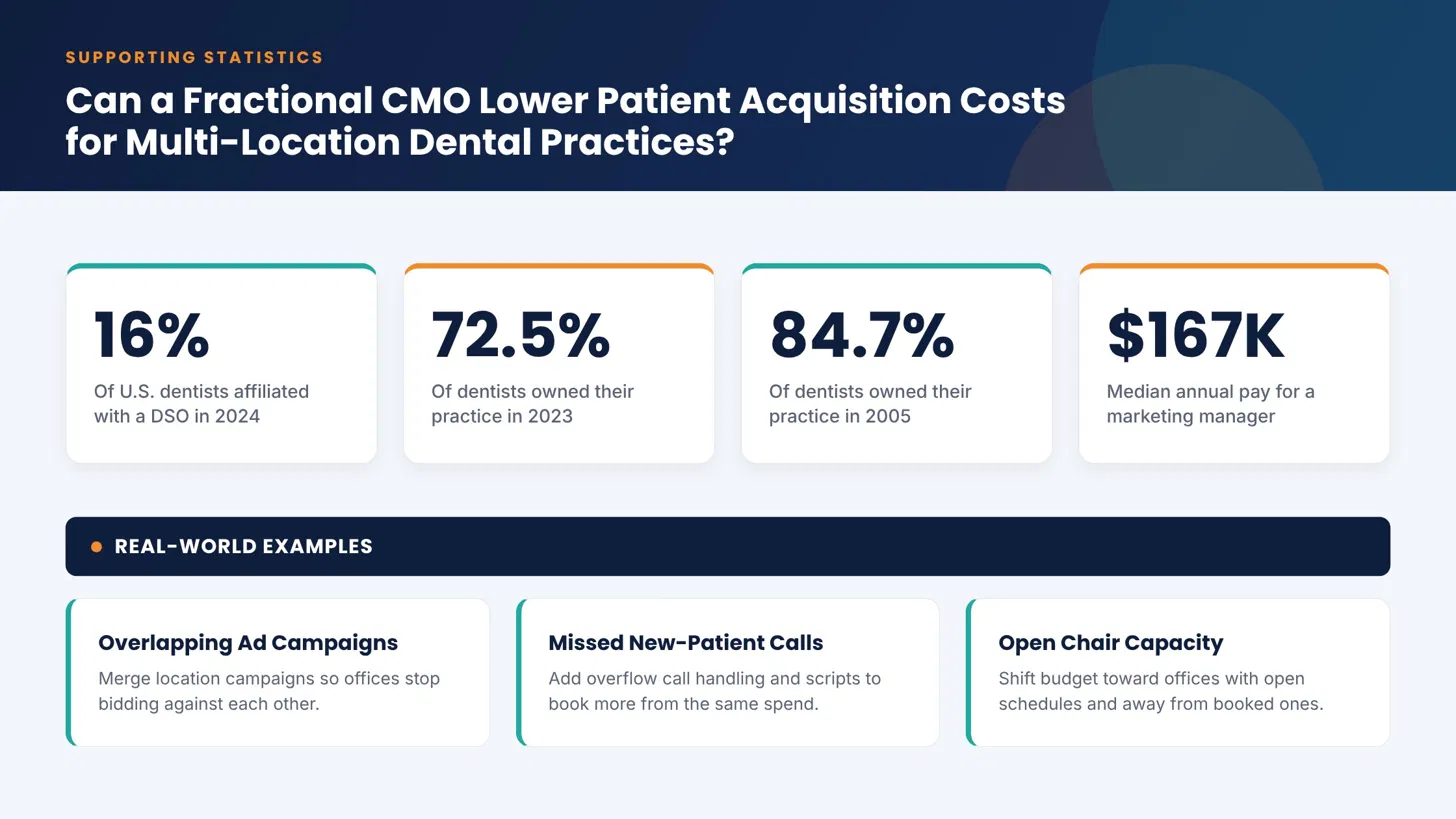
Industry data shows why multi-location dental practices need more structured marketing leadership.
The ADA Health Policy Institute reports that 16% of U.S. dentists were affiliated with a dental support organization in 2024. Practice ownership among dentists has also declined, from 84.7% in 2005 to 72.5% in 2023. The profession is moving toward larger groups, and many of those groups have dedicated marketing teams and centralized data.
For independent multi-location practices, matching that capability with a full-time hire is expensive. According to the U.S. Bureau of Labor Statistics, the median annual pay for marketing managers was $166,790 in May 2025. A chief marketing officer typically costs more, before benefits, recruiting, and tools.
A fractional CMO gives a growing dental group senior strategy and accountability for a fraction of that cost, which matters most when the group has outgrown office-by-office marketing but cannot yet justify a full executive team.
These findings do not prove that a fractional CMO will lower acquisition costs by a specific amount. They show that dentistry is consolidating, that competitors are becoming more organized, and that full-time marketing leadership is a significant expense.
Practical Dental Group Example
Consider a dental group with four locations spending a combined $12,000 per month on marketing and attracting 120 new patients.
$12,000 ÷ 120 new patients = $100 per new patient.
A fractional CMO audits the group and finds overlapping paid search campaigns, an unused software subscription, and two locations with low call answer rates.
The group cuts $1,000 in duplicate spend, shifts budget toward the locations with open chair time, improves Google Business Profiles, and adds overflow call handling.
Suppose new patients rise to 145 per month on an $11,000 budget.
$11,000 ÷ 145 new patients = about $76 per new patient.
That represents a reduction of roughly 24% in cost per new patient, along with 25 more new patients each month.
These figures are illustrative, not industry benchmarks. Actual results depend on local competition, services promoted, insurance mix, staffing, scheduling capacity, and how quickly changes are implemented.
The lesson is that lower acquisition costs often come from better coordination, not bigger budgets. A fractional CMO’s value comes from seeing the whole group at once and directing money where it works.
Quick Tactical Setup for Multi-Location Dental Groups
Start with a 30-day audit of every location’s marketing spend, channels, vendors, and tracking.
Agree on one definition of cost per new patient, then set up call tracking, form tracking, and appointment matching for each office and channel.
Identify the three biggest sources of waste, such as overlapping campaigns, unused tools, or missed calls, and fix them before adding new spend.
Reallocate budget based on each location’s capacity and results. Standardize Google Business Profiles, review requests, and brand templates across offices.
After 90 days, compare cost per new patient, new patient volume, and booking rates by location against the original baseline. Expand what works and cut what does not.
Conclusion
Can a fractional CMO lower patient acquisition costs for multi-location dental practices?
Yes. A fractional CMO can bring the strategy, tracking, and accountability that office-by-office marketing usually lacks. For dental groups, a fractional CMO for dentists turns scattered campaigns into one coordinated system measured by booked new patients.
The most valuable improvements include:
- One consistent definition of cost per new patient
- Accurate call and appointment tracking by location
- Less duplicate and wasted spend
- Budget matched to chair capacity and local competition
- Stronger local search for every office
- Higher front desk booking rates
- Clear accountability for agencies and vendors
- Monthly reporting owners can act on
A fractional CMO cannot compensate for poor patient experience, long wait times, or staffing gaps. Their value comes from making marketing measurable and coordinated, so every location benefits from what the group learns.
When a dental group knows what each new patient costs and where they come from, it can grow with confidence instead of guesswork.