Can cold email outreach win facility contracts for commercial cleaning companies when facility managers already have a vendor, rarely answer unknown numbers, and treat cleaning as a cost to be controlled?
For most commercial cleaning companies, growth depends on a small number of high-value accounts. One office building, medical practice, or multi-site retail chain can be worth tens of thousands of dollars a year, and contracts often renew for several years once the relationship is working.
The difficulty is getting in front of the person who controls the decision. Facility managers, property managers, and office administrators are busy, guarded, and rarely searching for a new cleaning vendor until something goes wrong. Referrals are valuable but unpredictable. Door-to-door visits and cold calls are slow and often stopped at the front desk.
The market is also crowded. According to IBISWorld’s analysis of US janitorial services, the industry is expected to generate $112.4 billion in revenue in 2026 across roughly one million businesses. IBISWorld describes the market as highly fragmented, with clients pushing hard on price and treating cleaning as a cost center.
In that environment, commercial cleaning cold email gives a cleaning company a direct, scalable way to reach decision-makers before a contract goes to bid, when dissatisfaction is building, or when a building changes hands.
It will not win contracts by itself. It can, however, create the conversations and site walkthroughs that lead to proposals.
Direct Answer
Yes. Cold email outreach can win facility contracts for commercial cleaning companies when it targets the right buildings, reaches the actual decision-maker, addresses a specific problem, and asks for a small next step such as a walkthrough rather than a signed contract.
A typical cold email path to a facility contract looks like this:
Targeted facility list → Verified decision-maker contact → Short problem-focused email → Follow-up sequence → Reply → Site walkthrough → Proposal → Contract
Each stage has a clear goal. The email earns a reply. The reply earns a walkthrough. The walkthrough earns the right to quote. The proposal and the quality of the service win the contract.
Cold email does not replace good service, fair pricing, or a strong reputation. Facility managers may decline because they are locked into a contract, satisfied with their current vendor, or bound by a formal procurement process. Outreach works best when it reaches buildings at the moment they are open to change, and stays in front of them until that moment arrives.
Step-by-Step Breakdown
1. Define the facilities you want to win
Before writing a single email, decide which facilities fit your crew size, equipment, service area, and margins.
A company that excels at nightly office cleaning should not chase hospitals that require specialized infection-control training. A company with strong day porter capability may be a better fit for busy multi-tenant buildings.
Useful criteria include:
- Facility type: Offices, medical and dental clinics, schools, retail, light industrial, or property management portfolios.
- Square footage: A range your team can service profitably.
- Location: Buildings within a realistic travel radius of your crews.
- Service frequency: Nightly, several times a week, or day porter coverage.
- Contract value: A minimum monthly value that justifies the sales effort.
A narrow, well-defined target list produces more relevant emails and fewer wasted sends.
2. Find the person who actually decides
Many cleaning companies email the wrong person. A receptionist or general inbox rarely forwards a vendor pitch.
The decision-maker depends on the facility. In a multi-tenant office, it is often the property manager or building engineer. In a medical practice, it may be the practice manager. In a single-tenant office, it may be the office manager or operations director. In a large organization, it may be facilities or procurement.
Use business directories, LinkedIn, property management company websites, and commercial real estate listings to identify the right contact. Verify every email address before sending. Bounced emails damage sender reputation and reduce the number of messages that reach the inbox.
3. Set up sending infrastructure properly
Cold email only works if it lands in the inbox.
Use a separate sending domain rather than your main company domain, so outreach problems do not affect day-to-day client communication. Configure SPF, DKIM, and DMARC authentication, warm up new mailboxes gradually, and keep daily volumes modest and consistent.
The 2026 Cold Email Benchmark Report from Instantly recommends warming new domains over four to six weeks and keeping bounce rates below 2%. Skipping this step is one of the most common reasons outreach campaigns fail before anyone reads them.
4. Lead with the facility’s problem, not your company
Facility managers do not care that you have been in business for 15 years or use eco-friendly products until they believe you understand their situation.
Open with a problem they recognize. For example:
- Tenant complaints about restrooms or trash in common areas.
- Missed tasks during evening cleaning that nobody notices until morning.
- High turnover in the cleaning crew and inconsistent results.
- Lack of documentation for inspections, audits, or compliance.
- Managing different vendors and standards across several locations.
A short example:
“Hi Daniel, property managers in multi-tenant offices often tell us the hardest part of cleaning is not the cleaning itself but chasing missed tasks and tenant complaints. We run nightly inspection checklists and send a short report each morning. Would a free 20-minute walkthrough of your building be useful?”
5. Keep the first email short and specific
Long emails get skimmed or ignored. Instantly’s benchmark data shows that top-performing cold emails stay under 80 words and use a single call to action.
A strong first email includes:
- The recipient’s name and building or company.
- One relevant problem.
- One sentence on how you solve it.
- One simple request.
Avoid attachments, large images, and multiple links in the first email. They can trigger spam filters and make the message look like a mass campaign.
6. Ask for a walkthrough, not a contract
Commercial cleaning is sold on site. A facility manager needs to see that you understand the building before trusting you with keys, alarm codes, and tenant relationships.
That makes the site walkthrough the ideal call to action. It is low-commitment for the prospect, gives you the information needed for an accurate quote, and starts a personal relationship.
Other effective asks include a free cleaning audit, a sample inspection report, or a quick call to understand current service gaps.
7. Build a follow-up sequence with new value in each step
Most facility managers will not reply to the first email, even if they are interested. Timing matters. Their current contract may have months left, or the problem may not feel urgent yet.
Instantly found that 58% of replies came from the first email in a sequence and 42% came from follow-ups. The report suggests four to seven touchpoints, spaced a few days apart.
Each follow-up should add something new:
- A short case example from a similar facility.
- A sample of your inspection checklist or morning report.
- A different problem angle, such as compliance or tenant retention.
- A brief, polite closing email that leaves the door open.
Never send a follow-up that only says “just checking in.”
8. Personalize by facility type
A medical clinic, a warehouse, and a multi-tenant office have different priorities. One generic template cannot speak to all of them.
Segment your list by facility type and write a version of the sequence for each:
- Medical and dental: Disinfection procedures, documentation, and patient perception.
- Multi-tenant office: Tenant satisfaction, common areas, and reliable night crews.
- Multi-site retail or franchises: One vendor, one invoice, and consistent standards across locations.
- Schools and childcare: Safety, background-checked staff, and scheduling around occupancy.
- Light industrial: Break rooms, restrooms, and offices alongside operational areas.
Even small adjustments, such as naming the facility type and its typical complaint, can make an email feel written for the reader.
9. Track contract renewal timing
Many facility contracts run for one to three years and may go to bid before renewal. A facility manager who is not interested today may be actively looking in six months.
When a prospect replies with “we are under contract until next spring,” record the date in your CRM and schedule a follow-up two to three months before renewal.
Also watch for signals that a building may be open to change: a new property manager, a change in ownership, a tenant moving in, a renovation, or a new location opening. These moments create natural reasons to reach out.
10. Measure what leads to contracts
Measure outreach by contracts won, not by emails sent.
Useful metrics include:
- Inbox placement and bounce rate
- Reply rate and positive reply rate
- Walkthroughs booked
- Proposals sent
- Proposal-to-contract conversion rate
- Average monthly contract value
- Cost per contract won
- Contract retention after 12 months
If reply rates are healthy but walkthroughs are low, the call to action may be too demanding. If walkthroughs are high but proposals rarely close, the issue may be pricing, scope, or how the proposal is presented.
Supporting Statistics and Real-World Examples
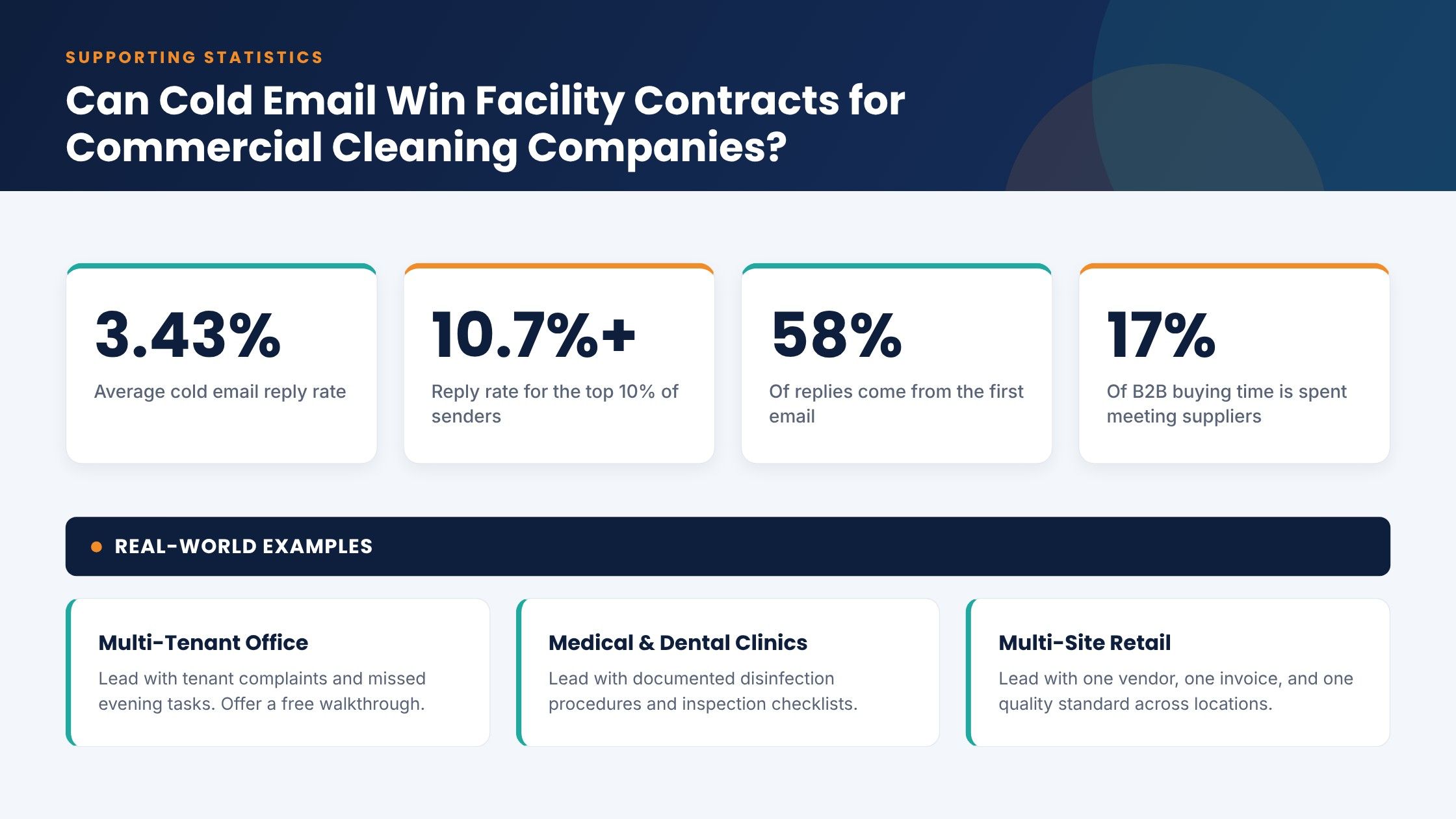
Benchmark data shows that cold email remains a viable channel when it is targeted and well written, although results vary widely between senders.
Instantly’s 2026 Cold Email Benchmark Report, based on billions of cold emails sent during 2025, found an average reply rate of 3.43%. The top quarter of senders reached 5.5% or higher, and the top 10% exceeded 10.7%. The report attributes the strongest results to tight segmentation, problem-first messaging, short emails, and frequent testing. These are averages across many industries, not commercial cleaning alone, but they show how much targeting and copy influence results.
The same report found that 58% of replies came from the first email and 42% from follow-ups. For cleaning companies, this means a single email is rarely enough. A structured sequence captures prospects who were interested but not ready on the first day.
Buyer behavior also explains why outreach matters. Gartner research has found that B2B buyers spend only about 17% of their buying journey meeting with potential suppliers. When several vendors are being compared, each one receives only a small share of the buyer’s attention. A cleaning company that starts the conversation early, before the facility manager has shortlisted vendors, has a better chance of being considered.
Finally, IBISWorld’s 2026 analysis describes the janitorial services market as highly fragmented and price-sensitive. In a crowded market, a relevant, specific email stands out more than a generic flyer or a cold call that never gets past reception.
These findings do not prove that cold email will win a specific number of contracts. They show that outreach can produce consistent conversations when it is targeted, short, and followed up properly.
Practical Commercial Cleaning Example
Consider a commercial cleaning company that wants to win office and medical facility contracts within its service area.
The company builds a list of 400 verified decision-makers at facilities that match its ideal size and location.
Suppose the campaign achieves a 4% reply rate.
400 contacts × 4% = 16 replies.
Suppose half of those replies are positive and six lead to site walkthroughs.
From six walkthroughs, the company sends five proposals and wins two contracts.
If each contract is worth $3,000 per month:
2 contracts × $3,000 × 12 months = $72,000 in annual contract value.
If the contracts renew for a second year, the value of that single campaign doubles.
These figures are illustrative, not industry benchmarks. Actual results depend on list quality, deliverability, the offer, pricing, local competition, and how well the walkthrough and proposal are handled.
The lesson is that cold email does not need high volume to be profitable. A few well-qualified conversations can produce contracts that pay for the outreach many times over.
Quick Tactical Setup for Commercial Cleaning Cold Email
Start with one facility type, such as multi-tenant offices or medical clinics, within a defined service radius.
Build a verified list of 200 to 400 decision-makers. Set up a separate sending domain with proper authentication and warm it up before launching.
Write a four- to six-step sequence with short, problem-focused emails, each adding a new angle. Make the call to action a free walkthrough or cleaning audit.
Track replies, walkthroughs, proposals, and contracts in a CRM, and record contract renewal dates for prospects who are not ready yet.
After the first month, review reply rates and walkthrough bookings. Refine the targeting and messaging before expanding to other facility types.
Conclusion
Can cold email outreach win facility contracts for commercial cleaning companies?
Yes. Cold email outreach can help cleaning companies reach facility decision-makers directly, start conversations before contracts go to bid, and build a predictable pipeline of walkthroughs and proposals.
The most valuable benefits include:
- Direct access to facility and property managers
- A predictable flow of qualified conversations
- Earlier entry into the buying process
- Messaging tailored to each facility type
- Follow-ups that catch prospects when they are ready
- Visibility into renewal timing
- Measurable cost per contract won
- Less dependence on referrals alone
Cold email cannot compensate for unreliable crews, unclear pricing, or weak service. Its value comes from opening the right doors consistently, so the quality of your walkthroughs, proposals, and service can do the rest.
When facility managers receive a short, relevant message that addresses a real problem and asks for a simple next step, they have a strong reason to reply.