Can win-back email campaigns reactivate lapsed patients for chiropractic clinics when patients stop coming once their pain eases, get busy, or simply forget to rebook?
For chiropractic clinics, lapsed patients are one of the largest untapped sources of revenue. Many patients start care for back pain, neck pain, or headaches, improve after a few visits, and then stop scheduling. Weeks turn into months. When the pain returns, some come back. Others try a different clinic, a physical therapist, or nothing at all.
These patients already know the clinic, the chiropractor, and the process. Reaching them again usually costs far less than finding a new patient through ads or referrals.
The audience is substantial. According to the CDC’s National Center for Health Statistics, 10.3% of U.S. adults saw a chiropractor in the previous 12 months in 2017, up from 9.1% in 2012. Many of those patients will need care again, and the clinic they remember is often the clinic they return to.
Chiropractic patient reactivation emails turn that familiarity into booked visits. A well-planned win-back sequence reminds lapsed patients why they started care, offers a simple reason to return, and makes rebooking easy.
The result is a fuller schedule from patients the clinic has already earned.
Direct Answer
Yes. Win-back email campaigns can reactivate lapsed patients for chiropractic clinics by reaching out at the right time, reminding patients of the progress they made, addressing common reasons for stopping care, and making it easy to book the next visit.
A typical chiropractic win-back workflow looks like this:
Patient inactive for a set period → Segmented by last visit and care type → Personal check-in email → Educational or seasonal follow-up → Simple rebooking offer → Text or call for engaged patients → Booked visit → Ongoing wellness reminders
Each stage has a clear trigger. A patient who has not visited in a defined period enters the sequence. Opening, clicking, or replying signals renewed interest. Booking removes them from the win-back sequence and moves them into regular care reminders.
Win-back emails do not guarantee that every lapsed patient returns. Some will have moved, changed insurance, chosen another provider, or simply no longer need care. However, a thoughtful sequence brings back patients who were satisfied but drifted away, without the cost of new patient advertising.
The objective is to reconnect with past patients respectfully and give them an easy path back when they are ready.
Step-by-Step Breakdown
1. Define what “lapsed” means for your clinic
A patient who visits monthly for maintenance and misses one appointment is different from a patient who completed a care plan a year ago.
Set clear inactivity rules based on how your clinic works. For example:
- Recently lapsed: No visit in 60 to 90 days
- Lapsed: No visit in 3 to 12 months
- Long-term inactive: No visit in more than 12 months
These definitions decide when patients enter the sequence and which message they receive.
2. Clean and segment your patient list
Start by exporting patients from the practice management system who match the inactivity rules and have a valid email address.
Remove patients who asked not to be contacted, have moved out of the area, or were discharged for reasons that make outreach inappropriate. Then segment by useful factors, such as:
- Time since last visit
- Original reason for care, such as low back pain, neck pain, sports injury, or prenatal care
- Completed care plan versus stopped mid-plan
- Wellness or maintenance patients versus acute care patients
Segmentation allows each email to feel relevant rather than generic.
3. Start with a personal check-in
The first email should feel like a note from the clinic, not an advertisement.
For example:
“Hi Maria, it’s been a few months since your last visit with Dr. Patel. We hope your back has been feeling good. If you’ve noticed any stiffness or discomfort returning, we’d be glad to help. You can book a visit online in under a minute.”
Use the chiropractor’s name, keep the message short, and include one clear link to book.
4. Address common reasons patients stop care
Patients lapse for predictable reasons. Win-back emails can answer them directly.
- “I feel better now.” Explain the value of maintenance care in preventing flare-ups.
- “I’m too busy.” Highlight early morning, evening, or weekend appointments.
- “It’s too expensive.” Clarify insurance coverage, payment options, or wellness plans.
- “I wasn’t sure it was helping.” Invite them to a re-evaluation to review progress and goals.
Each email in the sequence can focus on one of these concerns.
5. Share helpful, relevant content
Not every email should ask for a booking.
Educational emails build trust and keep the clinic top of mind. Useful topics include desk posture tips, stretches for lower back pain, preventing injuries during gardening or sports seasons, and how sleep position affects neck pain.
End each educational email with a soft invitation to book if the patient needs help.
6. Make a simple, compliant offer
A clear reason to return can help patients act.
Options might include a returning-patient re-evaluation, a seasonal wellness check, or a reminder that their insurance benefits may reset or expire at year-end.
Be careful with discounts and free services. Offers involving insured patients, especially Medicare and other government programs, can raise legal and billing issues. Review any offer with a compliance advisor before sending.
7. Make rebooking effortless
Every email should make the next step obvious.
Include a direct link to online scheduling, a click-to-call phone number, and the option to reply to the email. Show available times where possible, and keep the booking process short on mobile devices.
If online booking is not available, promise a quick call back and follow through the same day.
8. Combine email with text and phone follow-up
Email works well for longer messages and education. Some patients respond faster to texts or calls.
When a patient opens or clicks an email but does not book, a short text message or a call from the front desk can complete the reactivation. Text messages require patient consent under regulations such as the TCPA, so confirm consent records before sending.
All patient communication should follow HIPAA rules, using platforms that sign business associate agreements and avoiding sensitive health details in email subject lines.
9. Respect frequency and opt-outs
A win-back campaign should feel considerate, not persistent.
A practical sequence includes three to five emails spread over four to six weeks. Patients who do not engage can move to a lower-frequency newsletter rather than continuing to receive win-back messages.
Make unsubscribing easy and honor requests promptly. Respecting preferences protects both the clinic’s reputation and its email deliverability.
10. Measure reactivated patients and revenue
Clinics should measure win-back campaigns by returning patients, not opens alone.
Useful metrics include:
- Open and click rates by segment
- Replies and calls generated
- Appointments booked from the campaign
- Percentage of lapsed patients reactivated
- Visits per reactivated patient over the following 90 days
- Revenue from reactivated patients
- Unsubscribe rate
Compare results by segment to see which groups respond best and where messaging needs to change.
Supporting Statistics and Real-World Examples
Data shows that chiropractic clinics have both a meaningful patient base and an email channel that patients still pay attention to.
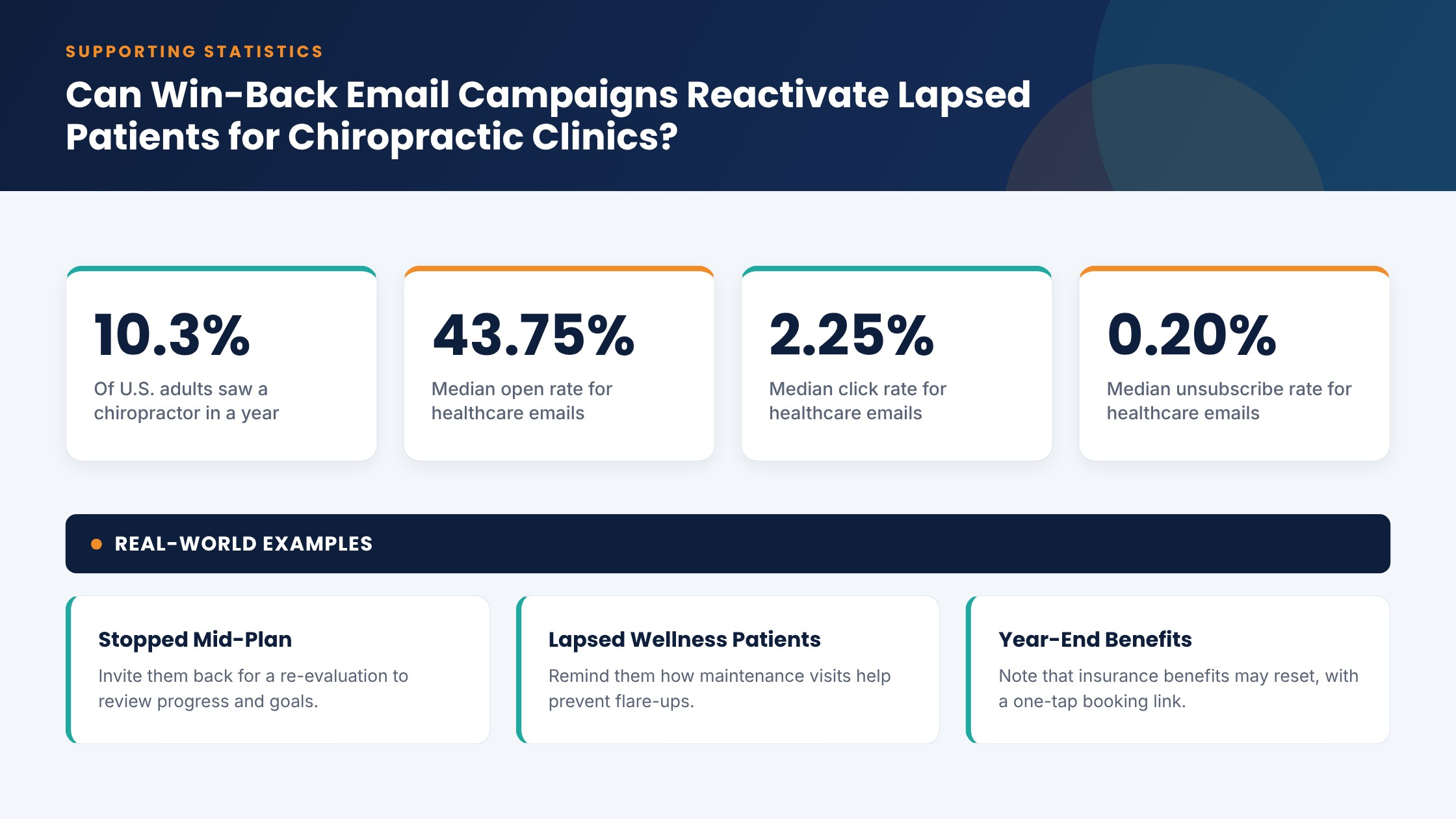
The CDC’s National Center for Health Statistics found that 10.3% of U.S. adults saw a chiropractor in the previous 12 months in 2017, up from 9.1% in 2012. Women were more likely than men to visit, at 11.1% compared with 9.4%. For a clinic, this means a large share of the local population has used chiropractic care, and many past patients may need it again.
Email remains an effective way to reach them. MailerLite’s 2025 email marketing benchmarks found that emails in the medical, dental, and healthcare category achieved a median open rate of 43.75%, a click rate of 2.25%, and an unsubscribe rate of 0.20%. Those figures were slightly above the all-industry medians for opens and clicks.
For win-back campaigns, these benchmarks suggest that a large share of lapsed patients will at least see the message, while very few will unsubscribe, provided the emails are relevant and respectful.
These findings do not prove that a win-back campaign will reactivate a specific percentage of patients. They show that chiropractic care reaches a large population and that healthcare emails continue to earn attention, which makes reactivation a practical opportunity.
Practical Chiropractic Clinic Example
Consider a clinic with 800 patients who have not visited in 3 to 12 months.
The clinic launches a four-email win-back sequence segmented by original reason for care.
Suppose 5% of those patients book a visit as a result of the campaign.
800 lapsed patients × 5% = 40 reactivated patients.
Now suppose each reactivated patient attends an average of four visits over the next 90 days, at an average of $65 per visit.
40 patients × 4 visits × $65 = $10,400 in revenue over 90 days.
Some of those patients may continue with maintenance care or refer family members, which increases the long-term value further.
These figures are illustrative, not industry benchmarks. Actual results depend on list quality, time since last visit, insurance coverage, visit fees, clinic availability, and how quickly the front desk follows up.
The lesson is that win-back campaigns do not need high response rates to be worthwhile. Reactivating a small share of past patients can fill open appointment slots at a fraction of the cost of new patient marketing.
Quick Tactical Setup for Chiropractic Patient Reactivation Emails
Start by exporting patients who have not visited in 3 to 12 months and have a valid email address and contact consent.
Segment them into two or three groups, such as acute care patients who stopped mid-plan and wellness patients who stopped maintenance visits.
Write a four-email sequence over four to six weeks: a personal check-in, a helpful educational email, an email addressing common reasons for stopping care, and a simple invitation to book a re-evaluation.
Use a HIPAA-compliant email platform, include online booking links in every email, and have the front desk call or text engaged patients who do not book.
After the campaign, review bookings, reactivated patients, visits, and revenue by segment. Refine the messages before running the sequence again each quarter.
Conclusion
Can win-back email campaigns reactivate lapsed patients for chiropractic clinics?
Yes. Chiropractic patient reactivation emails help clinics reconnect with people who already trust them, remind patients of the progress they made, and make returning to care simple. Combined with consistent email marketing, they turn a dormant patient list into a reliable source of booked visits.
The most valuable improvements include:
- More appointments from existing patients
- Lower cost than new patient advertising
- Messages tailored to each patient’s history
- Answers to common reasons patients stop care
- Easy rebooking through email, text, and phone
- Respectful frequency and clear opt-outs
- HIPAA-conscious communication
- Measurable reactivation and revenue
Win-back campaigns cannot replace good clinical care, convenient scheduling, or a welcoming front desk. Their value comes from reaching patients at the moment they are ready to return.
When past patients receive a thoughtful reminder and can book in a few taps, many will choose the clinic that helped them before.