Can missed-call text-back automation save lost leads for plumbing companies when homeowners with a leaking pipe or a backed-up drain will simply call the next plumber on the list if nobody answers?
For plumbing companies, the phone is still the main source of new jobs. A burst pipe, a broken water heater, or a clogged sewer line creates urgency. The homeowner searches, taps the first number they see, and expects someone to pick up.
But plumbers are often under a sink, in a crawl space, or driving between jobs. Office staff are handling other calls. After hours, the phone may go to voicemail. Most callers with an urgent problem do not leave a message. They hang up and call a competitor.
The gap is real. According to Invoca’s 2026 Home Services Lead Conversion Benchmarks Report, based on more than 70 million calls, only 52% of callers to home services businesses speak with a person. Nearly half of calls never reach someone who can book the job.
Plumber missed call automation closes part of that gap. When a call goes unanswered, the system instantly sends a text message to the caller, acknowledges the missed call, and invites them to describe the problem or book a time. The homeowner gets a response within seconds instead of silence.
The result is more conversations saved, more jobs booked, and fewer leads lost to the competitor down the street.
Direct Answer
Yes. Missed-call text-back automation can save lost leads for plumbing companies by responding to unanswered calls within seconds, keeping the homeowner engaged, collecting key job details, and routing urgent requests to a team member quickly.
A typical missed-call text-back workflow looks like this:
Call goes unanswered → Instant automated text → Homeowner replies with the problem → Urgency and service area checked → Team member alerted → Call back or online booking → Job scheduled
Each stage has a clear trigger. A missed call starts the text. A reply moves the lead into a conversation. Keywords such as “flooding” or “no water” can flag emergencies for immediate follow-up.
Text-back automation does not replace answering the phone. Some callers will still move on, especially in a true emergency. Others may be outside the service area or looking for a service the company does not offer. However, an instant text gives many callers a reason to wait for a response instead of dialing the next plumber.
The objective is to make sure no caller is met with silence, even when the team is busy or the office is closed.
Step-by-Step Breakdown
1. Use a text-enabled business number
Missed-call text-back requires a phone number that can send and receive text messages.
Many plumbing companies use a landline or a basic phone system that cannot text. The fix is usually to enable texting on the existing number through a VoIP provider or CRM, or to forward calls through a text-capable number.
Most U.S. business texting platforms also require A2P 10DLC registration for the number and its use case. Unregistered numbers may have messages blocked or filtered, so complete this step before launch.
2. Send the first text within seconds
Speed is the point. The text should go out immediately after the call is missed, ideally while the homeowner is still looking at their phone.
A simple first message works best:
“Hi, this is ABC Plumbing. Sorry we missed your call. We’re helping another customer right now. What’s going on, and what’s your address? We’ll get right back to you.”
Keep it short, friendly, and clearly from the business.
3. Ask for the details needed to triage
The text conversation should collect what the dispatcher needs to decide what happens next.
Useful details include:
- What the problem is, such as a leak, clog, water heater, or sewer issue
- Whether water is actively leaking or flooding
- The service address or ZIP code
- The best time to call or visit
- Whether the caller is the homeowner, tenant, or property manager
Ask one or two questions at a time. Long text interviews feel like a form and slow the conversation.
4. Flag emergencies for immediate follow-up
Not every missed call carries the same urgency. A slow drain can wait a few hours. A burst pipe cannot.
Set up keyword alerts for words such as “flooding,” “burst,” “no water,” “sewage,” or “gas smell.” When these appear, notify the on-call plumber or dispatcher immediately by text, push notification, or call.
For anything involving a possible gas leak, the automated reply should tell the customer to leave the property and contact the gas utility or 911 first.
5. Check the service area automatically
Missed calls often include people outside the company’s coverage area.
If the homeowner shares a ZIP code, the system can check it against the service area. In-area leads continue through the booking flow. Out-of-area leads receive a polite reply explaining that the company does not serve their location, so the team does not waste time calling back.
6. Offer an easy way to book
Some homeowners prefer to book without talking to anyone.
Include a link to online scheduling for non-urgent jobs, such as water heater installations, drain cleaning appointments, or estimates. Show available time windows and confirm the booking by text.
For urgent jobs, a fast call back from a person usually works better than a booking link.
7. Hand off smoothly to a real person
Automation starts the conversation, but people close the job.
All text conversations should appear in one shared inbox or CRM where the office team can see the history and reply. When a team member calls back, they should already know the problem, address, and urgency from the text thread.
This avoids asking the homeowner to repeat everything and makes the company look organized.
8. Cover after-hours calls
Many plumbing emergencies happen at night and on weekends.
After-hours text-back messages should set clear expectations. For example: “Our office is closed, but our on-call plumber is available for emergencies. Reply EMERGENCY if water is actively leaking, or book a time for tomorrow here.”
This helps capture urgent work while preventing the on-call technician from being woken up for routine requests.
9. Follow up with leads who stop replying
Some homeowners reply once and then go quiet.
A short, respectful follow-up a few hours later, and again the next day for non-urgent issues, can bring them back. For example: “Just checking in. Do you still need help with that water heater? We have openings tomorrow morning.”
Respect opt-out requests immediately. Every automated sequence should honor STOP replies and comply with texting regulations such as the TCPA.
10. Measure saved leads and booked jobs
Plumbing companies should measure text-back automation by the jobs it saves, not the number of texts sent.
Useful metrics include:
- Missed calls per week, by time of day
- Percentage of missed callers who reply to the text
- Leads booked from text conversations
- Average time to human follow-up
- Emergency jobs captured after hours
- Revenue from text-back leads
- Opt-out rate
These numbers also reveal staffing gaps. If most missed calls happen at specific times, the company may need extra phone coverage during those hours.
Supporting Statistics and Real-World Examples
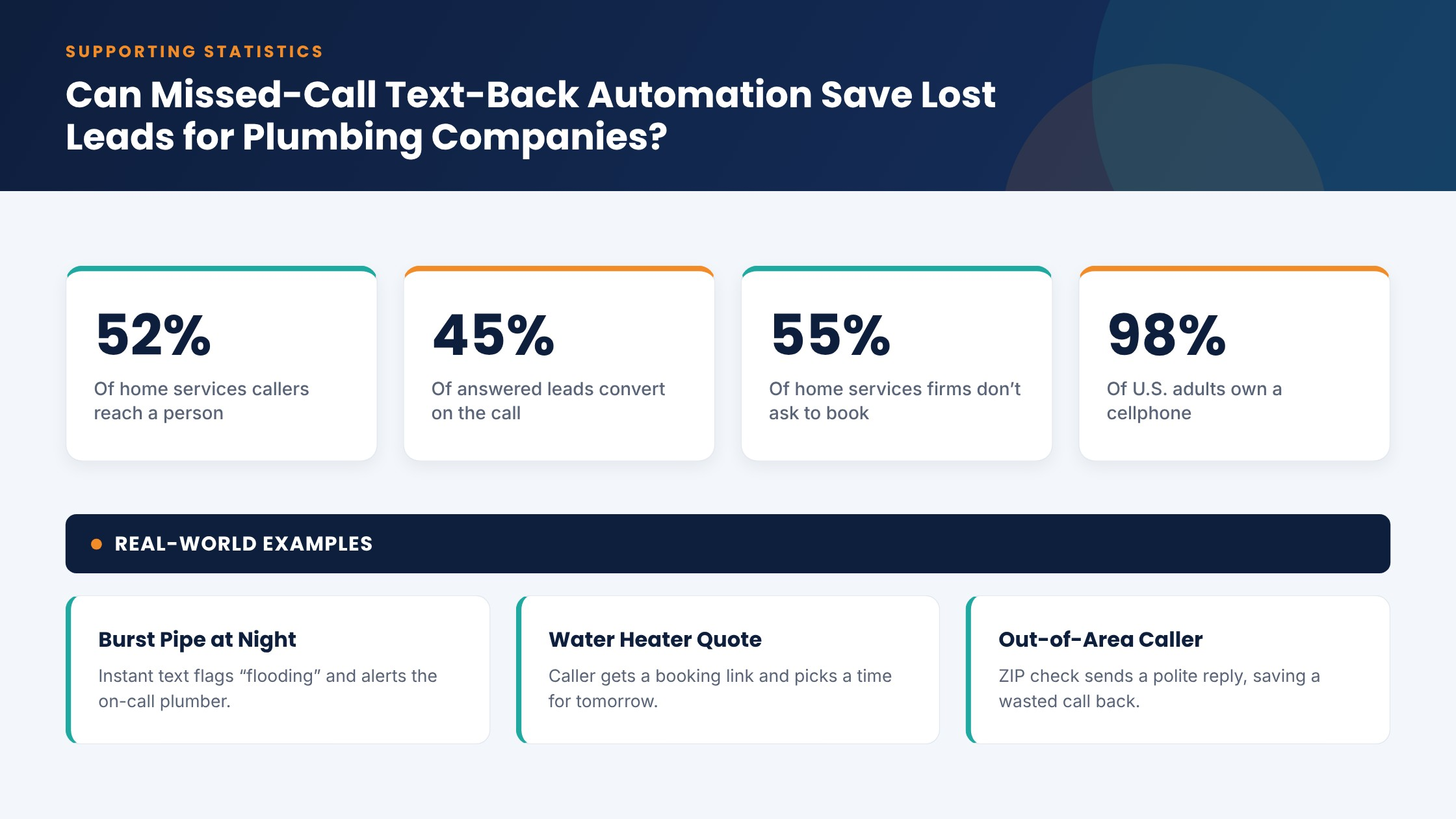
Research shows that home services companies lose a large share of phone opportunities, and that texting is a practical way to reach nearly every caller.
Invoca’s 2026 Home Services Lead Conversion Benchmarks Report, based on more than 70 million calls, found that only 52% of callers to home services businesses speak with a person. Of the calls that are answered, 38% are leads, and 45% of those leads convert on the call. The same report found that 55% of home services businesses do not ask leads to buy or book the job. These figures cover home services broadly, not plumbing alone, but they show how many opportunities slip away before and during the conversation.
Texting reaches almost everyone. According to the Pew Research Center, 98% of U.S. adults own a cellphone and 91% own a smartphone, based on its 2026 survey. Nearly every homeowner who calls a plumber can receive and reply to a text.
Together, these findings show the opportunity. Many calls are not answered, but almost every caller can be reached by text within seconds.
These findings do not prove that missed-call text-back will save a specific percentage of leads. They show that unanswered calls are common in home services and that text messaging is a near-universal way to keep the conversation going.
Practical Plumbing Company Example
Consider a plumbing company that receives 400 inbound calls per month and misses 25% of them.
400 calls × 25% = 100 missed calls per month.
The company sets up missed-call text-back automation. Suppose 35% of missed callers reply to the text.
100 missed calls × 35% = 35 text conversations.
Suppose half of those conversations become booked jobs.
35 × 50% = about 17 booked jobs.
If the average ticket is $450:
17 jobs × $450 = $7,650 in monthly revenue from calls that would otherwise have been lost.
Some of those customers may also return for future work or leave reviews, increasing their long-term value.
These figures are illustrative, not industry benchmarks. Actual results depend on call volume, the share of calls missed, urgency of the jobs, response speed, service area, and pricing.
The lesson is that missed-call text-back does not need to save every call to pay for itself. Recovering even a handful of jobs each month can cover the cost many times over.
Quick Tactical Setup for Plumber Missed Call Automation
Start by enabling texting on your main business number and completing A2P 10DLC registration.
Write one daytime and one after-hours text-back message. Ask for the problem and address, and add keyword alerts for emergencies such as flooding, burst pipes, or no water.
Connect all text conversations to a shared inbox or CRM so the office team can reply and call back with full context. Add an online booking link for non-urgent jobs.
After 30 days, review missed calls, reply rates, booked jobs, and revenue from text-back leads. Use the missed-call times to identify where more phone coverage is needed.
Conclusion
Can missed-call text-back automation save lost leads for plumbing companies?
Yes. Plumber missed call automation replaces silence with an instant, helpful response, giving homeowners a reason to wait for your team instead of calling a competitor. Combined with broader marketing automation, it turns missed calls into booked jobs.
The most valuable improvements include:
- Instant responses to every missed call
- Faster triage of emergencies
- Automatic service area checks
- Easy online booking for routine jobs
- Smooth handoff to the office team
- After-hours coverage without waking the on-call tech for routine work
- Respectful follow-up and opt-out handling
- Clear tracking of saved jobs and revenue
Text-back automation cannot replace a responsive team, fair pricing, or quality workmanship. Its value comes from keeping the conversation alive when nobody can pick up.
When a homeowner with an urgent plumbing problem gets a reply within seconds, they have a strong reason to choose the company that responded first.