How can automated inspection reminders increase bookings for auto garages when many drivers postpone vehicle checks until a warning light appears, a registration deadline approaches, or a mechanical problem becomes impossible to ignore?
For auto garages, inspections and routine maintenance create valuable opportunities to maintain long-term customer relationships. A vehicle that comes in for an inspection may also require tyres, brakes, fluids, filters, alignment, suspension work, or other maintenance. The challenge is getting customers back into the garage at the right time.
Many garages still rely on customers remembering when their next inspection or service is due. Others manually call customers or send generic promotional emails that have little connection to the vehicle’s actual maintenance schedule.
Automated inspection reminders change that process.
Instead of waiting for customers to remember, the garage can use vehicle and customer data to trigger timely SMS, email, WhatsApp, or app notifications before the next inspection becomes due.
Research from other appointment-driven industries demonstrates the power of reminders. A systematic review and meta-analysis found that customers receiving electronic text notifications were 23% more likely to attend scheduled appointments and 25% less likely to no-show than people receiving no notification.
For an auto garage, the same behavioral principle is useful: remind customers when action is relevant, make booking simple, and reduce the chance that maintenance gets forgotten.
Direct Answer
Automated inspection reminders can increase bookings for auto garages by identifying when a customer’s vehicle is approaching an inspection or maintenance milestone and automatically prompting the customer to schedule an appointment.
The system can use information such as:
- Previous inspection date
- Last service date
- Vehicle age
- Mileage
- Recommended maintenance interval
- Previous repairs
- Customer booking patterns
- Local inspection requirements
Instead of sending broad promotions, the garage can deliver a specific message such as:
“Your vehicle’s annual inspection is approaching. Book your inspection now to secure a convenient appointment.”
A direct booking link can then take the driver immediately to available appointments.
This transforms customer data already stored by the garage into a repeat-booking system.
Step-by-Step Breakdown
1. Automatically identify upcoming inspection dates
The first step is connecting reminders to actual vehicle information.
When a customer completes an inspection or service, the garage can store:
- Customer details
- Vehicle make and model
- Registration information
- Inspection date
- Mileage
- Services completed
The automation then calculates when the next relevant inspection or service is likely to be required.
For example:
Last inspection: October 15
Next inspection: Approximately October 15 next year
First reminder: September 15
Second reminder: October 1
Final reminder: October 10
Employees no longer need to search through old records every month.
2. Start reminders before the customer feels urgency
Sending an inspection reminder on the day the inspection becomes due misses part of the opportunity.
Customers need enough time to:
- Check their calendar
- Compare available appointments
- Arrange transportation
- Budget for possible maintenance
An effective sequence can begin several weeks before the expected deadline.
For example:
30 days before: Friendly inspection reminder.
14 days before: Booking prompt with available appointment link.
7 days before: More urgent reminder.
Due date: Final notification.
This creates multiple opportunities to convert the customer without requiring staff to make repeated calls.
Research supports the use of multiple reminders. A meta-analysis of electronic appointment notifications found that multiple notifications were significantly more effective at improving attendance than a single notification.
3. Personalize the reminder around the customer’s vehicle
A generic message saying “Book your car service today” looks like advertising.
A vehicle-specific reminder feels useful.
Compare:
“Don’t forget your annual vehicle inspection.”
with:
“Your 2021 Toyota Camry is approaching its next inspection. Book before October 15 to secure your preferred appointment.”
The second message explains exactly why the customer is being contacted.
Automation can personalize messages using:
- Customer name
- Vehicle
- Registration number
- Previous service
- Due date
- Preferred garage location
Personalization can improve the relevance of customer communication. McKinsey reports that 71% of consumers expect personalized interactions from companies, while 76% become frustrated when they do not receive them.
For garages, existing vehicle records provide an excellent foundation for this personalization.
4. Add direct booking links to every reminder
A reminder creates awareness.
The next challenge is converting that awareness into an appointment.
If customers have to call during business hours, wait for someone to answer, explain their vehicle details, and ask about available times, some will postpone the task.
Instead, the reminder can contain a direct booking link.
The customer journey becomes:
Reminder → Select appointment → Confirm details → Booking completed
This allows customers to schedule inspections while the need is fresh in their minds.
It also means bookings can happen outside normal garage opening hours.
5. Use AI to determine which customers need stronger follow-up
Not every customer responds the same way.
Some customers book immediately after the first reminder.
Others ignore several messages.
AI can analyze previous behavior to determine which customers may require additional communication.
Signals might include:
- Previous reminder response
- Historical service frequency
- Missed appointments
- Time since last garage visit
- Previous booking channel
A customer who consistently books after the first SMS may only need one or two messages.
Someone who repeatedly delays maintenance might receive an earlier sequence.
This avoids sending identical communications to everyone.
6. Connect inspection reminders with relevant maintenance opportunities
An inspection reminder should primarily encourage the customer to book the inspection.
However, the appointment can also create legitimate opportunities to identify other maintenance needs.
For example, the reminder could allow customers to request:
- Oil change
- Tyre inspection
- Brake check
- Battery test
- Wheel alignment
This does not mean aggressively selling unnecessary repairs.
Instead, customers can conveniently combine maintenance tasks into one garage visit.
The garage increases booking value while the driver saves time.
7. Recover customers who have stopped returning
Automated inspection reminders can also act as a customer retention system.
Suppose someone historically visits your garage every year.
Their records show:
2023: Inspection completed
2024: Inspection completed
2025: Inspection completed
2026: No appointment scheduled
The system can recognize that the customer has broken their usual pattern.
Instead of allowing the relationship to disappear, it can trigger a reactivation campaign.
The customer could receive:
“We haven’t seen your vehicle for its usual inspection. If you’re still due, you can check available appointments here.”
This is particularly valuable because the garage has already spent time and marketing resources acquiring that customer.
8. Reduce front-desk workload
Manual reminder campaigns require staff to:
- Search customer records
- Check due dates
- Make calls
- Leave voicemails
- Send texts
- Track responses
Automation performs much of this routine work.
A systematic review examining telephone and SMS reminders found that almost all included studies reported improved appointment attendance after reminders. The analysis estimated that automated reminders reduced non-attendance by approximately 29% relative to baseline in the healthcare settings studied.
Although auto garages differ from healthcare clinics, the research demonstrates how automated reminders can reduce dependence on manual calling while influencing appointment behavior.
Staff can instead focus on customers currently at the garage and people who genuinely need assistance.
9. Automatically fill quieter periods
Inspection reminders can also support capacity management.
Imagine Thursday afternoon has six available inspection slots.
Instead of sending a generic discount campaign to the entire database, the system can identify customers whose inspections are approaching and notify the most relevant group.
For example:
“Your inspection is approaching, and appointments are available this Thursday afternoon.”
The promotion connects genuine customer need with available garage capacity.
This can help reduce gaps in the workshop schedule.
10. Track which reminders actually generate bookings
Automation should produce measurable data.
Garage owners can track:
- Reminders sent
- SMS open or delivery rates
- Booking-link clicks
- Appointments generated
- Time between reminder and booking
- Customers reactivated
- Revenue generated from reminder-driven appointments
This makes it possible to improve the sequence.
If most bookings happen after the 14-day reminder, the garage can prioritize that timing.
If email generates few bookings but SMS performs strongly, communication can shift accordingly.
The objective is not simply sending more reminders. It is learning which reminders reliably produce appointments.
Supporting Statistics and Real-World Examples
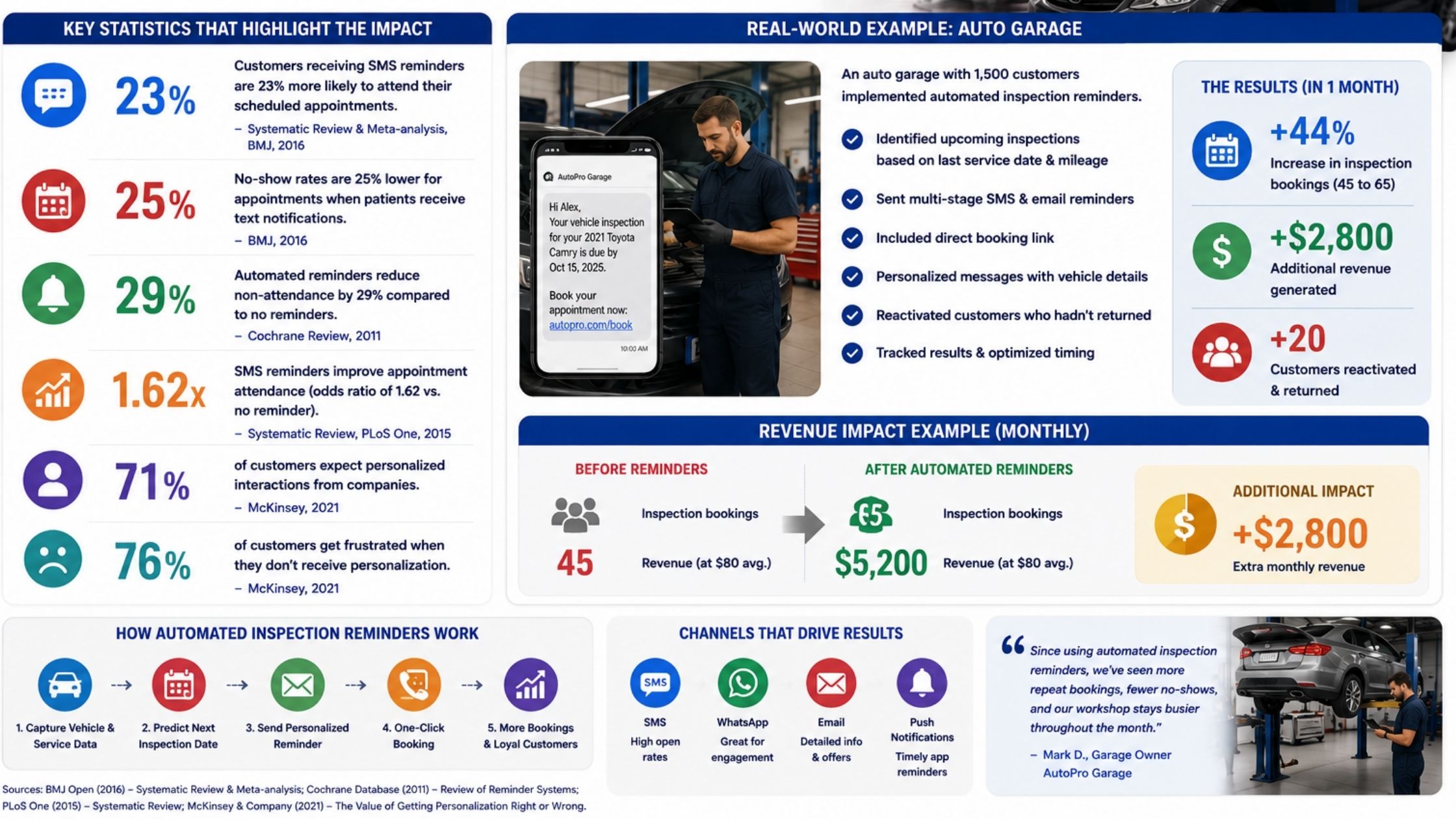
Evidence from appointment-based industries shows that reminders can materially influence customer behavior.
A meta-analysis covering 28 studies found that SMS reminders improved appointment attendance, with randomized controlled trials producing a pooled odds ratio of 1.62 compared with no reminder.
Another systematic review found that people receiving electronic text notifications were 23% more likely to attend appointments, while no-shows were 25% lower than among people who received no notification.
A separate review of 29 studies found that all but one reported benefits from appointment reminders. Automated reminders were associated with a 29% relative reduction in non-attendance from baseline in the settings studied.
These are healthcare studies rather than auto-garage benchmarks, so their exact results should not be directly applied to automotive businesses. However, they provide credible evidence that timely digital reminders can influence whether customers follow through with scheduled services.
Practical Auto Garage Example
Consider an independent garage with 1,500 customers in its database.
Suppose 100 previous customers are approaching an annual inspection during a particular month.
Without reminders, assume 45 customers independently remember and return.
The garage implements an automated sequence:
- Reminder 30 days before the expected inspection.
- Personalized SMS 14 days before.
- Direct booking link in every message.
- Seven-day reminder for customers who have not booked.
- Final reminder near the due date.
If another 20 customers book because of the sequence, monthly inspection bookings increase from 45 to 65.
At an average inspection ticket of $80:
20 additional bookings × $80 = $1,600 in recovered monthly revenue
If eight of those customers also legitimately require an average of $150 in additional maintenance:
8 × $150 = $1,200 in additional service revenue
The workflow could therefore influence $2,800 in additional monthly revenue in this illustrative example.
These figures are not an industry benchmark. They demonstrate how a modest improvement in returning-customer bookings can create meaningful revenue without purchasing additional leads.
Best Auto Garage Reminders to Automate First
Garages should begin with services that have predictable time or mileage intervals.
Annual Vehicle Inspections: Trigger reminders several weeks before the expected inspection date.
Oil and Filter Changes: Use previous mileage and service intervals to estimate when customers may be due.
Tyre Checks: Trigger seasonal or mileage-based reminders where appropriate.
Brake Inspections: Follow recommended inspection intervals and previous technician recommendations.
Scheduled Maintenance: Use manufacturer maintenance milestones where accurate vehicle information is available.
The key is relevance. Customers should receive reminders because their vehicle is genuinely approaching a service need, not simply because the garage wants to fill its calendar.
Conclusion
So, how can automated inspection reminders increase bookings for auto garages?
They convert existing customer and vehicle records into timely opportunities for repeat business.
Instead of relying on drivers to remember inspection dates, the garage can automatically identify upcoming needs, send personalized reminders, provide direct booking links, follow up with customers who have not responded, and track which communications generate appointments.
The benefits can include:
- More repeat inspection bookings
- Better customer retention
- Fewer forgotten maintenance appointments
- Less manual follow-up
- Higher workshop utilization
- More predictable service demand
- Additional legitimate maintenance opportunities
Most importantly, automated inspection reminders help garages generate bookings from customers they already know.
The vehicle will eventually need another inspection or service. Automation simply helps ensure that when the time arrives, the customer remembers your garage first.