How can AI repair updates reduce calls for appliance technicians when customers naturally want to know when their washing machine, refrigerator, oven, dishwasher, or dryer will be fixed?
For appliance repair businesses, many incoming calls are not new leads. They are existing customers asking questions such as:
“Is the technician still coming today?”
“Has my replacement part arrived?”
“When will my appliance be repaired?”
“Is the technician on the way?”
“What’s happening with my service request?”
Each question is reasonable. The problem is that answering dozens of routine status calls every day takes technicians and office staff away from scheduling jobs, completing repairs, ordering parts, and serving customers.
AI-powered repair updates can reduce this communication burden by automatically notifying customers whenever a repair moves to a new stage.
The opportunity is becoming increasingly important as customer expectations rise. Salesforce’s State of Service research, based on more than 5,500 service professionals, found that 86% of service agents and 74% of mobile workers say customer expectations are increasing. It also found that 53% of customers want companies to anticipate their needs before they arise.
For appliance technicians, proactive communication provides a straightforward response: give customers the information they are likely to request before they need to call.
Direct Answer
Yes. AI repair updates can reduce calls for appliance technicians by automatically keeping customers informed throughout the repair process.
Instead of requiring customers to contact the business, an AI-supported workflow can send updates when:
- The appointment is confirmed
- The technician is assigned
- The technician is on the way
- Diagnosis is completed
- A replacement part is ordered
- The part arrives
- A follow-up appointment is required
- The repair is completed
Customers receive relevant information without calling the office.
This does not mean replacing technicians or customer service employees with AI. Complex questions, complaints, unusual repairs, and technical decisions still require human involvement.
The goal is to automate predictable status communication so employees can focus on work where human expertise actually matters.
Step-by-Step Breakdown
1. Automatically confirm every repair appointment
The communication process should begin immediately after a customer books.
Once an appointment enters the scheduling system, automation can send a confirmation containing:
- Appointment date
- Expected arrival window
- Appliance being repaired
- Service address
- Booking reference
- Rescheduling link
This prevents the first category of unnecessary calls: customers checking whether their appointment was successfully scheduled.
The message can also tell customers what to prepare before the technician arrives, such as ensuring access to the appliance or having relevant model information available.
2. Send technician arrival updates automatically
One of the most common reasons customers contact field-service businesses is uncertainty about arrival times.
A customer may have been given a window between 1 PM and 4 PM. At 2:30 PM, they begin wondering whether the technician is still coming.
Instead of making them call, the system can automatically send:
“Your technician is scheduled for today and remains within the expected arrival window.”
When the technician starts travelling to the property, another update can be triggered:
“Your appliance technician is on the way. Estimated arrival: approximately 25 minutes.”
Customers stay informed without interrupting the technician or dispatcher.
This is especially relevant because Salesforce reports that 53% of customers want companies to anticipate their needs before they arise, yet only 33% of customers believe companies generally do so.
Proactive arrival notifications are a practical way for a local repair company to close that gap.
3. Turn technician notes into customer-friendly updates
Technicians often record job information internally after inspecting an appliance.
For example:
“Drain pump failed. Replacement required. Part ordered. ETA 3-5 business days.”
That note is useful internally but may not be ideal customer communication.
AI can transform structured technician notes into a clearer message:
“We identified an issue with your washing machine’s drain pump. A replacement part has been ordered. We expect it to arrive within approximately 3-5 business days and will contact you when it is ready to schedule.”
The technician records the repair status once.
AI helps turn that information into customer communication.
This avoids requiring the technician or office employee to separately write essentially the same update.
4. Automate parts-order status notifications
Waiting for replacement parts creates one of the biggest communication gaps in appliance repair.
The technician has diagnosed the problem, but the repair cannot continue until a component arrives.
Customers may hear nothing for several days.
That silence encourages calls.
A better workflow automatically sends updates when the part status changes.
For example:
Day 1: Replacement part ordered.
Day 3: Part remains in transit.
Day 5: Part received.
Day 5: Customer receives booking link for follow-up repair.
Even an update saying there is no major change can reassure a customer that the repair has not been forgotten.
5. Let AI answer simple status questions instantly
Proactive notifications should reduce calls, but some customers will still want information.
An AI assistant connected to the repair management system can answer simple questions through website chat or messaging.
A customer might ask:
“Has my dishwasher part arrived?”
The system can check the repair record and respond with the current approved status.
Another customer might ask:
“When is my technician coming?”
The assistant can provide the scheduled appointment window.
Zendesk’s 2025 CX Trends research found that 67% of consumers were ready to delegate tasks such as tracking orders and receiving personalized recommendations to AI. The same report found that 73% of agents believed an AI copilot could help them perform their jobs better.
Repair-status checking is a strong candidate for this type of automation because the customer usually needs information rather than a complex technical diagnosis.
6. Use AI to recognize when a human should take over
Not every interaction should be automated.
If a customer says:
“My refrigerator still isn’t cooling after yesterday’s repair.”
or:
“The technician damaged my flooring.”
AI should not continue sending generic status messages.
The system should recognize the issue as an exception and escalate it.
Possible escalation triggers include:
- Repeat repair failure
- Customer complaint
- Safety concern
- Billing dispute
- Technician delay beyond a threshold
- Multiple unanswered messages
- Customer explicitly requesting a person
Automation works best when it handles routine communication while quickly routing exceptions to humans.
7. Personalize updates using actual repair information
Generic messages can create more confusion.
“Your service request has been updated.”
Updated how?
A useful message should provide enough context to answer the customer’s likely question.
For example:
“Hi Sarah, the replacement heating element for your Whirlpool dryer has arrived. You can now schedule the installation appointment.”
Personalization can include:
- Customer name
- Appliance type
- Brand or model
- Technician
- Appointment date
- Repair stage
- Part status
This makes automated communication feel connected to the actual job rather than like a mass notification.
Zendesk’s 2025 CX Trends report found that CX organizations leading in AI adoption were emphasizing personalized experiences. The report also found these “CX Trendsetters” experienced 22% higher customer retention rates than peers using more traditional approaches.
That does not mean automated appliance repair updates will automatically produce a 22% retention increase. It does show that personalization and AI-enabled customer experience are increasingly associated with stronger service outcomes.
8. Reduce repeat calls by creating a repair-status page
AI notifications can become even more effective when customers have a self-service page.
The customer receives a secure link showing:
Appointment: Completed
Diagnosis: Completed
Replacement Part: Ordered
Current Status: In Transit
Estimated Arrival: September 8
Next Step: Follow-up appointment available after part arrival
Instead of calling every time they want an update, customers can check the current repair status themselves.
McKinsey reports that AI technologies are already being deployed in customer care for chatbots, automated email responses, agent support, analytics, and decision-making. More than 80% of surveyed customer-care leaders were already investing in generative AI or expected to do so in the coming months.
Self-service repair tracking gives smaller appliance businesses a practical version of the same broader customer-service shift.
9. Use updates to improve the technician’s daily productivity
Every unnecessary call has a hidden operational cost.
Suppose a small appliance repair company receives 30 repair-status calls per day.
If each conversation, record lookup, and follow-up takes an average of four minutes:
30 calls × 4 minutes = 120 minutes
That equals two staff hours per day spent largely communicating information that already exists somewhere in the repair system.
Across 22 working days:
2 hours × 22 days = 44 hours per month
If automation prevents even half of those calls, the business recovers approximately 22 staff hours per month.
This is an illustrative calculation, not an industry benchmark, but it demonstrates why reducing repetitive status calls can matter even for a small repair company.
Technicians and dispatchers can use that recovered time for revenue-generating and customer-critical work.
10. Send repair-completion and follow-up messages
Communication should not stop when the appliance starts working again.
After the technician marks a repair complete, automation can send:
“Your refrigerator repair has been marked complete. If you experience any further problems, reply here or contact our team.”
A later message might request a review or confirm that the appliance is operating correctly.
Salesforce reports that 88% of customers say good service makes them more likely to purchase from the same company again.
For appliance businesses, a transparent repair process can therefore contribute to more than fewer calls. It can strengthen the relationship for the next time the household needs service.
Supporting Statistics and Real-World Examples
The wider customer-service market provides useful evidence for appliance repair businesses considering AI communication.
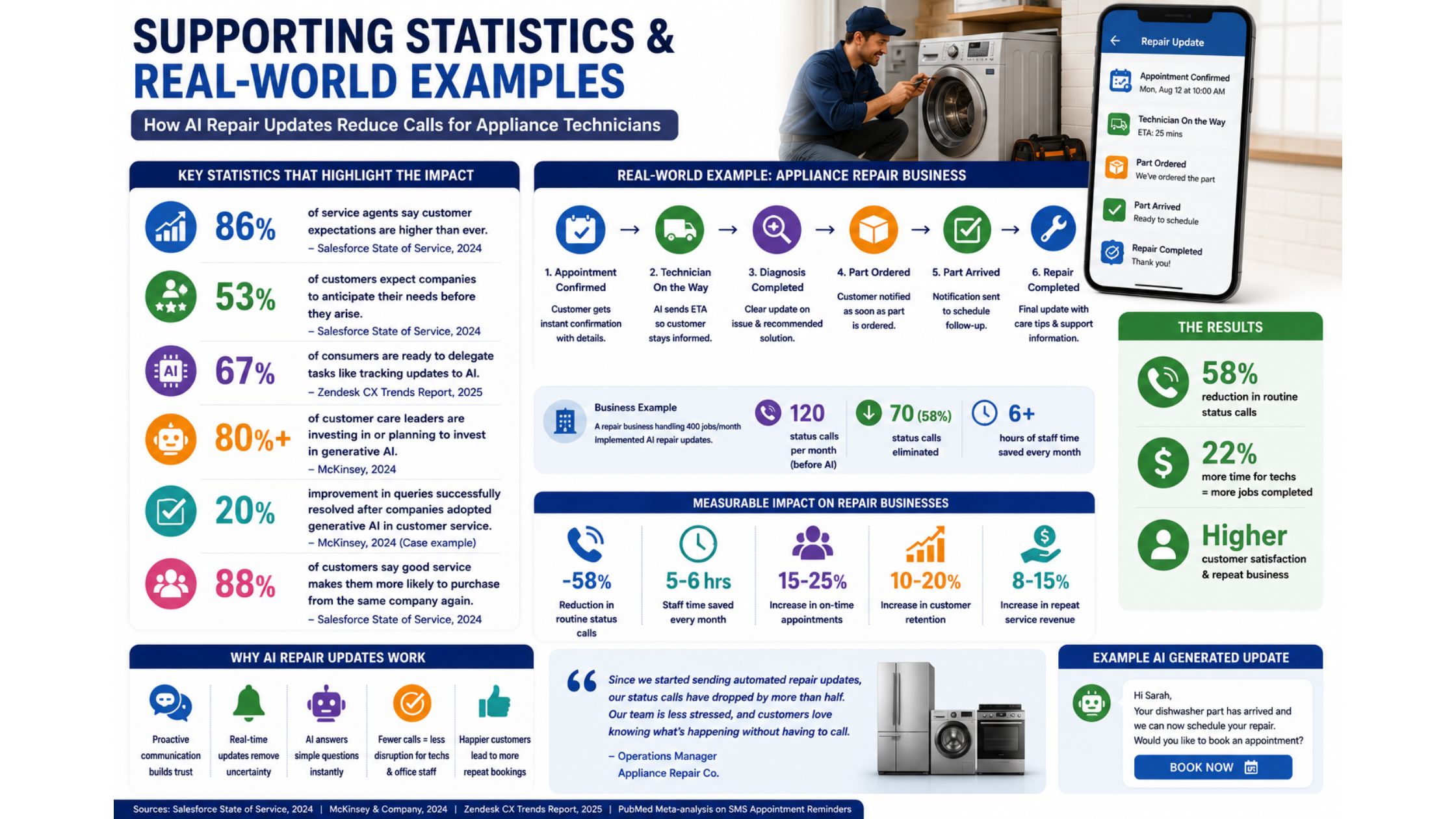
Salesforce’s State of Service research found that 86% of service agents say customer expectations are rising, while 76% of service organizations expected higher case volumes. It also found that 53% of customers want businesses to anticipate their needs proactively.
McKinsey found that more than 80% of customer-care leaders were investing in generative AI or expected to do so soon. One organization cited by McKinsey replaced a traditional rules-based chatbot with a generative AI system and achieved a 20% improvement in successfully answered customer queries after seven weeks.
Zendesk’s 2025 research found that 67% of consumers were ready to delegate certain routine tasks to AI assistants, while CX Trendsetters reported stronger customer acquisition, retention, and cross-sell performance than organizations taking more traditional approaches.
These figures are not appliance-repair-specific benchmarks. They show the broader movement toward proactive, automated, personalized customer communication.
Practical Appliance Repair Example
Consider an appliance repair business completing 400 service jobs per month.
Suppose the office receives 120 status-related calls each month covering technician arrival, diagnosis, parts availability, and follow-up scheduling.
The business introduces an AI-supported workflow:
- Appointment confirmation is automatically sent.
- Customers receive technician arrival notifications.
- Diagnosis updates are generated from approved technician notes.
- Parts-order statuses trigger automatic messages.
- Customers receive a notification when parts arrive.
- Follow-up appointments include direct booking links.
- Complex issues are escalated to staff.
Assume these updates prevent 70 of the 120 routine calls.
At an average of five minutes of staff handling time per call:
70 × 5 minutes = 350 minutes
That represents almost six hours of administrative time recovered each month.
If faster communication also helps the company schedule five additional repair jobs that would otherwise have been delayed or lost, the operational benefit becomes even greater.
Again, these numbers are illustrative. The actual result depends on call volume, repair workflow, software integration, customer behavior, and the accuracy of the automated information.
What Repair Updates Should Appliance Technicians Automate First?
The highest-value starting points are predictable events that generate frequent customer questions.
Appointment Confirmation: Confirm the booking immediately.
Technician On-the-Way Alert: Reduce “Where is the technician?” calls.
Diagnosis Update: Explain what was identified and what happens next.
Part Ordered: Confirm that the repair remains active.
Part Arrived: Prompt the customer to schedule the next visit.
Repair Completed: Confirm completion and provide support instructions.
These messages address the moments when uncertainty is most likely to generate a phone call.
Conclusion
So, how can AI repair updates reduce calls for appliance technicians?
They replace unnecessary uncertainty with proactive communication.
Instead of waiting for customers to ask where their technician is, whether a part has arrived, or what happens next, AI-supported workflows can provide those answers automatically.
The result can be fewer repetitive calls, less administrative work, better-informed customers, faster follow-up scheduling, and more time for technicians to complete actual repairs.
AI should not replace human communication when a customer has a complicated technical problem, complaint, safety issue, or unusual request. It should handle predictable updates so humans have more time for the situations that genuinely require them.
For appliance repair businesses, that distinction is important.
Customers do not necessarily want to call the technician more often. They usually call because they do not know what is happening.
Give them the right repair update at the right time, and many of those calls never need to happen.