Can automated warranty tracking improve retention for electronics retailers when customers often forget warranty dates, lose receipts, or only contact the retailer after a device develops a problem?
Electronics retailers sell products that can remain in customers’ homes and workplaces for years. Laptops, televisions, smartphones, monitors, headphones, gaming systems, cameras, appliances, and accessories all create opportunities for a longer relationship after checkout.
Yet many retailers treat the transaction as complete once the product leaves the store.
That creates a missed retention opportunity.
A customer may not remember when their warranty expires, what it covers, where their receipt is stored, or who to contact if something goes wrong. When they eventually need support, the process can feel disconnected from the retailer that originally made the sale.
Automated warranty tracking changes this by connecting purchase data with post-purchase communication.
A retailer can automatically record warranty information, send relevant reminders, provide warranty documents, notify customers before coverage expires, and direct them toward appropriate support when needed.
This approach aligns with broader customer expectations. McKinsey found that 71% of consumers expect personalized interactions, while 78% said personalized content makes them more likely to repurchase.
For electronics retailers, warranty tracking can therefore become more than administration. It can become a structured retention touchpoint.
Direct Answer
Yes. Automated warranty tracking can improve retention for electronics retailers by keeping customers informed and supported throughout the ownership period instead of allowing the relationship to end after the initial purchase.
The workflow can automatically track:
- Purchase date
- Product and model
- Warranty duration
- Warranty expiration date
- Receipt or proof of purchase
- Coverage information
- Customer contact details
- Service history
The customer can then receive useful communications at relevant moments.
For example:
“Your laptop’s manufacturer warranty expires in 30 days. You can view your purchase details and warranty information here.”
That message is useful because it relates directly to something the customer already owns.
The Federal Trade Commission explains that written warranties are promises to stand behind consumer products and that warranty information should clearly communicate coverage. It also recommends that customers retain their warranty and purchase receipt because the receipt helps establish when the product was purchased.
Automation can make those records easier for both the retailer and customer to manage.
Step-by-Step Breakdown
1. Capture warranty information at the point of sale
Effective automation starts with accurate purchase data.
When a customer purchases an eligible electronic product, the retailer’s CRM, POS, e-commerce platform, or warranty system should capture relevant information.
This might include:
Product: Laptop
Model: XYZ Pro 14
Purchase date: September 10
Warranty: 12 months
Expected expiration: September 10 next year
The system can associate that information with the customer’s account.
Instead of asking employees to manually review warranty dates later, automation calculates the relevant milestones immediately.
This creates the foundation for future communication.
2. Send warranty information immediately after purchase
Customers should not need to search through emails or packaging six months later to understand their coverage.
After purchase, automation can send a confirmation containing:
- Product purchased
- Purchase date
- Warranty period
- Warranty documentation
- Receipt
- Support instructions
- Customer-service contact information
This creates an immediate post-purchase touchpoint.
It also reinforces the retailer’s role after the sale.
The FTC advises consumers to save copies of warranties and receipts for products covered by warranties. A digital post-purchase workflow makes doing this considerably easier.
3. Create a digital warranty record for each customer
One useful extension is a customer portal containing registered products and warranty information.
Instead of searching through old paperwork, customers could see:
Laptop – Warranty active until September 2027
Monitor – Warranty active until January 2028
Headphones – Warranty expired
The portal could also store receipts, warranty documents, support links, and previous service interactions.
This reduces friction when something goes wrong.
It can also encourage customers to return to the retailer’s website instead of immediately searching elsewhere for help.
McKinsey has highlighted the value of unified customer data in creating personalized service, noting that organizations can use customer histories and profiles to determine more relevant actions and interactions.
Warranty data can become part of that customer profile.
4. Send reminders before warranty expiration
A warranty expiration date creates a natural reason to contact the customer.
A simple workflow might include:
90 days before expiration: Informational reminder.
30 days before expiration: Coverage reminder and support check.
7 days before expiration: Final reminder.
The communication should be genuinely helpful rather than manufactured urgency.
For example:
“Your television’s limited warranty is approaching its expiration date. If you’ve experienced any covered issues, review your warranty information before September 30.”
This helps customers stay informed while bringing the retailer back into the relationship at a relevant moment.
McKinsey’s personalization research specifically notes that customers appreciate brands reminding them about information they want to know but may not be tracking themselves.
Warranty expiration is a strong example of exactly that type of reminder.
5. Personalize reminders around the actual product
Generic warranty emails are easy to ignore.
Compare:
“Your warranty may be expiring soon.”
with:
“Your 55-inch television purchased last September is approaching the end of its warranty period.”
The second message immediately explains why the customer should care.
Automation can personalize communication using:
- Customer name
- Product category
- Product model
- Purchase date
- Warranty expiration
- Store or channel purchased from
This matters because customers increasingly expect businesses to recognize their previous interactions.
McKinsey reports that 72% of consumers expect businesses they buy from to recognize them as individuals and know their interests. It also found that 76% said personalized communications were an important factor in considering a brand.
For electronics retailers, product ownership is one of the strongest pieces of personalization data available.
6. Route warranty problems before they become frustrating
Warranty tracking becomes particularly valuable when the customer experiences a problem.
Suppose someone reports:
“My monitor has stopped displaying properly.”
The system already knows:
- Which monitor they purchased
- When it was purchased
- Whether the recorded warranty period is active
- What documents are associated with the transaction
Instead of forcing the customer to explain everything again, the retailer can route them toward the appropriate next step.
That could include manufacturer support, retailer support, repair scheduling, or another approved process depending on the warranty terms.
The FTC notes that written warranty terms must clearly communicate coverage and that federal warranty law establishes disclosure requirements for covered consumer products.
Automation should therefore communicate actual warranty terms rather than making assumptions about coverage.
7. Use AI to identify customers who may need proactive support
Automation can track dates. AI can add another layer by analyzing customer behavior.
For example, a customer might:
- Repeatedly visit a troubleshooting page
- Open several support emails
- Contact chat support about a device
- Begin a warranty claim but not complete it
Those signals can indicate that assistance may be needed.
The system could create a customer-service task:
“Customer may need assistance with laptop purchased eight months ago.”
McKinsey describes this broader shift as moving customer service from reactive support toward proactive engagement where businesses identify potential needs before customers have to reach out.
That approach can be especially useful for electronics, where technical frustration can quickly affect how customers perceive both the product and the retailer.
8. Turn warranty expiration into a relevant retention opportunity
A warranty reminder does not need to end with the warranty itself.
It can create another useful customer touchpoint.
Suppose a customer’s laptop warranty is approaching expiration.
The retailer could provide:
- Warranty information
- Device-care guidance
- Available support options
- Compatible accessories
- Trade-in information, if applicable
- Upgrade information, if genuinely relevant
The sequence should prioritize helping the customer rather than pushing an unrelated promotion.
That distinction matters.
McKinsey reports that effective personalization can increase loyalty and share of wallet, with personalization at scale producing a 1% to 2% lift in total sales for grocery companies and even higher lifts for other retailers in the examples it studied.
Automated warranty tracking gives electronics retailers another data-driven moment for relevant personalization.
9. Re-engage customers after warranty expiration
Warranty expiration should not mean customer relationship expiration.
After coverage ends, the system can continue maintaining the product record.
Several months later, communication might focus on:
“Need help with your laptop? Your original warranty has expired, but your purchase information and support options remain available in your account.”
Later, if the typical replacement cycle approaches, the retailer could send genuinely relevant upgrade information.
This creates a longer customer lifecycle:
Purchase → Warranty registration → Ownership support → Warranty reminder → Post-warranty support → Replacement or upgrade
The retailer stays connected throughout ownership rather than restarting customer acquisition from zero every time.
10. Use warranty data to improve future marketing
Warranty records also reveal valuable customer information.
A retailer can learn:
- Which product categories customers own
- Approximate product age
- Typical replacement timing
- Warranty-service frequency
- Product combinations
- Upgrade behavior
That information can improve segmentation.
Someone who purchased a gaming laptop, gaming monitor, and headset should not receive the same marketing sequence as someone who purchased a basic office printer.
McKinsey’s 2025 research on personalized marketing highlights how AI and generative AI can help companies scale more tailored experiences across large customer bases.
Warranty tracking adds another useful source of first-party customer data to that process.
Supporting Statistics and Real-World Examples
Several customer-experience benchmarks support the business case for automated warranty tracking.
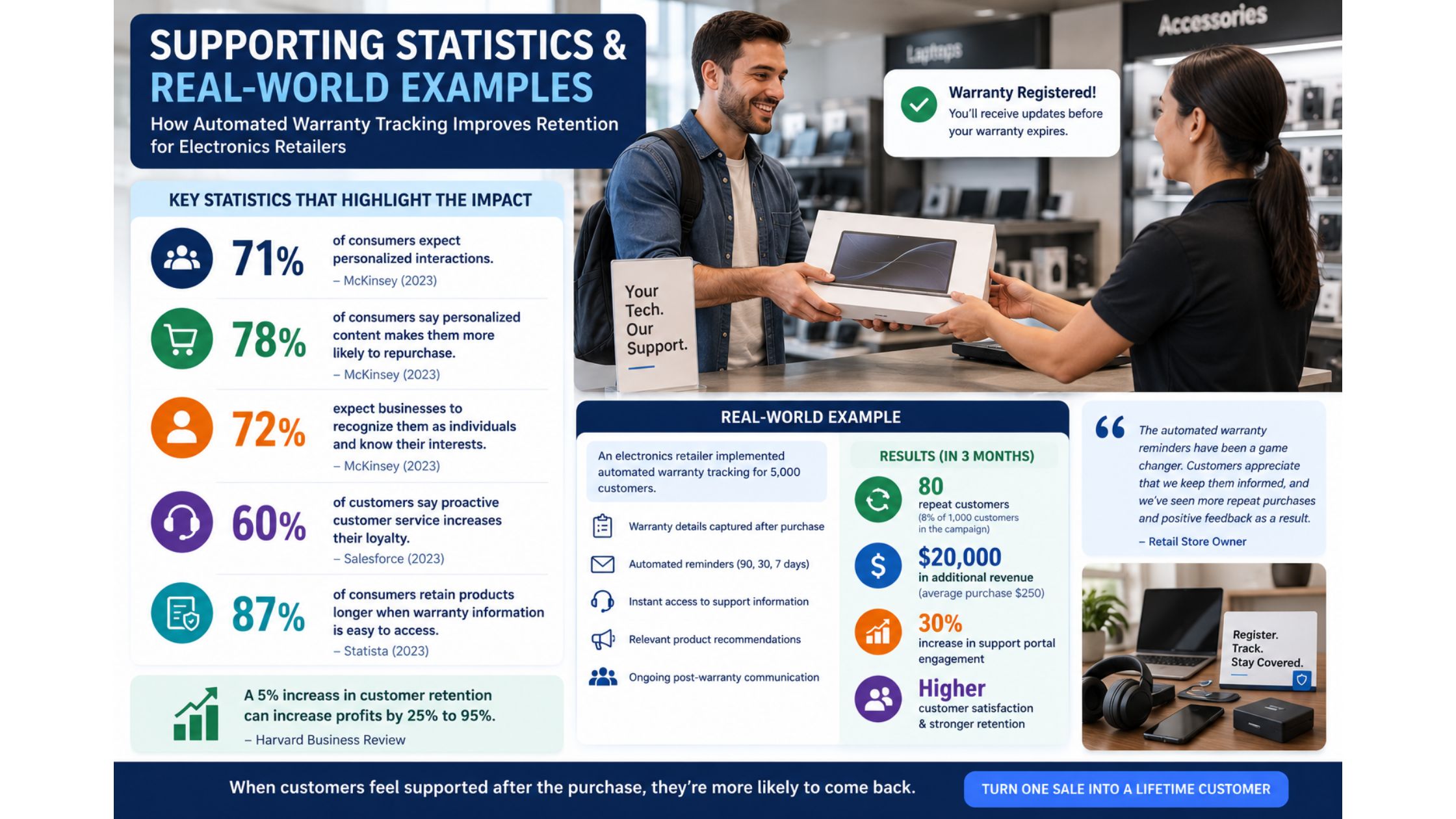
McKinsey found that 71% of consumers expect personalized interactions, 76% become frustrated when personalization does not happen, and 78% say personalized content makes them more likely to repurchase.
The same research found that 72% expect businesses to recognize them as individuals and know their interests. Warranty and product-ownership records provide electronics retailers with concrete information that can make post-purchase communication more relevant.
McKinsey has also highlighted proactive customer service as a way to reduce customers’ need to call while deepening trust and loyalty, supporting retention and relevant cross-selling.
From a regulatory and customer-information perspective, the FTC explains that the Magnuson-Moss Warranty Act governs written warranties on consumer products and requires applicable warranty information to be communicated clearly. The FTC also advises customers to retain warranties and receipts.
Practical Electronics Retailer Example
Consider an electronics retailer with 5,000 customers who purchased warranty-covered products during the previous year.
Without automation, warranty communication is largely reactive. Customers contact the retailer only when they remember their warranty or experience a problem.
The retailer introduces automated warranty tracking that:
- Records warranty dates after purchase.
- Stores receipts and product information.
- Sends post-purchase warranty details.
- Sends 90-day and 30-day expiration reminders.
- Provides direct access to support information.
- Continues post-warranty communication where relevant.
Suppose 1,000 customers receive warranty-expiration sequences during a quarter.
If 8% of those customers subsequently make another purchase from the retailer during the campaign period, that represents:
1,000 customers × 8% = 80 repeat customers
If their average subsequent purchase is $250:
80 × $250 = $20,000 in repeat revenue
These figures are illustrative, not an industry benchmark. The purpose is to demonstrate how even a modest improvement in retention can become meaningful when warranty automation operates across a large customer database.
The retailer should measure actual performance using repeat-purchase rate, customer lifetime value, support engagement, warranty-portal usage, and revenue from customers receiving warranty communications.
Quick Tactical Setup for Electronics Retailers
Start with higher-value products where warranty information is important to customers, such as laptops, televisions, smartphones, gaming systems, monitors, cameras, and major electronics.
Connect the POS or e-commerce system to a CRM or automation platform. Capture purchase dates, product identifiers, warranty periods, receipts, and customer consented contact details.
Create the first three automated touchpoints: post-purchase warranty confirmation, pre-expiration reminder, and post-warranty support message.
Then measure whether customers receiving these communications show stronger repeat-purchase or engagement rates than comparable customers who do not.
The objective is not to send more messages. It is to make the retailer more useful throughout the product’s ownership lifecycle.
Conclusion
Can automated warranty tracking improve retention for electronics retailers?
Yes, particularly when it transforms warranty information from a forgotten record into an ongoing customer-service experience.
Automated tracking can help retailers maintain product records, deliver warranty documents, remind customers before coverage expires, simplify support, identify customers who may need help, and create more relevant post-purchase communication.
That can contribute to:
- Better post-purchase experiences
- Stronger customer relationships
- More personalized communication
- Easier warranty support
- More repeat-purchase opportunities
- Better customer data
- Longer customer lifecycles
The important point is that warranty tracking should not become an excuse for aggressive promotions.
Its first purpose should be useful service.
When customers know that a retailer remembers what they purchased, helps them understand their coverage, and remains useful long after checkout, the retailer has a stronger reason to be considered when that customer is ready to buy again.