
How can AI demand forecasting reduce shortages for florists when flower demand can change dramatically around holidays, weddings, local events, weather conditions, and even specific days of the week?
Inventory planning is unusually difficult for flower businesses. Florists need enough roses, lilies, tulips, carnations, greenery, and seasonal flowers to fulfil orders, but stocking excessively creates another problem: flowers are perishable.
Order too little and popular varieties sell out. Order too much and unsold stems lose freshness and become waste.
The size of the industry makes inventory decisions commercially significant. According to the USDA National Agricultural Statistics Service, U.S. floriculture crop sales reached $6.71 billion in 2024, with 11,262 floriculture producers recorded nationwide.
AI demand forecasting can help florists find a better balance.
Instead of basing tomorrow’s flower order primarily on intuition or last year’s numbers, AI can analyze historical sales, current orders, seasonal patterns, weather, promotions, events, inventory levels, and other demand signals.
The result is a more informed estimate of what customers are likely to order and which flowers the florist should have available.
Direct Answer
Yes. AI demand forecasting can reduce shortages for florists by predicting future demand at the product, category, and occasion level before purchasing decisions are made.
IBM defines AI demand forecasting as using artificial intelligence to estimate future demand by analyzing historical and real-time data alongside relevant external factors. Better forecasts help businesses maintain enough inventory to satisfy customers without unnecessarily overstocking.
For a florist, the system could predict:
Red roses: 450 stems expected next week
White roses: 180 stems
Lilies: 120 stems
Sunflowers: 75 stems
Mixed greenery: 240 bunches
Purchasing decisions can then reflect predicted demand rather than relying on a fixed weekly order.
The objective is not perfect prediction. It is reducing the gap between what customers want and what the florist has available.
Step-by-Step Breakdown
1. Start with historical sales data
AI forecasting needs reliable information about previous demand.
A florist should begin by connecting data from its POS, e-commerce store, CRM, phone orders, and delivery system.
Useful information includes previous order dates, products sold, stem quantities, bouquet types, transaction values, delivery dates, customer types, and sales channels.
Patterns can then emerge.
For example, Friday demand for bouquets might consistently exceed Tuesday demand. Red roses may surge around Valentine’s Day, while white flowers may experience stronger demand during wedding periods.
AI makes those patterns easier to identify across thousands of transactions.
2. Forecast individual flowers instead of total sales
Knowing that the shop expects $8,000 in sales next week does not tell the buyer what flowers to order.
Forecasts should reach the product level whenever enough data exists.
Suppose the system predicts 300 bouquet orders next week.
It should also estimate the likely composition of those orders.
That might mean 420 roses, 150 lilies, 100 sunflowers, 90 hydrangeas, and a specific volume of greenery.
The USDA itself collects detailed floriculture information including quantities sold, prices, sales values, and individual crop categories because product-level information is important for understanding and planning within the industry.
For an individual florist, SKU-level forecasting applies the same principle at business scale.
3. Build holidays into the forecast
Florists experience demand spikes that ordinary businesses may not.
Valentine’s Day, Mother’s Day, Christmas, Easter, graduations, and other occasions can dramatically change normal purchasing patterns.
A traditional forecast might calculate average February sales.
AI can distinguish Valentine’s week from an ordinary February week.
Suppose a florist typically sells 400 red roses per week but sold 2,300 during Valentine’s week last year.
That event history becomes a meaningful forecasting signal.
The system can also compare multiple years to determine whether demand is increasing, declining, or shifting between products.
This helps prevent one of the costliest florist problems: discovering that the most requested flower is unavailable during the year’s busiest selling period.
4. Include weddings and advance orders
Florists often have information about future demand before it happens.
A wedding scheduled three weeks from now may already require 500 roses, 200 hydrangeas, and large quantities of greenery.
Those confirmed orders should automatically affect the forecast.
The system can combine:
Known demand: confirmed weddings and events
Predicted demand: expected walk-ins, online orders, and regular customers
That produces a more useful purchasing recommendation.
If 500 white roses are already committed and another 250 are predicted from ordinary demand, the buyer knows that ordering 400 would almost certainly create a shortage.
5. Add weather and external signals
Demand is not driven exclusively by previous transactions.
Weather can affect walk-in traffic, deliveries, weddings, outdoor events, and customer behavior.
IBM notes that AI forecasting can incorporate information such as weather forecasts, economic indicators, social signals, real-time data, and historical transactions.
A florist might discover that severe rain reduces spontaneous store visits but has less effect on preordered deliveries.
AI can continuously test these relationships rather than assuming every external factor affects demand equally.
6. Calculate reorder quantities using current stock
Predicting demand is only half the job.
The system also needs to know what is already available.
Suppose AI predicts demand for 500 red roses over the next few days.
The florist currently has 160 usable stems and another 100 already scheduled to arrive.
The remaining requirement is approximately 240 stems, plus an appropriate safety buffer.
That is much more useful than simply telling the florist, “Demand will be 500.”
Inventory, incoming orders, predicted demand, lead times, and spoilage risk should work together.
7. Account for supplier lead times
Not every flower can be replenished immediately.
Some varieties may arrive the next morning. Others may require several days, especially specialty or imported flowers.
AI forecasting can incorporate supplier lead times into reorder recommendations.
If roses require two days to replenish, the system can flag an expected shortage before inventory reaches zero.
For example:
Current roses: 200
Expected two-day demand: 260
Incoming inventory: 0
Action: Reorder immediately
This turns forecasting into an early-warning system.
McKinsey reports that applying AI-driven forecasting in supply chains can reduce forecasting errors by 20% to 50% and can translate into reductions in lost sales and product unavailability of up to 65% in some applications.
Those figures are not florist-specific guarantees, but they demonstrate the potential operational value of more accurate demand planning.
8. Create shortage alerts before products sell out
A useful AI system should not require the florist to constantly inspect forecasting dashboards.
It should proactively alert staff.
For example:
“Red rose inventory is projected to fall below required levels within 36 hours.”
Another alert could say:
“White hydrangea demand is running 27% above forecast. Current stock may not cover confirmed weekend orders.”
These alerts allow employees to act while inventory can still be replenished.
9. Detect unexpected demand changes in real time
Forecasts should change when reality changes.
Imagine the florist expected to sell 100 sunflowers on Saturday.
By noon Friday, online orders already require 85.
The original forecast is probably too low.
AI can compare actual demand against expected demand and revise the prediction.
Instead of waiting until the sunflowers sell out, the florist receives an early recommendation to increase the next supplier order.
This is one advantage of AI forecasting over static spreadsheets.
IBM notes that AI-based forecasting can adapt to changing market conditions and real-time information, helping organizations respond more quickly to disruptions and demand changes.
10. Forecast substitutions when shortages cannot be avoided
Some shortages cannot be prevented.
A grower may have a production issue. Weather may disrupt supply. Imported flowers may arrive late.
AI can still help.
If a particular flower becomes unavailable, the system can identify arrangements that depend on it and suggest appropriate alternatives based on existing inventory.
For example:
Unavailable: White peonies
Possible substitutes: White garden roses or ranunculus
The final substitution should still be approved by an experienced florist, especially for weddings and custom arrangements.
AI supports the decision rather than replacing professional floral judgment.
Supporting Statistics and Real-World Examples
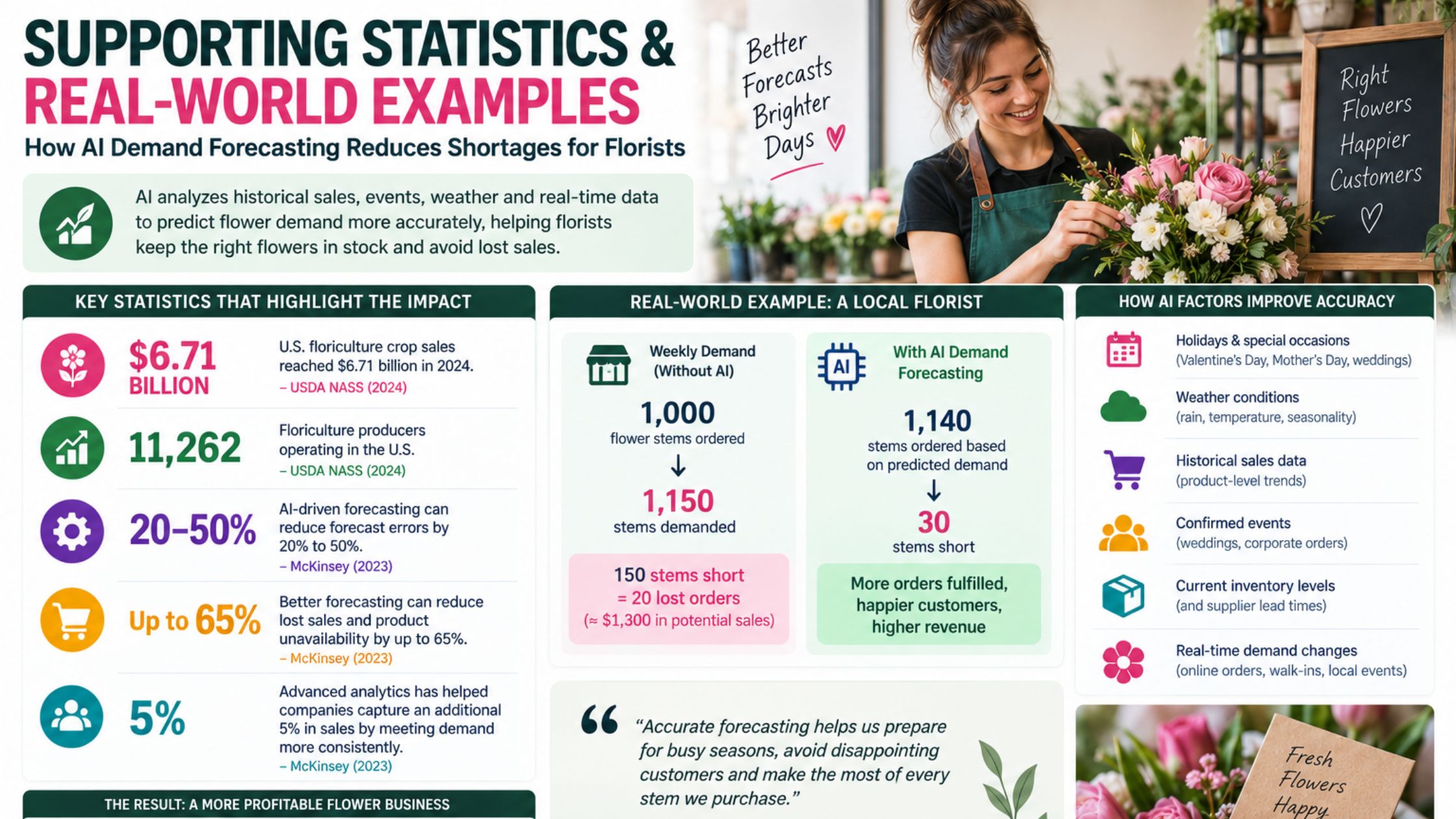
The business case for better forecasting extends beyond florists.
McKinsey reports that AI-driven supply-chain forecasting can reduce forecast errors by 20% to 50%. In some applications, improved forecasting can reduce lost sales and product unavailability by as much as 65%.
McKinsey has separately reported that next-generation supply-chain technologies can reduce forecasting error by 30% to 50%, enabling inventory decisions to respond dynamically to expected demand rather than relying on fixed safety-stock assumptions.
Another McKinsey case found that advanced analytics helped one company reduce inventory and product obsolescence by 20% to 40% depending on the SKU, while capturing an additional 5% in sales by meeting demand more consistently.
These figures should not be treated as guaranteed florist results. They demonstrate how better forecasting can simultaneously address two competing problems: excess inventory and unavailable products.
That balance matters particularly in floriculture because flowers have limited useful selling lives.
USDA data shows the commercial importance of the sector. U.S. floriculture crop sales reached $6.71 billion in 2024, while the broader horticultural specialty sector generated $18.3 billion in sales.
Practical Florist Example
Consider a florist that normally orders 1,000 flower stems per week.
During a busy spring week, actual customer demand reaches 1,150 stems.
The florist only ordered 1,000 because purchasing was based largely on previous weekly averages.
That creates a shortage of:
1,150 demand – 1,000 available = 150 stems
Suppose the shortage causes 20 potential orders to be declined or substituted, with an average order value of $65.
That represents:
20 × $65 = $1,300 in potential sales at risk
Now suppose AI forecasting analyzes historical spring sales, confirmed wedding orders, weather, upcoming events, online order growth, and current inventory.
The revised forecast predicts approximately 1,140 stems.
The florist orders closer to expected demand and keeps an appropriate buffer.
Even if the forecast is not perfect, reducing the shortage from 150 stems to 30 could allow the florist to fulfil substantially more customer orders.
These numbers are illustrative, not an industry benchmark. Actual performance depends on product mix, supplier reliability, lead times, demand volatility, spoilage, and forecasting accuracy.
Quick Tactical Setup for Florists
Start with the products responsible for the highest sales or the most frequent shortages. Roses, lilies, carnations, hydrangeas, tulips, seasonal flowers, and common greenery may be good starting categories depending on the business.
Connect historical POS data, online orders, current inventory, confirmed events, supplier lead times, and spoilage records.
Then add calendar variables such as Valentine’s Day, Mother’s Day, weddings, graduations, local events, and promotions.
Measure forecast quantity against actual demand every week.
Track four core metrics: forecast accuracy, stockout rate, lost sales from unavailable flowers, and spoilage rate.
A successful system should not simply reduce shortages by ordering more inventory. It should improve availability without creating unnecessary waste.
Conclusion
So, how can AI demand forecasting reduce shortages for florists?
It gives florists earlier and more precise information about what customers are likely to buy.
Instead of discovering that roses, lilies, or other popular flowers are running out after demand arrives, AI can analyze historical sales, current orders, seasonal events, weather, supplier lead times, and inventory to identify potential shortages before they happen.
Better forecasting can help florists achieve:
- Fewer flower stockouts
- Fewer lost orders
- Better holiday preparation
- Smarter supplier purchasing
- More accurate wedding inventory
- Faster response to demand spikes
- Lower unnecessary safety stock
- Better balance between availability and spoilage
The goal is not to fill the cooler with more flowers.
It is to stock the right flowers, in the right quantities, at the right time.
For a florist dealing with highly perishable inventory and unpredictable customer demand, that difference can directly affect both customer satisfaction and profitability.