Can AI reorder alerts improve repeat sales for office suppliers when business customers regularly purchase the same products but do not always reorder from the same company?
Office supply businesses have a natural advantage: many of their products are consumable. Printer paper gets used. Toner cartridges run out. Pens disappear. Labels, envelopes, notebooks, cleaning supplies, packaging materials, and breakroom essentials all need replenishment.
That should create predictable repeat revenue.
However, many suppliers still depend on customers remembering when to reorder. When supplies begin running low, an office manager may search online, compare prices, use a marketplace, or purchase from whichever supplier makes ordering easiest at that moment.
AI reorder alerts can intervene before that happens.
By analyzing previous purchases, average consumption cycles, account behavior, and product history, AI can estimate when a customer is likely to need more stock and automatically send a relevant reminder.
This approach fits increasingly digital B2B purchasing behavior. McKinsey’s 2024 B2B Pulse research found that e-commerce has become central to B2B sales, while buyers are increasingly comfortable completing substantial purchases through remote and self-service channels.
Instead of waiting for customers to remember your business, AI can bring the next likely purchase directly to them.
Direct Answer
Yes. AI reorder alerts can improve repeat sales for office suppliers by predicting when business customers are likely to run low on frequently purchased products and prompting them to reorder before they start shopping elsewhere.
Unlike a basic promotional email, an intelligent reorder alert can consider:
- Previous order dates
- Products purchased
- Quantities ordered
- Average reorder intervals
- Seasonal demand
- Customer size
- Multiple office locations
- Previous response behavior
The alert can then provide a direct link to reorder the same products, adjust quantities, or add related items.
For office suppliers, this creates a more convenient buying experience while increasing repeat-order opportunities, customer retention, and account value.
Step-by-Step Breakdown
1. AI learns each customer’s purchasing cycle
Different businesses consume office supplies at very different rates.
A five-person consultancy may purchase printer paper every three months, while a 200-person office may reorder every two weeks.
Sending both companies a generic monthly reminder makes little sense.
AI can analyze each customer’s historical transactions and identify patterns.
For example:
Customer A: Orders 10 boxes of paper every 30 to 35 days.
Customer B: Orders toner approximately every 75 days.
Customer C: Reorders shipping labels every three weeks.
Once those patterns become visible, the system can predict the likely next purchase window.
The supplier can contact the customer before supplies become urgent.
2. Reorder alerts reduce the chance of customers shopping elsewhere
Repeat business is not guaranteed simply because someone purchased from a supplier previously.
When an office manager notices the last toner cartridge is almost empty, convenience becomes the priority.
They might:
- Search Google
- Visit an online marketplace
- Compare another supplier
- Purchase from a local store
A timely reorder alert reduces this risk.
Instead of requiring the customer to search, the supplier can send:
“Your team may be approaching its usual toner reorder window. Reorder your previous cartridges here.”
The customer already knows the product and supplier, making the next purchase much easier.
This matters because B2B buyers increasingly expect seamless digital purchasing. McKinsey reports that B2B customers regularly use ten or more channels to interact with suppliers, compared with five in 2016.
Suppliers therefore need to remain visible across the customer’s purchasing journey.
3. AI makes alerts specific to the products customers actually need
Generic sales emails often promote dozens of unrelated products.
Reorder alerts are different.
They are based on known purchasing behavior.
An accounting firm that repeatedly purchases:
- A4 printer paper
- Black toner
- File folders
can receive a reminder specifically about those products.
A warehouse purchasing:
- Shipping labels
- Packing tape
- Permanent markers
should receive a completely different alert.
Personalization matters. McKinsey research found that 71% of consumers expect personalized interactions, while 76% become frustrated when companies fail to provide them.
Although that research focuses broadly on consumers, the underlying principle is relevant to B2B reorder communication: customers are more likely to value messages that reflect their actual needs.
4. One-click reordering removes unnecessary buying friction
A reminder is most effective when customers can act immediately.
Consider two experiences.
Option A:
“Time to reorder office supplies.”
The customer then needs to visit the website, search for the previous toner model, confirm compatibility, select the quantity, and complete checkout.
Option B:
“Reorder your last toner purchase.”
The customer clicks once and sees the previous products already selected.
The second workflow removes unnecessary steps.
McKinsey’s B2B research shows that digital self-service is no longer limited to small purchases. In its omnichannel research, 77% of B2B customers said they were willing to spend $50,000 or more through remote or self-service interactions.
Office supplies are particularly well suited to self-service because many orders involve familiar products that customers have already evaluated.
5. AI can predict replenishment before supplies completely run out
The goal should not be to send the reminder on the exact day an item is expected to run out.
That may already be too late.
Instead, AI can create a buffer based on:
- Normal consumption
- Delivery times
- Previous reorder behavior
- Product availability
Suppose a company typically reorders 20 boxes of printer paper every 45 days.
The system might trigger the alert on day 38.
That gives the customer time to reorder without creating an urgent stock shortage.
For the supplier, this creates a predictable opportunity to capture the next transaction before another seller enters the buying process.
6. AI reorder alerts can increase average order value
Reorder reminders can also identify logical complementary purchases.
Suppose the customer normally reorders printer paper.
The system could suggest:
- Toner
- Labels
- Envelopes
A customer reordering whiteboard markers might also need:
- Whiteboard cleaner
- Erasers
- Replacement boards
These recommendations should be based on previous purchasing behavior or genuine product relationships rather than random upselling.
AI-driven personalization can create measurable commercial impact. McKinsey reports that AI-driven personalization can increase revenue by approximately 5% to 8% while also improving customer satisfaction.
For office suppliers, relevant recommendations can turn a routine replenishment order into a larger basket.
7. Different accounts can receive different reorder workflows
Not every customer should receive identical communication.
AI can segment accounts based on factors such as:
- Purchase frequency
- Annual spending
- Business size
- Products purchased
- Number of locations
- Reorder consistency
A small business might receive a straightforward automated reminder.
A high-value corporate account might trigger an alert for the assigned account manager.
For example:
Standard account: Automated email with reorder button.
Growing account: Personalized email plus volume pricing suggestion.
Enterprise account: Account manager task created before expected reorder date.
This allows automation to support the sales team rather than replace it.
8. AI can recover customers whose reorder pattern suddenly stops
One of the most valuable signals in recurring B2B purchasing is not an order.
It is the absence of one.
Suppose a customer normally purchases paper every month:
January → February → March → April → May
Then June passes without an order.
AI can recognize that the customer has moved outside their normal buying pattern.
That can trigger a re-engagement message:
“Your regular paper order may be due. Would you like to repeat your previous purchase?”
If the account remains inactive, a sales representative can be notified.
This allows suppliers to address potential churn before the customer relationship disappears completely.
9. AI helps sales teams prioritize accounts that need human attention
Salespeople do not need to manually call every customer before every reorder.
Automation can handle predictable purchases while identifying exceptions.
Human attention can be reserved for accounts showing signals such as:
- Declining order frequency
- Reduced quantities
- Repeated abandoned carts
- High-value reorder opportunities
- Unusual product changes
This is where AI becomes particularly valuable.
Instead of giving salespeople a huge list of previous customers, the system can surface the accounts most likely to require intervention.
Sales teams can spend more time strengthening important relationships and less time sending routine reminders.
10. Reorder data can improve inventory planning
AI reorder alerts can also benefit the supplier operationally.
If hundreds of customers have predictable replenishment cycles, those patterns can help forecast future product demand.
For example, the system may identify that:
- 85 customers are approaching toner replenishment
- 120 accounts typically reorder paper next month
- Label demand increases during a particular season
The supplier can use these signals to make better purchasing and stocking decisions.
That helps connect customer retention with inventory management.
Supporting Statistics and Real-World Examples
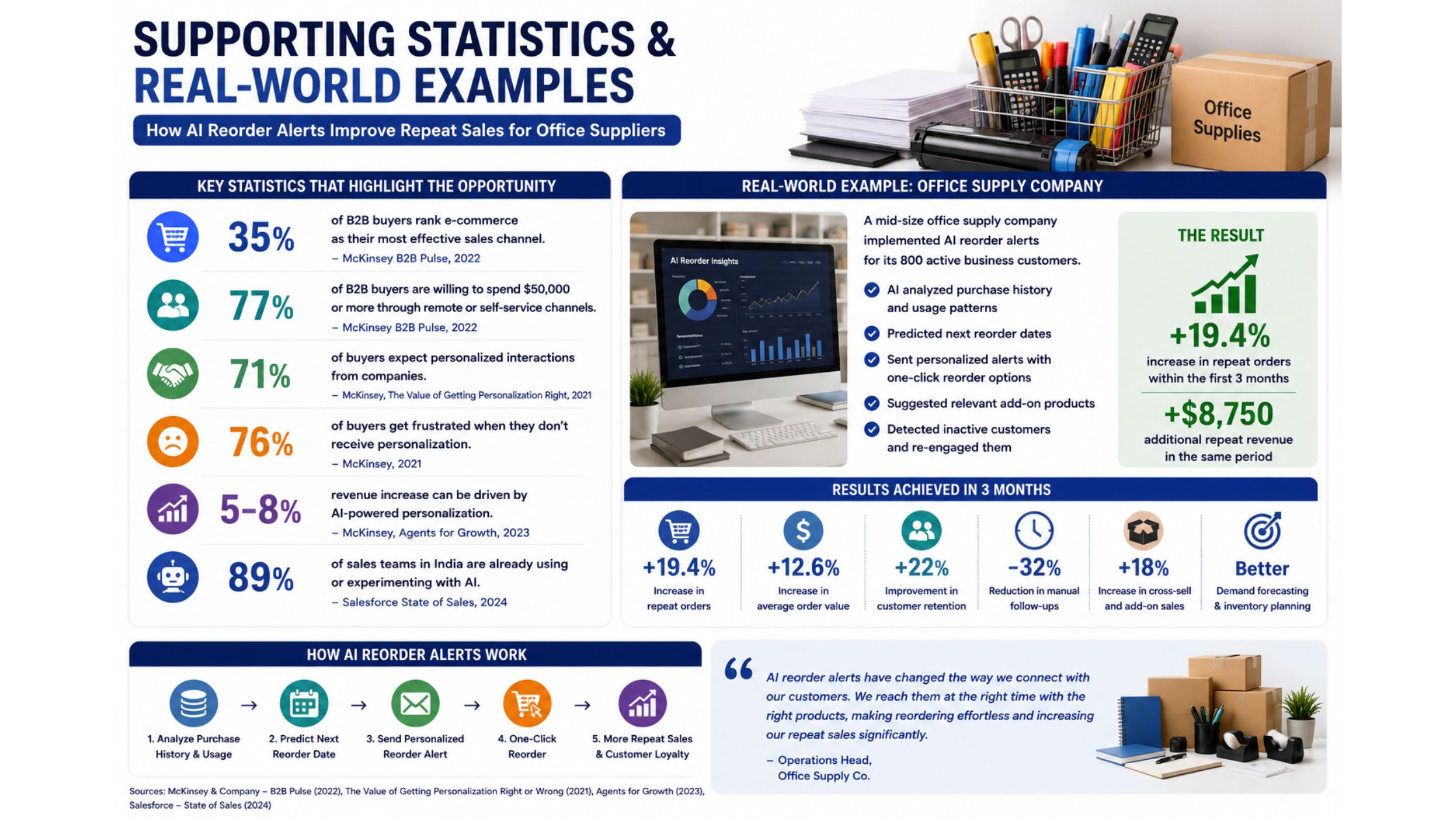
Several broader B2B trends support automated reorder strategies.
McKinsey’s research found that e-commerce is now a leading B2B sales channel. In earlier B2B Pulse research, 35% of respondents ranked e-commerce as their most effective sales channel, ahead of in-person sales, videoconferencing, email, and telephone.
The shift has continued. McKinsey reported in 2024 that buyers’ comfort with remote and self-service spending had increased substantially, reinforcing e-commerce as a core part of modern B2B sales.
AI adoption within sales is also accelerating. Salesforce’s 2024 State of Sales research found that 89% of surveyed sales teams in India were already using or experimenting with AI, with another 10% evaluating it.
Practical Office Supplier Example
Consider an office supplier with 800 active business customers.
Suppose 300 regularly purchase consumable products such as paper, toner, labels, envelopes, and cleaning supplies.
Without automated reminders, assume 180 of those customers reorder during the expected period.
The supplier introduces AI reorder alerts that:
- Analyze previous purchase intervals.
- Predict the next likely replenishment date.
- Send personalized reminders.
- Display previous products.
- Provide a direct reorder button.
- Recommend relevant complementary products.
If the system encourages another 35 customers to reorder during that period, the supplier increases repeat transactions from 180 to 215.
At an average order value of $250, those 35 additional orders represent:
35 × $250 = $8,750 in additional repeat revenue.
If a similar uplift occurred quarterly, that would represent $35,000 in additional annual sales.
These figures are illustrative rather than an industry benchmark, but they demonstrate why small improvements in repeat-order rates can create meaningful revenue when applied across a large customer base.
Best Office Supplies for AI Reorder Alerts
Office suppliers should begin with products that have predictable consumption patterns.
Printer Paper: Purchase history can reveal approximate monthly or quarterly usage.
Ink and Toner: Previous printer supplies make highly specific reorder recommendations possible.
Labels and Packaging Materials: Businesses involved in shipping may replenish these frequently.
Pens and Stationery: Larger offices often purchase these products on recurring schedules.
Cleaning and Breakroom Supplies: Coffee, tissues, cleaning products, cups, and similar consumables naturally require replenishment.
These categories provide clear historical signals that AI can use to predict future purchasing needs.
Conclusion
So, can AI reorder alerts improve repeat sales for office suppliers?
Yes. Their value comes from turning historical purchase data into timely, actionable sales opportunities.
AI can identify when customers are approaching their normal replenishment window, personalize reminders around products they actually purchase, provide direct reorder options, recommend useful complementary products, and detect accounts whose normal buying patterns have stopped.
For office suppliers, the benefits can include:
- More repeat orders
- Higher customer retention
- Larger average order values
- Less manual sales follow-up
- Better customer convenience
- Earlier churn detection
- More predictable demand
Most importantly, reorder alerts help suppliers capture revenue from demand that already exists.
Businesses will continue using paper, toner, labels, stationery, and other consumable products. The question is simply which supplier will receive the next order.
AI reorder alerts help make sure existing customers remember your business before they start looking somewhere else.