Speed matters in franchise sales and customer acquisition.
Whether a prospect is requesting information about a franchise opportunity, booking a local service, or asking for pricing, the first business to respond often has the greatest chance of winning the customer.
For franchise businesses, however, responding quickly is more challenging than for single-location companies.
Leads may need to be assigned based on:
- Geographic territory
- Franchise ownership
- Service availability
- Business hours
- Product category
- Customer intent
Manual lead distribution slows this process and increases the risk of missed opportunities.
This raises an important question:
Can AI lead routing improve response times for franchise businesses?
The answer is yes.
AI-powered lead routing automatically analyzes incoming inquiries and sends them to the most appropriate franchise location or representative within seconds. Faster responses improve customer experience, increase lead quality, and ultimately generate more conversions.
This guide explains how AI lead routing works, why it improves response times, and how franchise businesses can implement it effectively.
Direct Answer
AI lead routing improves response times for franchise businesses by automatically analyzing incoming inquiries, identifying the most appropriate destination, and instantly assigning leads to the correct franchise location or team member.
Instead of relying on manual processes, AI uses customer information to route leads intelligently.
This helps franchise businesses:
- Respond faster
- Reduce missed opportunities
- Improve customer experience
- Increase lead conversion
- Balance lead distribution
- Improve operational efficiency
According to McKinsey & Company, AI-powered automation is helping organizations improve operational efficiency, reduce manual work, and enhance customer experiences across multiple industries.
For franchise businesses, faster routing often translates directly into higher conversion potential.
Why Fast Response Times Matter
Customers Expect Immediate Responses
Modern consumers expect businesses to respond quickly.
Long delays often result in:
- Lost interest
- Competitor inquiries
- Reduced trust
- Lower conversion rates
The faster a franchise responds, the greater the likelihood of securing the opportunity.
Franchise Networks Add Complexity
Unlike centralized businesses, franchises must determine:
- Which location owns the lead
- Which representative should respond
- Whether capacity exists
- Which services are available locally
Manual routing introduces delays.
AI eliminates much of this complexity.
Speed Builds Trust
According to HubSpot Research, quick responses improve customer experience and contribute to stronger sales performance.
Customers often associate responsiveness with professionalism.
Fast communication builds confidence.
Step-by-Step Breakdown: How AI Lead Routing Improves Response Times
Step 1: Capture Lead Information Automatically
AI begins by collecting available information, including:
- Location
- Contact details
- Service requested
- Inquiry source
- Product interest
- Customer intent
This information becomes the foundation for intelligent routing.
Step 2: Analyze Lead Intent
Not every inquiry requires the same destination.
AI evaluates signals such as:
- Franchise inquiries
- Customer service requests
- Product purchases
- Service appointments
- Partnership opportunities
The system identifies the purpose before assigning the lead.
This reduces manual review.
Step 3: Route Leads to the Correct Franchise
Location-based routing is one of AI’s greatest strengths.
Leads can be assigned using:
- ZIP codes
- Postal codes
- GPS location
- Territory mapping
- Service radius
- Regional availability
The correct franchise receives the inquiry immediately.
Customers avoid unnecessary transfers.
Step 4: Prioritize High-Intent Opportunities
Some leads require immediate attention.
AI can prioritize inquiries based on:
- Urgency
- Buying signals
- Appointment requests
- Previous interactions
- Product interest
High-value opportunities receive faster responses.
This improves sales efficiency.
Step 5: Use AI to Balance Workloads
AI does more than route by geography.
It can also consider:
- Team availability
- Response times
- Representative workload
- Business hours
- Capacity limits
According to Deloitte Insights, intelligent workflow automation improves operational efficiency by distributing work more effectively across teams.
Balanced workloads reduce response delays.
Step 6: Measure and Continuously Improve Performance
AI systems continuously learn from performance data.
Metrics include:
- Response time
- Conversion rates
- Lead quality
- Customer satisfaction
- Routing accuracy
These insights help improve routing decisions over time.
Supporting Data and Real-World Examples
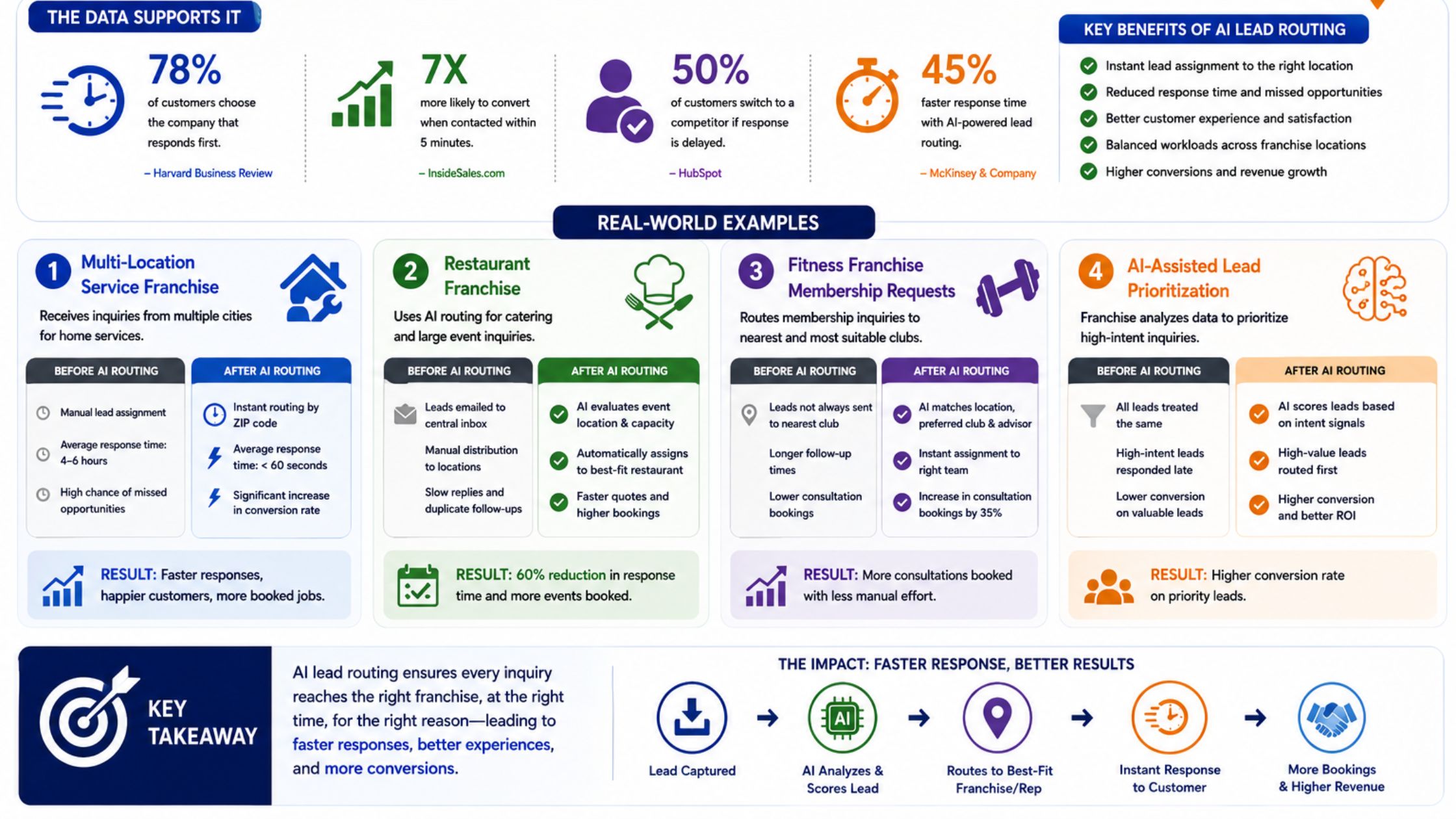
Example 1: Multi-Location Service Franchise
A home services franchise receives inquiries from multiple cities.
Before AI routing:
- Leads were manually assigned.
- Response delays averaged several hours.
After implementing AI:
- Leads were instantly routed by ZIP code.
- Franchise owners responded much faster.
- Customer satisfaction improved.
Example 2: Restaurant Franchise Inquiry System
A restaurant franchise uses AI routing for catering requests.
The system automatically evaluates:
- Event location
- Restaurant capacity
- Delivery availability
Each inquiry reaches the correct restaurant immediately.
Customers receive faster quotes and confirmations.
Example 3: Fitness Franchise Membership Requests
A fitness franchise routes membership inquiries using:
- Customer location
- Preferred club
- Available membership advisors
Prospects receive responses from the nearest club without needing manual transfers.
The simplified process improves consultation bookings.
Example 4: AI-Assisted Lead Prioritization
A franchise organization analyzes historical conversion data using AI.
The system identifies high-intent inquiries based on:
- Appointment requests
- Pricing questions
- Service urgency
- Previous engagement
These leads receive priority routing, improving conversion opportunities.
Common AI Lead Routing Mistakes
Relying Only on Geography
Location matters, but so do:
- Availability
- Capacity
- Lead intent
- Business hours
Multiple routing factors improve efficiency.
Ignoring Lead Quality
Not every inquiry requires immediate sales attention.
AI should prioritize high-value opportunities.
Failing to Monitor Performance
Routing systems should be reviewed regularly.
Response times and conversion rates provide valuable optimization insights.
Overcomplicating the Process
The customer experience should remain simple.
AI should remove complexity rather than introduce it.
Conclusion
AI lead routing can significantly improve response times for franchise businesses because it eliminates manual assignment, reduces delays, and ensures inquiries reach the right location or representative immediately.
The most effective AI lead routing strategies focus on:
- Automatic data capture
- Intent analysis
- Location-based routing
- Lead prioritization
- Workload balancing
- Continuous optimization
For franchise organizations managing multiple territories and high inquiry volumes, AI routing creates a faster, more consistent customer experience.
The goal is not simply to automate lead distribution.
The goal is to ensure every prospect reaches the right franchise quickly, receives a timely response, and experiences a seamless journey from inquiry to conversion.