Why do webinar leads disappear before reaching sales teams, even after generating hundreds of registrations and attendees?
Webinars have become one of the most effective B2B lead generation channels. Businesses use them to educate prospects, demonstrate expertise, launch products, and build trust before making a sales offer.
However, many marketing teams experience a frustrating problem.
A webinar generates:
- Hundreds of registrations
- Strong attendance
- Active engagement
- Positive feedback
Yet only a small percentage of those leads ever make it to the sales pipeline.
Some prospects stop responding immediately after the webinar. Others never receive follow-up. Some remain buried inside marketing platforms, while others are handed to sales too late to maintain momentum.
According to Harvard Business Review, responding to leads quickly has a significant impact on qualification and conversion outcomes. Delayed follow-up often causes interest to fade before meaningful sales conversations begin.
The good news is that webinar lead loss is usually caused by process issues rather than lead quality.
So, why do webinar leads disappear before reaching sales teams?
Let’s examine the most common reasons and how automation can solve them.
Direct Answer
Webinar leads disappear before reaching sales teams because of delayed follow-ups, poor CRM integration, lack of lead qualification, inconsistent lead routing, missing engagement tracking, and weak nurturing workflows. By automating these processes, businesses can significantly increase the number of qualified webinar attendees who become sales opportunities.
Instead of allowing leads to sit inside webinar software or email platforms, businesses should automatically qualify, score, route, and nurture every attendee.
The result is more qualified conversations, shorter sales cycles, and higher conversion rates.
Step-by-Step Breakdown
1. Follow-up happens too slowly
The biggest reason webinar leads disappear is simple.
Nobody contacts them quickly enough.
After attending a webinar, prospects often continue researching solutions and comparing vendors.
If another company responds first, they frequently win the opportunity.
Delayed follow-up often happens because:
- Marketing exports attendee lists manually
- CRM updates happen days later
- Sales representatives receive leads too late
According to Harvard Business Review, faster lead response dramatically improves qualification rates.
Automated workflows eliminate this delay by sending webinar attendees directly into the CRM within minutes.
2. Not every webinar attendee is sales-ready
Many webinar attendees register because they want to:
- Learn about a topic
- Stay informed
- Conduct research
- Compare solutions
- Explore future options
Sending every attendee directly to sales wastes valuable time.
AI lead qualification helps identify attendees based on:
- Attendance duration
- Questions asked
- Poll responses
- Resource downloads
- Company size
- Job title
High-intent attendees can move directly to sales, while others enter nurturing campaigns.
This improves efficiency for both marketing and sales teams.
3. Webinar platforms fail to integrate properly
Many businesses use separate systems for:
- Webinar hosting
- Email marketing
- CRM
- Marketing automation
- Sales tracking
Without proper integration, valuable information becomes fragmented.
Sales representatives may never know:
- Which sessions prospects attended
- Which questions they asked
- Which resources they downloaded
CRM automation automatically transfers webinar engagement data into customer records.
This gives sales teams complete context before making contact.
4. Lead scoring is missing
Every webinar attendee should not receive the same priority.
Examples of high-intent signals include:
- Attending the full webinar
- Downloading bonus resources
- Requesting demonstrations
- Asking pricing questions
- Visiting product pages afterward
AI lead scoring automatically prioritizes these prospects.
According to HubSpot Lead Generation Statistics, organizations that prioritize qualified leads improve sales efficiency and conversion outcomes.
Lead scoring ensures sales representatives spend their time on the opportunities most likely to convert.
5. No post-webinar nurturing exists
Many companies send only one email after the webinar.
If prospects don’t respond immediately, communication ends.
This is a missed opportunity.
Automated nurturing campaigns can include:
- Webinar replay links
- Educational content
- Case studies
- Customer success stories
- Consultation invitations
Consistent communication keeps businesses top of mind while prospects continue evaluating solutions.
6. Sales teams lack engagement visibility
Sales representatives perform better when they understand buyer behavior.
AI tracks activities such as:
- Replay views
- Website visits
- Email opens
- Link clicks
- Resource downloads
This information helps sales representatives personalize outreach.
For example:
Instead of asking generic questions, advisers can reference the specific webinar topics that interested the prospect.
According to Salesforce State of the Connected Customer, personalized communication improves customer engagement and purchasing decisions.
7. Lead routing is inconsistent
In growing organizations, webinar leads often pass through multiple departments before reaching sales.
Examples include:
- Marketing managers
- SDR teams
- Regional sales managers
- Territory representatives
Manual routing creates delays and confusion.
Automation routes leads instantly based on:
- Territory
- Industry
- Company size
- Product interest
- Sales ownership
The right representative receives the lead immediately.
Faster routing increases conversion potential.
8. Marketing and sales measure different success metrics
Marketing often measures:
- Registrations
- Attendance
- Engagement
Sales focuses on:
- Meetings booked
- Qualified opportunities
- Closed revenue
Without shared visibility, webinar performance becomes difficult to evaluate.
Integrated CRM reporting connects:
- Webinar attendance
- Lead qualification
- Sales activities
- Revenue generation
This alignment helps both teams optimize future campaigns.
According to McKinsey & Company Sales Insights, organizations using automation and data-driven sales processes consistently improve commercial performance.
Supporting Statistics and Real-World Examples
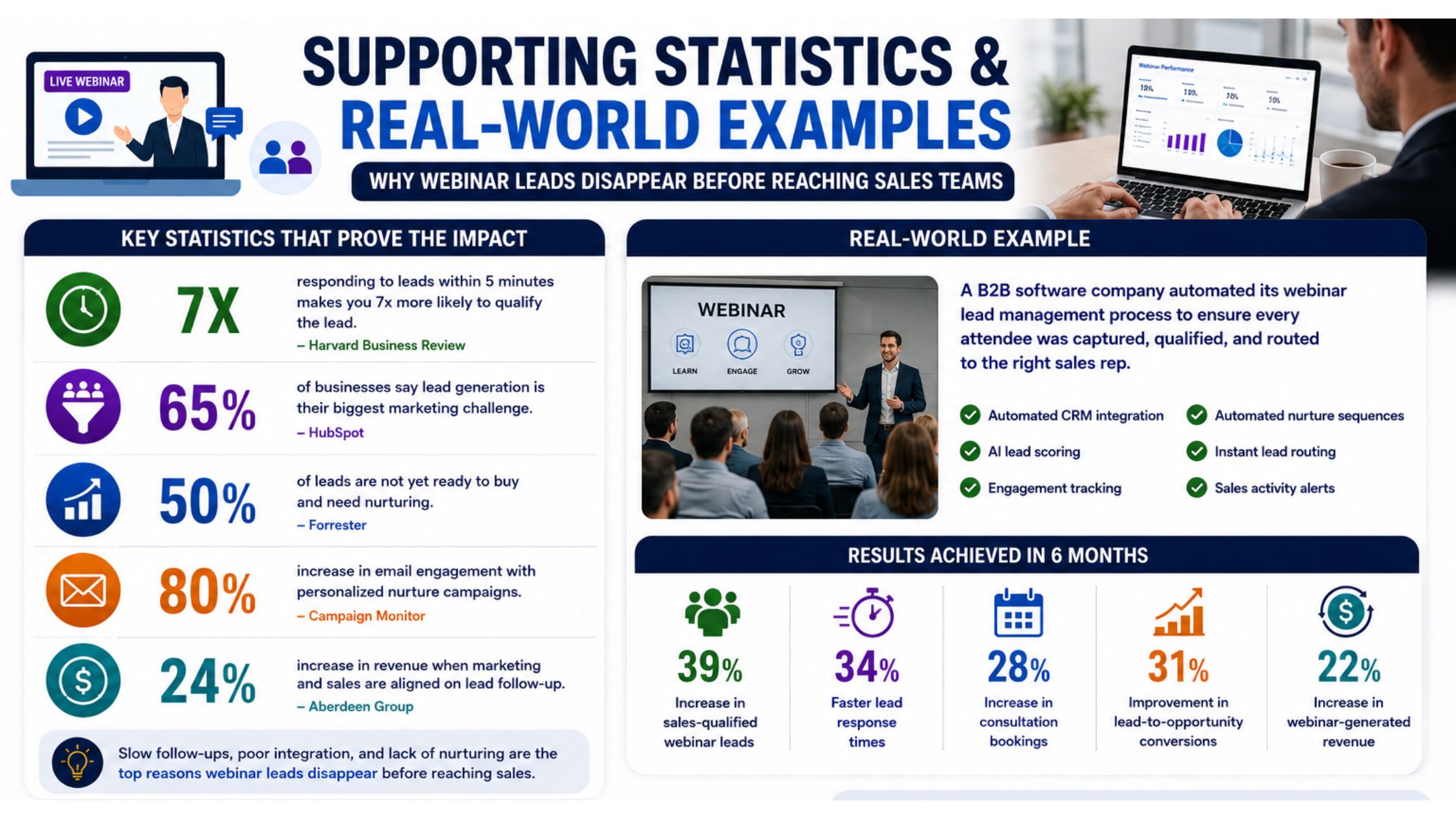
Key webinar lead management benchmarks
Relevant industry benchmarks include:
- Faster lead response significantly improves qualification rates (Harvard Business Review)
- Lead scoring improves sales efficiency (HubSpot)
- Personalized engagement increases customer response (Salesforce)
- Sales automation improves productivity (McKinsey)
- Automated CRM integration improves lead visibility
These benchmarks demonstrate why automation has become essential for maximizing webinar ROI.
Real-world webinar example
A B2B software company hosting monthly educational webinars implemented:
- Automated CRM integration
- AI lead scoring
- Webinar engagement tracking
- Automated email nurturing
- Instant lead routing
Within six months, the company reported:
- 39% increase in sales-qualified webinar leads
- 34% faster lead response times
- 28% increase in consultation bookings
- 31% improvement in lead-to-opportunity conversions
- Higher webinar-generated revenue without increasing advertising spend
Most importantly, nearly every engaged webinar attendee entered an automated sales workflow instead of being lost after the event.
Why webinar leads disappear without automation
Many organizations assume webinar attendees who fail to respond simply were not interested.
In reality, many leads disappear because:
- Follow-up is delayed
- Lead qualification is missing
- CRM updates are incomplete
- Nurturing stops too early
- Sales lacks engagement insights
Automation removes these bottlenecks and keeps prospects moving through the sales funnel.
Best webinar activities to automate first
Businesses typically achieve the fastest ROI by automating:
Registration workflows
- Confirmation emails
- Calendar invitations
- Reminder sequences
Lead qualification
- Attendance scoring
- Engagement tracking
- AI lead scoring
Post-webinar communication
- Replay emails
- Educational resources
- Consultation offers
Sales workflows
- CRM updates
- Lead routing
- Task creation
Reporting
- Attendance dashboards
- Pipeline attribution
- Revenue tracking
These workflows help ensure valuable webinar leads never disappear before reaching the sales team.
Conclusion
So, why do webinar leads disappear before reaching sales teams?
They disappear because of slow follow-up, disconnected systems, inconsistent lead routing, missing lead qualification, weak nurturing campaigns, and limited visibility into prospect engagement.
The solution is not generating more webinar registrations.
The solution is building an automated workflow that captures, qualifies, scores, routes, nurtures, and tracks every attendee from registration through the sales process.
The benefits are substantial:
- More qualified sales opportunities
- Faster lead response
- Better sales alignment
- Higher webinar ROI
- Improved conversion rates
- Increased revenue
Most importantly, automation ensures that the time and budget invested in webinars produce measurable business results instead of disappearing into disconnected systems.
For organizations that rely on webinars as a lead generation channel, automated lead management is one of the most effective ways to convert audience engagement into predictable revenue.