Can AI call summaries improve follow-ups for financial advisers and help advisory firms strengthen client relationships while increasing conversion opportunities?
Financial advisers spend a significant portion of their day speaking with prospects and existing clients about retirement planning, investments, insurance, tax strategies, estate planning, and wealth management. These conversations contain valuable information that influences future recommendations and client decisions.
The challenge is that advisers often need to manually document every conversation after the call.
This creates several problems:
- Time-consuming note-taking
- Missed action items
- Incomplete client records
- Delayed follow-ups
- Inconsistent communication
When important details are forgotten, follow-up conversations become less personalized and less effective.
According to McKinsey & Company Wealth Management Insights, digital technologies are transforming advisory services by improving efficiency and enhancing the client experience.
AI call summaries automatically capture key discussion points, action items, and client preferences, allowing advisers to focus on building stronger relationships instead of writing notes.
So, can AI call summaries actually improve follow-ups for financial advisers?
The answer is yes.
Direct Answer
AI call summaries improve follow-ups by automatically recording key discussion points, identifying client priorities, extracting action items, updating CRM records, and generating accurate meeting summaries that allow financial advisers to deliver faster, more personalized communication.
In practical terms, AI helps advisers:
- Improve client follow-ups
- Reduce administrative work
- Capture important meeting details
- Improve CRM accuracy
- Strengthen client relationships
- Increase advisor productivity
Instead of spending valuable time documenting meetings, advisers can focus on serving clients and growing their practice.
The result is better communication, stronger trust, and improved client retention.
Step-by-Step Breakdown
1. AI captures complete meeting summaries automatically
During client meetings, advisers discuss numerous topics including:
- Financial goals
- Retirement plans
- Investment preferences
- Risk tolerance
- Insurance needs
- Estate planning
Manually recording every detail is difficult.
AI listens to conversations and automatically generates structured summaries containing:
- Key discussion points
- Client concerns
- Decisions made
- Questions raised
- Next steps
This ensures important information is never overlooked.
According to McKinsey, automation allows financial professionals to spend more time delivering client value.
2. Advisers spend less time on administrative work
After every client meeting, advisers often spend considerable time:
- Writing notes
- Updating CRM records
- Recording action items
- Sending recap emails
AI automates much of this documentation.
Instead of spending 20 to 30 minutes preparing meeting notes, advisers receive organized summaries immediately after each call.
This creates more time for:
- Client meetings
- Business development
- Financial planning
- Relationship management
Administrative efficiency directly improves adviser productivity.
3. Follow-up communication becomes more personalized
Strong client relationships depend on remembering personal details.
AI summaries capture:
- Financial priorities
- Family discussions
- Investment interests
- Retirement goals
- Upcoming life events
Follow-up communication becomes much more relevant.
For example:
Instead of sending a generic email, advisers can reference the client’s specific retirement objectives discussed during the meeting.
According to Salesforce State of the Connected Customer, personalized communication significantly improves customer engagement and loyalty.
4. AI identifies important action items
Financial meetings frequently generate multiple follow-up tasks.
Examples include:
- Preparing investment proposals
- Scheduling review meetings
- Collecting financial documents
- Coordinating with accountants
- Updating insurance coverage
AI automatically extracts these action items.
Tasks can be assigned directly to:
- Advisers
- Administrative staff
- Client service teams
Nothing gets forgotten.
This improves service quality while reducing delays.
5. CRM records remain accurate and complete
Many CRM systems contain incomplete client records because advisers do not have time to update every interaction.
AI summaries automatically populate CRM fields including:
- Meeting notes
- Client preferences
- Financial objectives
- Follow-up tasks
- Contact history
Accurate CRM data improves:
- Future meetings
- Team collaboration
- Compliance documentation
- Client service
Better information leads to better advice.
6. AI improves compliance documentation
Financial advisory firms operate within highly regulated environments.
Meeting records often need to demonstrate:
- Advice provided
- Client objectives
- Recommendations discussed
- Risk conversations
AI summaries create consistent documentation that supports compliance requirements.
Although advisers should always review AI-generated notes for accuracy, automated documentation significantly improves record-keeping consistency.
According to FINRA Investor Resources, maintaining complete records is an important part of regulatory compliance for financial professionals.
7. AI helps prioritize client follow-ups
Not every client requires the same level of urgency.
AI can identify conversations involving:
- Imminent retirement
- Portfolio changes
- Insurance renewals
- Investment opportunities
- Time-sensitive decisions
These clients can automatically receive higher priority.
Advisers know exactly which follow-ups require immediate attention.
This improves responsiveness while strengthening client confidence.
8. Better follow-ups improve long-term retention
Clients expect advisers to remember previous conversations.
When advisers consistently reference:
- Financial goals
- Previous discussions
- Family milestones
- Investment preferences
clients feel understood.
AI summaries make this much easier.
According to PwC Future of Customer Experience Report, customer experience remains one of the strongest drivers of loyalty across professional service industries.
More personalized follow-ups strengthen long-term relationships.
Supporting Statistics and Real-World Examples
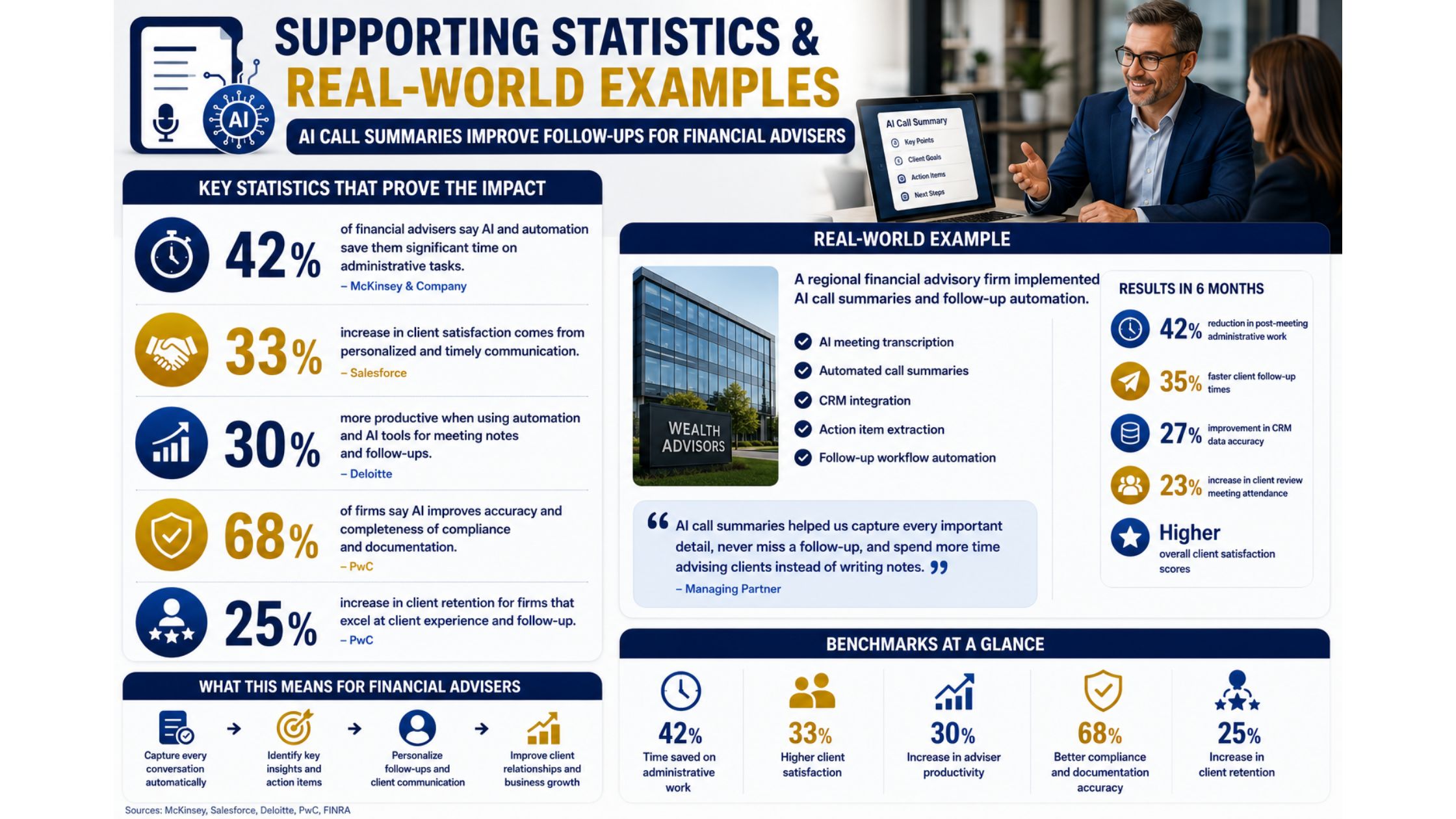
Key AI call summary benchmarks for financial advisers
Relevant industry benchmarks include:
- Automation improves adviser productivity (McKinsey)
- Personalized communication increases customer engagement (Salesforce)
- Better customer experiences improve loyalty (PwC)
- Consistent documentation strengthens compliance processes
- Workflow automation reduces administrative workload
These benchmarks demonstrate why AI call summaries are becoming increasingly valuable across wealth management and financial advisory firms.
Real-world financial advisory example
A regional financial advisory firm implemented:
- AI meeting transcription
- Automated call summaries
- CRM integration
- Task extraction
- Follow-up workflow automation
Within six months, the firm reported:
- 42% reduction in post-meeting administrative work
- 35% faster client follow-up times
- 27% improvement in CRM data accuracy
- 23% increase in client review meeting attendance
- Higher overall client satisfaction scores
Most importantly, advisers spent significantly more time serving clients instead of completing paperwork.
Why financial advisers struggle without AI summaries
Many advisers rely on:
- Handwritten notes
- Manual CRM updates
- Memory
- Separate meeting documents
These methods often result in:
- Missing information
- Delayed follow-ups
- Inconsistent documentation
- Reduced productivity
AI summaries eliminate much of this manual work while improving information quality.
Best financial advisory conversations to summarize
Advisory firms typically achieve the greatest value by summarizing:
Discovery meetings
- Financial goals
- Risk assessments
- Client priorities
Portfolio reviews
- Performance discussions
- Investment changes
- Rebalancing decisions
Retirement planning
- Income strategies
- Pension discussions
- Long-term planning
Insurance consultations
- Coverage reviews
- Policy recommendations
- Renewal discussions
Annual client reviews
- Progress updates
- New objectives
- Future planning
These meetings contain high-value information that benefits from automated documentation.
Conclusion
So, can AI call summaries improve follow-ups for financial advisers?
Absolutely.
They improve follow-ups by capturing complete meeting details, identifying action items, updating CRM records, personalizing future communication, supporting compliance documentation, and allowing advisers to spend more time building client relationships.
The benefits are substantial:
- Faster follow-ups
- Better client experiences
- Improved CRM accuracy
- Reduced administrative workload
- Stronger compliance documentation
- Higher client retention
Most importantly, AI call summaries allow financial advisers to focus less on note-taking and more on delivering trusted financial guidance.
For advisory firms looking to improve efficiency, strengthen relationships, and scale client service without adding administrative burden, AI-powered call summaries are one of the most valuable productivity tools available today.