Can AI maintenance alerts reduce downtime for manufacturing plants and help manufacturers improve productivity while lowering maintenance costs?
For manufacturing facilities, unplanned equipment downtime is one of the most expensive operational challenges. A single machine failure can disrupt production schedules, delay customer deliveries, increase labor costs, and reduce profitability.
Many plants still rely on reactive maintenance, repairing equipment only after it fails. Others use fixed maintenance schedules that may result in unnecessary servicing or missed warning signs.
Common causes of production downtime include:
- Equipment wear and tear
- Bearing failures
- Motor overheating
- Hydraulic issues
- Conveyor malfunctions
- Unexpected electrical failures
When these issues go undetected, they often lead to costly production interruptions.
According to McKinsey & Company Predictive Maintenance Insights, predictive maintenance technologies can significantly reduce machine downtime while improving equipment reliability.
AI maintenance alerts allow manufacturers to identify potential equipment failures before they occur, giving maintenance teams time to intervene proactively.
So, can AI maintenance alerts actually reduce downtime for manufacturing plants?
The answer is yes.
Direct Answer
AI maintenance alerts reduce downtime by continuously monitoring equipment, detecting abnormal operating conditions, predicting failures before breakdowns occur, automatically notifying maintenance teams, and helping manufacturers schedule repairs before production is interrupted.
In practical terms, AI helps manufacturing plants:
- Reduce unplanned downtime
- Increase equipment reliability
- Improve maintenance efficiency
- Extend asset life
- Lower repair costs
- Improve production output
Instead of reacting after equipment fails, maintenance teams can resolve problems while machines remain operational.
The result is higher productivity and lower operating costs.
Step-by-Step Breakdown
1. AI continuously monitors equipment performance
Traditional maintenance inspections occur periodically.
Between inspections, equipment problems may develop unnoticed.
AI systems continuously monitor data from:
- Temperature sensors
- Vibration monitors
- Power consumption
- Pressure gauges
- Motor performance
- Production equipment
The system analyzes thousands of data points in real time.
Even small performance changes can indicate developing mechanical issues.
According to McKinsey, predictive maintenance significantly improves equipment availability while reducing unexpected failures.
2. AI detects failures before they happen
Equipment rarely fails without warning.
Small warning signs often appear long before breakdowns occur.
Examples include:
- Increased vibration
- Higher operating temperatures
- Reduced efficiency
- Irregular power usage
- Unusual machine noise
AI recognizes these patterns much earlier than traditional monitoring.
Maintenance teams receive alerts before the problem becomes critical.
This enables planned repairs instead of emergency shutdowns.
3. Maintenance becomes predictive instead of reactive
Reactive maintenance often creates:
- Emergency repairs
- Overtime labor
- Production delays
- Expensive replacement parts
AI shifts maintenance toward prediction.
Instead of repairing machines after failure, teams repair equipment based on actual condition.
This improves:
- Maintenance scheduling
- Equipment utilization
- Labor planning
- Spare parts management
Predictive maintenance reduces unnecessary servicing while minimizing failures.
4. Automated alerts improve response times
One of the greatest advantages of AI is immediate notification.
When abnormal conditions are detected, the system can automatically send:
- SMS alerts
- Email notifications
- Mobile app notifications
- CMMS work orders
- Maintenance dashboard updates
Technicians receive information instantly.
Faster awareness leads to faster intervention.
According to IBM Predictive Maintenance, predictive maintenance helps organizations improve asset reliability while reducing operational disruptions.
5. AI optimizes maintenance schedules
Many manufacturers perform maintenance based solely on calendars.
For example:
- Every three months
- Every 500 operating hours
- Every production cycle
While simple, these schedules may:
- Replace healthy components too early
- Miss developing failures
AI recommends maintenance based on actual equipment condition.
Maintenance occurs only when necessary.
This reduces maintenance costs while maximizing equipment availability.
6. AI improves spare parts planning
Unexpected failures often create another challenge.
Replacement parts may not be available when needed.
AI forecasting helps maintenance teams anticipate:
- Component wear
- Replacement timelines
- Inventory requirements
Procurement teams can order parts before failures occur.
This minimizes production delays while reducing emergency purchasing costs.
7. AI identifies recurring equipment problems
Some machines experience repeated failures.
AI analyzes historical maintenance records and identifies:
- Frequently failing components
- High-risk equipment
- Common breakdown patterns
- Root causes
Maintenance managers can:
- Upgrade components
- Improve maintenance procedures
- Replace aging equipment
- Optimize production workflows
Continuous improvement reduces long-term downtime.
8. AI provides plant-wide operational visibility
Manufacturing leaders need visibility across multiple production lines.
AI dashboards provide real-time insights into:
- Equipment health
- Maintenance status
- Downtime trends
- Alert history
- Production risks
Managers can prioritize maintenance resources based on actual business impact.
According to Deloitte Smart Manufacturing Insights, connected manufacturing technologies improve operational visibility and production efficiency.
Better visibility leads to better operational decisions.
Supporting Statistics and Real-World Examples
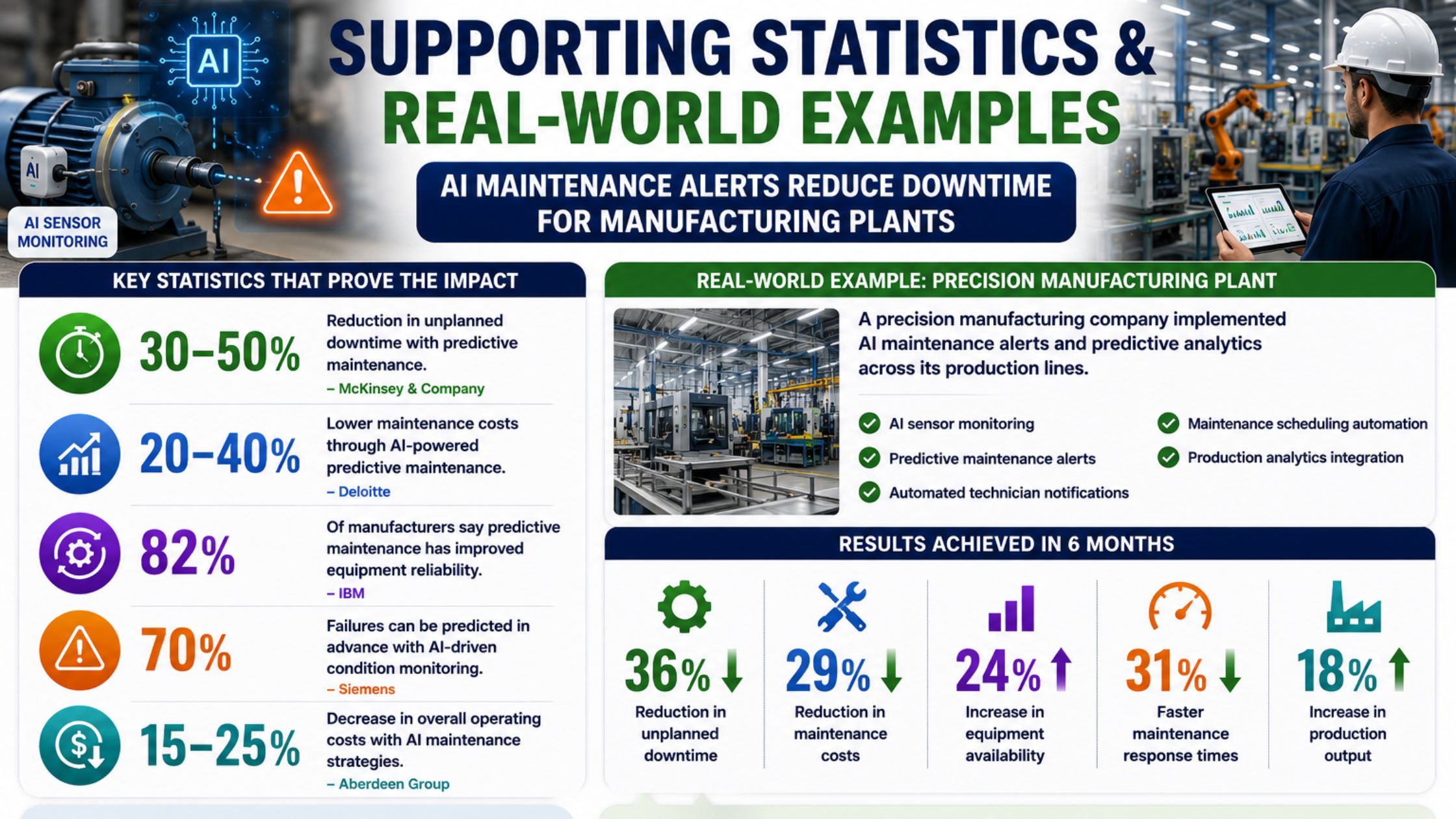
Key AI predictive maintenance benchmarks for manufacturers
Relevant industry benchmarks include:
- Predictive maintenance significantly reduces equipment downtime (McKinsey)
- AI-powered asset monitoring improves equipment reliability (IBM)
- Connected manufacturing improves operational visibility (Deloitte)
- Predictive maintenance lowers maintenance costs
- Early failure detection reduces production interruptions
These benchmarks demonstrate why AI maintenance alerts are becoming essential across modern manufacturing facilities.
Real-world manufacturing example
A precision manufacturing plant implemented:
- AI equipment monitoring
- Predictive maintenance alerts
- Automated technician notifications
- Maintenance scheduling automation
- Production analytics integration
Within six months, the company reported:
- 36% reduction in unplanned downtime
- 29% reduction in maintenance costs
- 24% increase in equipment availability
- 31% faster maintenance response times
- 18% increase in production output
Most importantly, the plant significantly reduced costly production interruptions while improving equipment reliability.
Why manufacturers struggle without predictive alerts
Many manufacturers continue relying on:
- Manual inspections
- Scheduled maintenance
- Operator observations
- Reactive repairs
These methods often fail to detect developing equipment problems early enough.
The result is:
- Unexpected breakdowns
- Expensive emergency repairs
- Production delays
- Lost revenue
AI maintenance alerts eliminate much of this uncertainty by identifying problems before failures occur.
Best manufacturing equipment to monitor first
Manufacturing plants often achieve the fastest ROI by monitoring:
Rotating equipment
- Motors
- Pumps
- Compressors
Production machinery
- CNC machines
- Presses
- Injection molding equipment
Material handling systems
- Conveyors
- Robotics
- Automated storage systems
Utility equipment
- HVAC systems
- Boilers
- Air compressors
These assets typically create the greatest operational impact when downtime occurs.
Conclusion
So, can AI maintenance alerts reduce downtime for manufacturing plants?
Absolutely.
They reduce downtime by continuously monitoring equipment, detecting failures before breakdowns occur, automating maintenance alerts, improving scheduling, optimizing spare parts planning, and helping maintenance teams act proactively rather than reactively.
The benefits are substantial:
- Lower unplanned downtime
- Higher equipment reliability
- Reduced maintenance costs
- Faster response times
- Increased production output
- Longer equipment life
Most importantly, AI maintenance alerts help manufacturers move from reactive maintenance to predictive operations, allowing production lines to run more efficiently and profitably.
For manufacturing plants seeking higher productivity and lower operating costs, AI-powered maintenance alerts are one of the most valuable operational investments available today.