Can AI scheduling optimize technician routes for pool maintenance companies when technicians may visit dozens of properties across different neighborhoods every day?
Route planning is one of the hidden operational challenges in pool service businesses. A technician might begin the morning with eight scheduled pools, only for a customer to reschedule, an urgent repair to appear, traffic to increase, or one maintenance visit to take longer than expected.
When routes are planned manually, small inefficiencies accumulate.
A technician may drive across town for one appointment, return to the same neighborhood later, lose time between jobs, arrive late, or finish the day with unused capacity that could have accommodated another customer.
The challenge becomes harder as the company grows from two technicians to five, ten, or twenty.
Field-service research shows why scheduling deserves attention. Salesforce reported in 2025 that inefficient scheduling is the number-one time drain for field-service teams, while skilled tradespeople and technicians lose nearly an entire workday each week to administrative work.
AI scheduling can help pool maintenance companies reduce this friction by analyzing technician locations, customer addresses, appointment windows, travel times, job durations, technician skills, workload, and changing conditions.
Instead of simply asking, “Which technician is available?”, the system can ask a more useful question:
Which technician can complete this job while creating the most efficient overall schedule?
Direct Answer
Yes. AI scheduling can optimize technician routes for pool maintenance companies by automatically assigning and sequencing service appointments according to location, travel time, technician availability, job requirements, customer time windows, and operational priorities.
Salesforce describes AI scheduling assistants as systems capable of evaluating thousands of scheduling possibilities while considering technician skills, availability, location, traffic, job priority, and customer preferences.
For a pool maintenance company, that could transform a route such as:
Office → Customer A → Customer D → Customer B → Customer E → Customer C
into:
Office → Customer A → Customer B → Customer C → Customer D → Customer E
if the second sequence reduces unnecessary driving while still respecting appointment requirements.
The benefit is not simply fewer miles.
Better routing can potentially create more productive technician hours, more predictable arrival windows, lower vehicle costs, and additional capacity for customer appointments.
Google’s vehicle-routing documentation describes the same optimization problem: determining efficient routes for multiple vehicles visiting different locations while accounting for constraints such as time windows and vehicle capacity.
Pool maintenance companies face a practical version of that problem every working day.
Step-by-Step Breakdown
1. Map every recurring pool-service location
Route optimization starts with accurate customer locations.
The scheduling system should maintain:
- Customer address
- Service frequency
- Preferred service day
- Appointment window
- Expected job duration
- Pool type
- Required service
- Technician requirements
- Equipment or chemical requirements
Once these properties are mapped, the system can identify geographic clusters.
Suppose a company services 200 pools across five neighborhoods.
Instead of assigning appointments primarily according to when customers joined the service, AI can group compatible recurring visits geographically.
Monday might focus on one territory, Tuesday on another, and Wednesday on a third.
This reduces unnecessary movement between distant areas.
2. Calculate realistic travel time between appointments
Straight-line distance is not enough.
Two homes may be five miles apart but require very different travel times depending on roads, congestion, time of day, and neighborhood access.
Modern field-service routing systems can incorporate actual travel-time calculations.
Salesforce explains that accurate routing improves scheduling because better travel-time predictions help mobile workers complete more jobs in less time while reducing travel costs and supporting timely arrivals.
AI scheduling can therefore build travel time directly into each technician’s day.
Instead of:
8 jobs × 45 minutes = 6 working hours
the system considers:
Job time + travel time + breaks + appointment constraints
That creates a schedule technicians can realistically complete.
3. Cluster recurring maintenance appointments geographically
Recurring pool maintenance gives companies an important scheduling advantage.
Unlike emergency repair businesses, many pool visits are predictable.
A customer might require service every Monday, every second Thursday, or once per month.
AI can analyze whether changing flexible service days would create more efficient geographic clusters.
Imagine Technician A currently services:
Monday: North, South, North, East
The system identifies that three South-area customers scheduled Tuesday could be moved within their permitted service windows.
The optimized schedule becomes:
Monday: North territory
Tuesday: South territory
The total number of customers remains the same, but the technician spends less time crossing service areas.
4. Match the right technician to each pool
Distance should not be the only scheduling factor.
Some appointments may involve routine cleaning, while others require pump troubleshooting, filtration work, chemical balancing, automation-system knowledge, or equipment repair.
The nearest technician may not always be the right technician.
AI scheduling can consider both location and capability.
Salesforce says intelligent field-service scheduling can match technicians to jobs according to factors including skills, location, availability, travel time, and service requirements.
For pool companies, this helps prevent a common inefficiency: sending one technician to diagnose a problem and then sending another technician later because the first person lacked the required skills or equipment.
5. Estimate job duration using historical data
Not every pool takes the same amount of time.
A small residential pool receiving weekly maintenance may require substantially less time than a large property with complex equipment.
AI can examine historical work orders to estimate realistic service duration.
For example:
Property A: Average visit 32 minutes
Property B: Average visit 51 minutes
Property C: Average visit 27 minutes
Scheduling every appointment as a generic 45-minute block would create unnecessary gaps in some places and delays in others.
More accurate job-duration estimates help build tighter but achievable schedules.
6. Reoptimize routes when customers cancel
Morning schedules rarely remain unchanged all day.
Suppose a technician has eight appointments and the fourth customer cancels.
Without dynamic scheduling, the technician may simply have a 60-minute gap.
AI can evaluate the remaining route and determine whether another nearby appointment can move into that opening.
Salesforce notes that AI scheduling can continuously adapt when appointments are canceled, delayed, completed early, or otherwise changed, allowing field-service teams to fill schedule gaps and maintain efficient routes.
For a pool company, this could turn lost time into productive capacity.
7. Insert urgent repair calls intelligently
Pool maintenance companies also receive unexpected service requests.
A customer’s pump stops working. A pool turns cloudy. Equipment begins leaking.
The dispatcher now has to determine which technician can respond without disrupting the entire day’s schedule.
AI can evaluate:
Technician A: 7 miles away, but fully booked.
Technician B: 10 miles away with a 90-minute opening.
Technician C: 4 miles away but lacks the required repair skill.
The system can recommend Technician B because that assignment creates the best operational outcome.
This is more useful than simply choosing whoever is geographically closest.
8. Account for technician supplies and equipment
Pool technicians carry chemicals, testing supplies, cleaning equipment, replacement components, and tools.
An optimized route loses value if the technician arrives without what the job requires.
Scheduling data can connect with inventory or vehicle-stock information.
If an appointment requires a replacement pump component, AI can prioritize a technician who already has the necessary part or incorporate a supply pickup into the route.
McKinsey describes how connected AI field-service use cases can reduce repeat visits by combining scheduling with parts prediction and ensuring necessary components are available before dispatch.
The principle applies directly to pool equipment service.
9. Reduce repeat visits
Sending technicians back to the same property unnecessarily increases cost.
Suppose a technician visits a pool, identifies a failing component, and leaves because the required part is unavailable.
A second trip is now necessary.
AI scheduling works best when connected with customer history, equipment records, work orders, and inventory information.
McKinsey reports that one industrial company used an AI-driven scheduling algorithm to reduce travel by minimizing the need to visit the same customer multiple times.
Pool companies can apply the same idea to pumps, filters, heaters, chlorinators, automation systems, and other equipment.
10. Optimize for the whole day, not the next appointment
Manual dispatching often focuses on the immediate decision.
“Who should take the next job?”
Route optimization considers the entire schedule.
Google’s Route Optimization API, for example, can optimize assignments and stop sequences according to objectives such as travel efficiency and on-time arrival while respecting constraints including working hours, capacity, and appointment time windows.
That distinction matters.
Assigning the nearest technician to every new request can create a worse overall route later.
AI can evaluate the downstream impact before changing the schedule.
11. Automatically notify customers when schedules change
Route optimization also affects customer communication.
If AI determines that a technician’s arrival time has changed, automation can update the customer.
For example:
“Your pool technician is expected between 1:30 PM and 2:00 PM.”
If traffic or an earlier job changes the estimate, the customer can receive an updated notification.
This reduces uncertainty and potentially reduces calls asking:
“When will the technician arrive?”
Salesforce’s 2025 field-service research found that 76% of mobile workers say customers want more from service organizations, while 72% say customers seem more rushed.
More accurate scheduling and proactive updates can help address those expectations.
Supporting Statistics and Real-World Examples
Several field-service benchmarks demonstrate why scheduling optimization matters.
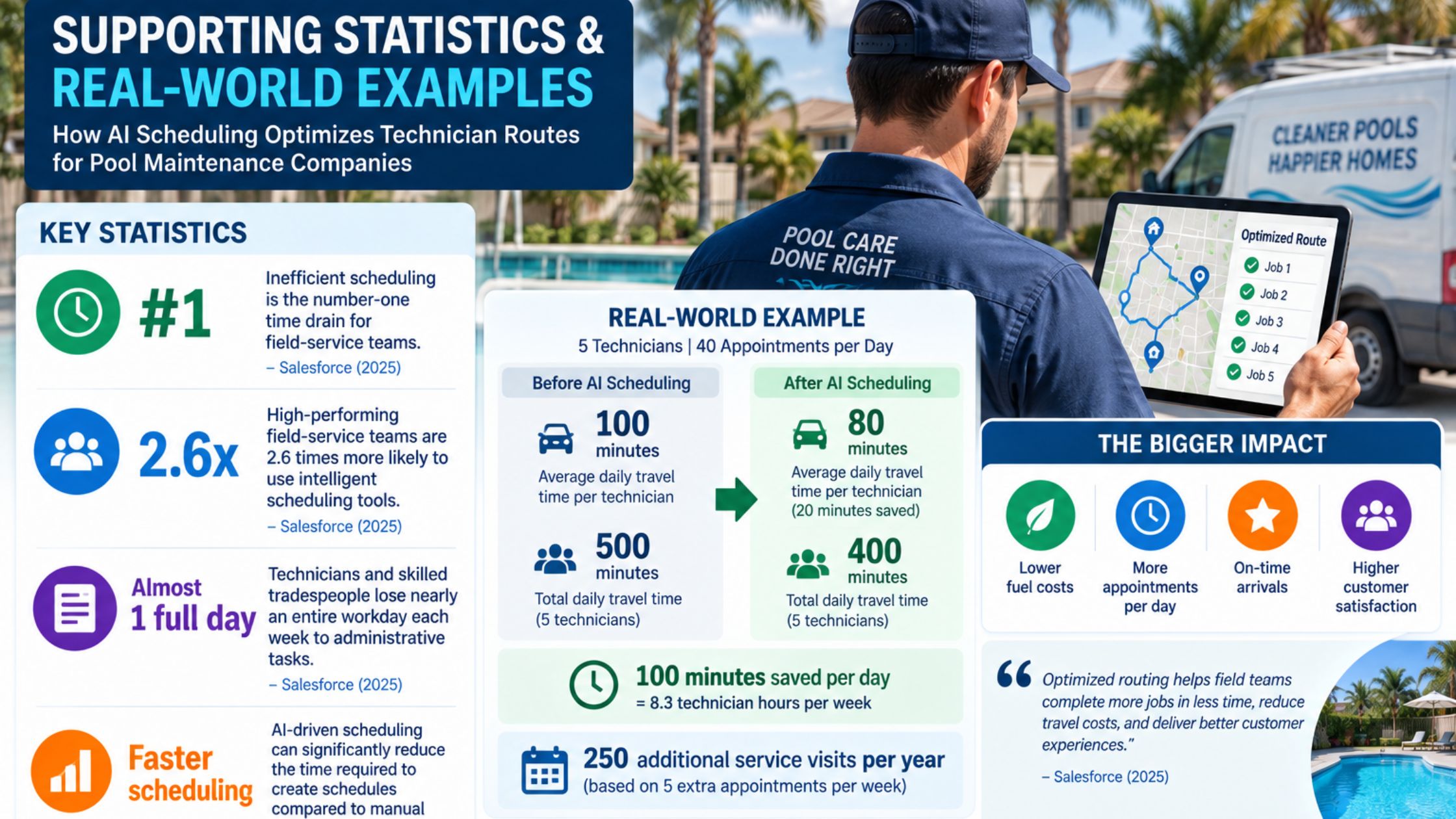
Salesforce reported that inefficient scheduling is the number-one time drain for field-service teams, while technicians can lose nearly an entire workday each week to administrative tasks.
Salesforce also reports that high-performing field-service teams are 2.6 times more likely to use intelligent scheduling tools. Its AI scheduling research describes systems that evaluate technician skills, availability, location, traffic, job urgency, and customer preferences when assigning work.
McKinsey’s research on smart workforce scheduling explains that AI-driven scheduling can reduce the time required to create schedules compared with spreadsheet-based approaches and respond more effectively to unexpected operational changes. For mobile field-service teams, route optimization can sequence assigned jobs to minimize overall travel time.
Google’s routing technology demonstrates the underlying optimization challenge. Vehicle-routing systems can optimize fleets across multiple destinations while incorporating constraints such as appointment time windows, driver working hours, vehicle capacity, and other business requirements.
These are general field-service and routing findings rather than pool-maintenance-specific performance guarantees. Actual savings depend on territory density, technician count, traffic, customer flexibility, job duration, and current routing efficiency.
Practical Pool Maintenance Example
Consider a pool maintenance company with five technicians.
Each technician completes approximately eight appointments per day, producing:
5 technicians × 8 visits = 40 daily appointments
Suppose each technician currently spends an average of 100 minutes per day driving between jobs.
Across five technicians:
100 minutes × 5 = 500 minutes of daily travel
That equals approximately 8.3 technician hours per day spent traveling.
Now suppose AI scheduling clusters appointments geographically and improves stop sequencing enough to reduce average travel by 20 minutes per technician.
The company saves:
20 minutes × 5 technicians = 100 minutes per day
Across a five-day workweek:
100 × 5 = 500 minutes
That equals approximately 8.3 technician hours recovered per week.
If operational conditions allow that recovered capacity to support one additional service appointment per technician each week, the business could potentially complete:
5 additional appointments per week
Across 50 working weeks:
5 × 50 = 250 additional service visits per year
These figures are illustrative, not an industry benchmark. Actual results will vary based on route density, service duration, technician skills, customer time windows, traffic, cancellations, and existing scheduling efficiency.
The important point is that the company did not hire another technician.
It created additional capacity by reducing unproductive travel.
Quick Tactical Setup for Pool Maintenance Companies
Start by mapping every recurring customer, technician starting location, normal service duration, required skills, and preferred service window.
Next, divide the service territory into geographic clusters and compare current routes with geographically optimized alternatives.
Connect scheduling with customer records, work orders, technician skills, equipment history, and vehicle inventory where practical.
Allow the system to reoptimize when cancellations, urgent calls, delays, or early completions occur.
Track five metrics: travel time per technician, miles per service visit, appointments completed per day, on-time arrival rate, and repeat-visit rate.
Salesforce recommends defining measurable scheduling goals before implementing optimization, such as minimizing travel time or reducing cost to serve.
Start with one goal and one territory. Once the results are measurable, expand the workflow.
Conclusion
Can AI scheduling optimize technician routes for pool maintenance companies?
Yes.
AI can evaluate customer locations, technician availability, skills, travel time, job duration, appointment windows, equipment requirements, cancellations, urgent calls, and changing conditions to build more efficient daily routes.
That can help pool maintenance businesses achieve:
- Less technician driving
- Better geographic route density
- More realistic schedules
- Faster response to urgent calls
- Fewer unnecessary repeat visits
- Better technician utilization
- More accurate arrival windows
- More appointments within existing capacity
- Lower administrative workload
- Better customer communication
The objective is not simply to find the shortest road between two pools.
It is to build the most efficient working day for every technician.
For pool maintenance companies managing dozens or hundreds of recurring properties, improving a few minutes between appointments can compound into hours of recovered capacity across the week.
AI scheduling turns those small route improvements into a repeatable operating system rather than leaving them dependent on a dispatcher manually rearranging the calendar every morning.