How can AI reorder reminders increase sales for pet groomers without requiring staff to constantly call previous customers and ask them to book again?
Pet grooming is naturally a repeat-purchase business. Dogs and cats that need bathing, nail trimming, coat maintenance, deshedding, ear cleaning, or breed-specific grooming rarely need those services only once. The real revenue opportunity comes from bringing satisfied customers back at the right interval.
Yet many grooming businesses leave repeat bookings to chance. A customer completes an appointment, pays, leaves, and receives little or no communication until they decide their pet needs another groom. By that point, they may book with another groomer, forget their preferred schedule, or wait much longer than recommended.
The opportunity is significant. The American Pet Products Association reported that U.S. pet industry expenditures reached $152 billion in 2024 and projected $157 billion for 2025, showing the scale of ongoing consumer spending around pets.
AI reorder reminders help groomers convert that recurring need into a predictable retention workflow. Instead of sending the same generic reminder to every customer, AI can use appointment history, pet characteristics, previous services, and engagement behavior to determine when and how to encourage the next booking.
Direct Answer
AI reorder reminders can increase sales for pet groomers by identifying when individual pets are likely to need their next service and automatically contacting their owners with a timely, personalized rebooking message.
The system can use information such as:
- Previous grooming date
- Service purchased
- Typical booking interval
- Breed or coat requirements
- Customer booking history
- Preferred groomer
- Previous response behavior
For example, a customer who normally books a full groom every six weeks could automatically receive a reminder around week five rather than waiting until they remember.
The reminder can also contain a direct booking link, allowing the customer to schedule immediately.
This helps pet groomers increase repeat bookings, improve customer retention, maintain fuller calendars, and generate more revenue from customers they have already acquired.
Step-by-Step Breakdown
1. AI identifies each pet’s normal grooming cycle
A basic reminder system might send every customer the same message 30 days after an appointment.
AI can make the timing more relevant.
Different pets may have very different grooming needs. A long-haired dog receiving a full groom every six weeks should not necessarily receive the same sequence as a short-haired dog visiting periodically for nail trimming.
An AI-enabled CRM can analyze:
- Time between previous appointments
- Service frequency
- Seasonal booking patterns
- Pet-specific information
- Customer scheduling habits
The system can then estimate the appropriate time for another reminder.
This turns historical booking data into a repeat-sales tool.
2. Reminders arrive before customers start shopping again
Timing matters because groomers are not only competing when a customer initially discovers their business.
They compete again every time the customer needs another appointment.
If a pet owner realizes on Monday that their dog needs grooming, they may search Google, check nearby availability, or ask friends for recommendations, even if they previously visited your business.
A proactive reminder changes the sequence.
Instead of waiting for the customer to recognize the need, the groomer reaches them first:
“Bella may be due for her next full groom soon. Would you like to reserve her usual appointment?”
The message reconnects the existing relationship before the customer begins comparing alternatives.
Research from McKinsey & Company found that 71% of consumers expect personalized interactions and 76% become frustrated when they do not receive them.
A relevant reminder therefore has an advantage over a generic promotional message.
3. AI personalizes the reminder around the pet
Pet businesses have a valuable personalization opportunity: the service revolves around an individual animal that the customer cares deeply about.
Compare these messages:
“Book your next grooming appointment today.”
versus:
“It’s almost time for Milo’s next deshedding appointment. His usual six-week window is coming up. Reserve a time here.”
The second message communicates that the business remembers the customer, the pet, and the previous service.
AI can automatically populate:
- Pet name
- Service type
- Previous groomer
- Last appointment
- Suggested next service
- Preferred branch
This level of personalization would be time-consuming if employees had to create every reminder manually.
4. Direct booking links shorten the path to purchase
A reminder can successfully create interest and still fail to generate a sale if booking is inconvenient.
Suppose a pet owner receives a reminder while at work.
If they need to remember to call the groomer later, the booking can easily be forgotten.
Instead, the reminder should provide a direct route to available appointments.
The workflow becomes:
Reminder → View availability → Select time → Confirm appointment
Reducing unnecessary steps makes it easier for existing customers to act immediately.
This principle is especially valuable on mobile devices, where pet owners may interact with SMS, WhatsApp, or email reminders while away from a computer.
5. AI can recommend relevant add-on services
Reorder reminders do not have to promote only the previous service.
AI can use customer and pet history to identify relevant additions.
For example:
Previous booking: Full groom
Suggested addition: Nail grinding
Previous booking: Bath and brush
Suggested addition: Deshedding treatment
Previous booking: Regular groom
Suggested addition: Teeth cleaning
The recommendation should remain relevant rather than turning every reminder into an aggressive upsell.
When used carefully, these suggestions can increase average booking value while making the appointment more convenient for the pet owner.
6. Different customers can receive different reminder sequences
Some customers book immediately after one reminder.
Others need more time.
AI workflows can adapt based on behavior.
For example:
Week 5: Initial grooming reminder.
Week 6: Second reminder if no booking occurs.
Week 7: Availability-focused message.
Week 8: Re-engagement message if the customer remains inactive.
Once the customer books, the sequence automatically stops.
The system can also detect whether someone opened a message, clicked the booking link, or repeatedly ignored communications.
This prevents employees from manually tracking every customer’s follow-up status.
7. AI helps recover customers who stop returning
One of the most valuable applications of reorder automation is identifying customers whose normal booking pattern has changed.
Imagine a customer historically books every six weeks.
Their appointment history looks like:
January → February → April → May → July
If September arrives without another appointment, the system can flag the account as potentially lapsing.
A different message can then be triggered:
“We haven’t seen Luna recently. If she’s ready for her next groom, you can check available appointments here.”
This is different from ordinary advertising because the customer already knows the business.
The goal is reactivation rather than acquisition.
Keeping existing customers engaged matters financially because acquiring replacement customers requires additional advertising and marketing expenditure.
8. AI can select the best communication channel
Not every pet owner responds to the same channel.
Some customers may regularly interact with SMS messages, while others engage through email or WhatsApp.
An automated system can track response patterns and use the most effective channel.
A workflow could prioritize:
- SMS for short booking reminders
- Email for longer grooming recommendations
- WhatsApp for conversational rebooking
- Push notifications for customers using a booking app
This improves the likelihood that reminders are actually noticed.
9. Reorder reminders make demand more predictable
AI reminders do more than generate individual bookings.
They can help grooming businesses smooth future demand.
Without proactive rebooking, the calendar may become uneven:
This week: Fully booked
Next week: Several empty slots
Following week: Overbooked again
Automated reminders can target customers whose estimated grooming cycle corresponds with quieter periods.
For example, if Tuesday afternoon has open capacity, the business could prioritize suitable customers who are already approaching their next expected appointment.
This allows marketing automation to support operational scheduling rather than simply sending promotions.
Supporting Statistics and Real-World Examples
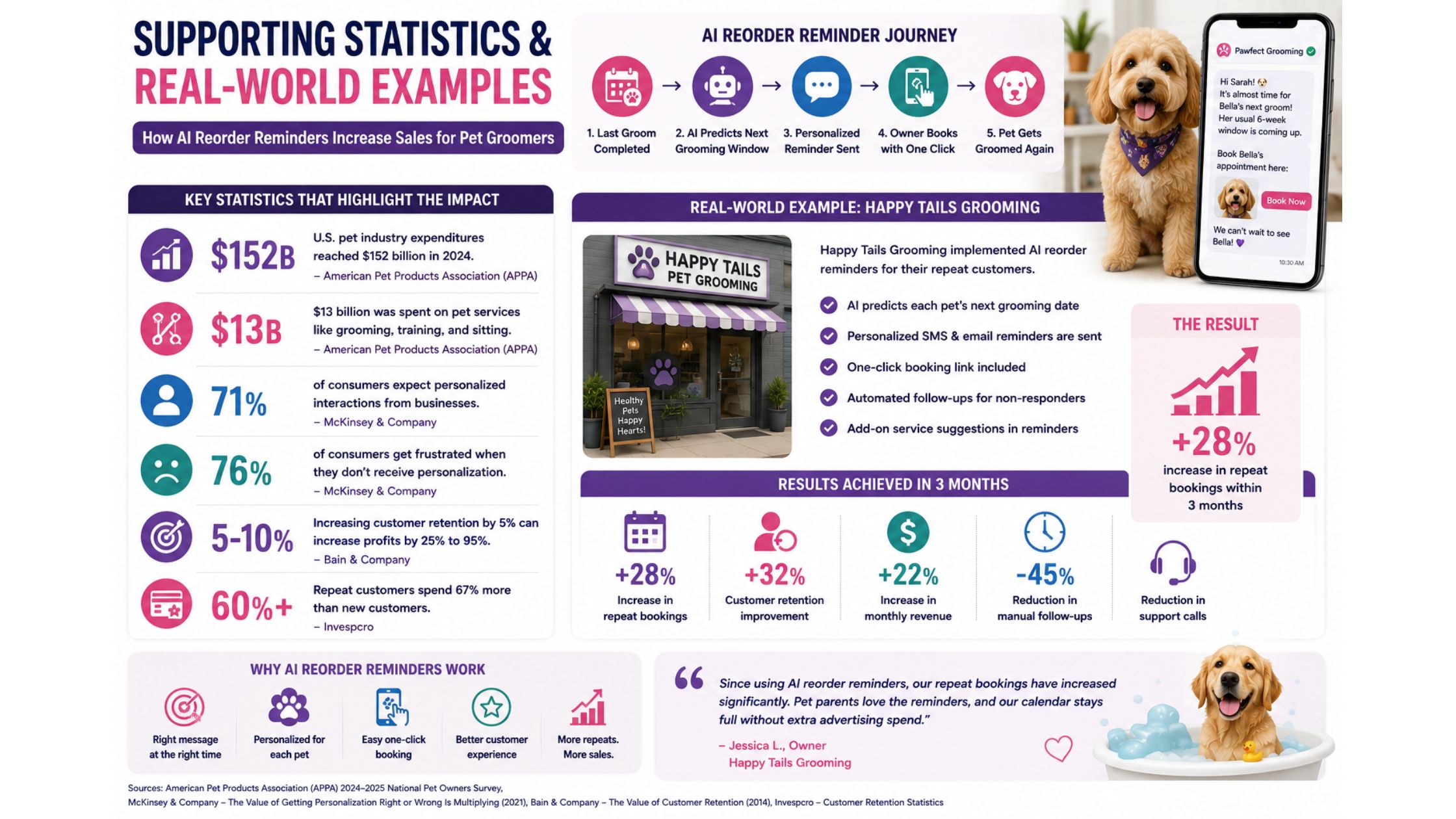
Pet ownership represents a large recurring consumer market. APPA reported $152 billion in U.S. pet industry expenditures in 2024, with $13 billion attributed to services such as grooming, training, pet sitting, walking, and other non-veterinary services.
Personalization also matters when businesses communicate with existing customers. McKinsey found that 71% of consumers expect personalized interactions, while 76% report frustration when businesses fail to provide them. The same research notes that effective personalization can contribute to meaningful revenue improvements.
These trends support a simple strategy for groomers: use existing customer data to make the next booking easier and more relevant.
Practical Pet Grooming Example
Consider a grooming salon serving 500 unique customers who have previously booked services.
Suppose 200 of those customers are expected to return during the next two months based on their historical grooming intervals.
Without automated reminders, assume 120 proactively rebook.
That produces a 60% repeat-booking rate within this illustrative scenario.
The groomer introduces AI reorder reminders that:
- Predict each customer’s next likely grooming window.
- Send a personalized message before that date.
- Include the pet’s name and previous service.
- Provide an immediate booking link.
- Follow up once if the customer does not book.
If another 30 customers return because of the workflow, repeat appointments increase from 120 to 150.
At an average appointment value of $75, those additional bookings would represent:
30 × $75 = $2,250 in additional repeat revenue
If similar results occurred across six two-month cycles, that would equal $13,500 in additional annual revenue.
These numbers are illustrative rather than an industry benchmark, but they show why even modest improvements in rebooking can materially affect a grooming business.
Best Reorder Reminders for Pet Groomers to Automate First
Groomers should begin with services that naturally have predictable repeat cycles.
Full grooming
Use the pet’s previous interval to suggest the next appointment before coat maintenance becomes overdue.
Bath and brush
Remind recurring customers when they approach their typical bathing schedule.
Nail trimming
Shorter service cycles make nail appointments particularly suitable for automated reminders.
Deshedding treatments
Use historical and seasonal behavior to trigger timely follow-ups.
Regular maintenance packages
Customers who repeatedly purchase multiple services can receive reminders encouraging them to reserve the same package again.
The goal is not to bombard customers with promotions. It is to identify genuine recurring needs and make acting on them easier.
Conclusion
So, how can AI reorder reminders increase sales for pet groomers?
They turn historical appointment data into timely opportunities for repeat business.
AI can estimate when a pet is likely to need another groom, personalize communication around that pet and service, send the reminder through the appropriate channel, provide an immediate booking path, and follow up automatically when necessary.
For pet groomers, this can produce:
- More repeat appointments
- Higher customer retention
- Fewer forgotten rebookings
- More relevant add-on opportunities
- Better calendar utilization
- More predictable recurring revenue
Most importantly, the strategy does not depend on continuously buying more leads.
The groomer already paid to acquire the customer, delivered the service, and established the relationship.
AI reorder reminders simply help ensure that when the pet needs grooming again, the existing customer remembers exactly where to book.