How can AI order updates reduce support calls for florists when customers naturally want reassurance that important flowers will arrive at the right place and time?
Flower orders are different from many ordinary e-commerce purchases. Customers frequently order arrangements for birthdays, anniversaries, weddings, funerals, graduations, Valentine’s Day, Mother’s Day, and other time-sensitive occasions. A delivery that arrives several hours late can significantly affect the customer’s experience.
That creates a predictable stream of questions for florist teams:
- Did you receive my order?
- Has my arrangement been prepared?
- Is it out for delivery?
- What time will it arrive?
- Has it been delivered?
- Can I change the delivery address?
Most of these questions do not require a florist or customer service employee to solve a complex problem. Customers simply need information.
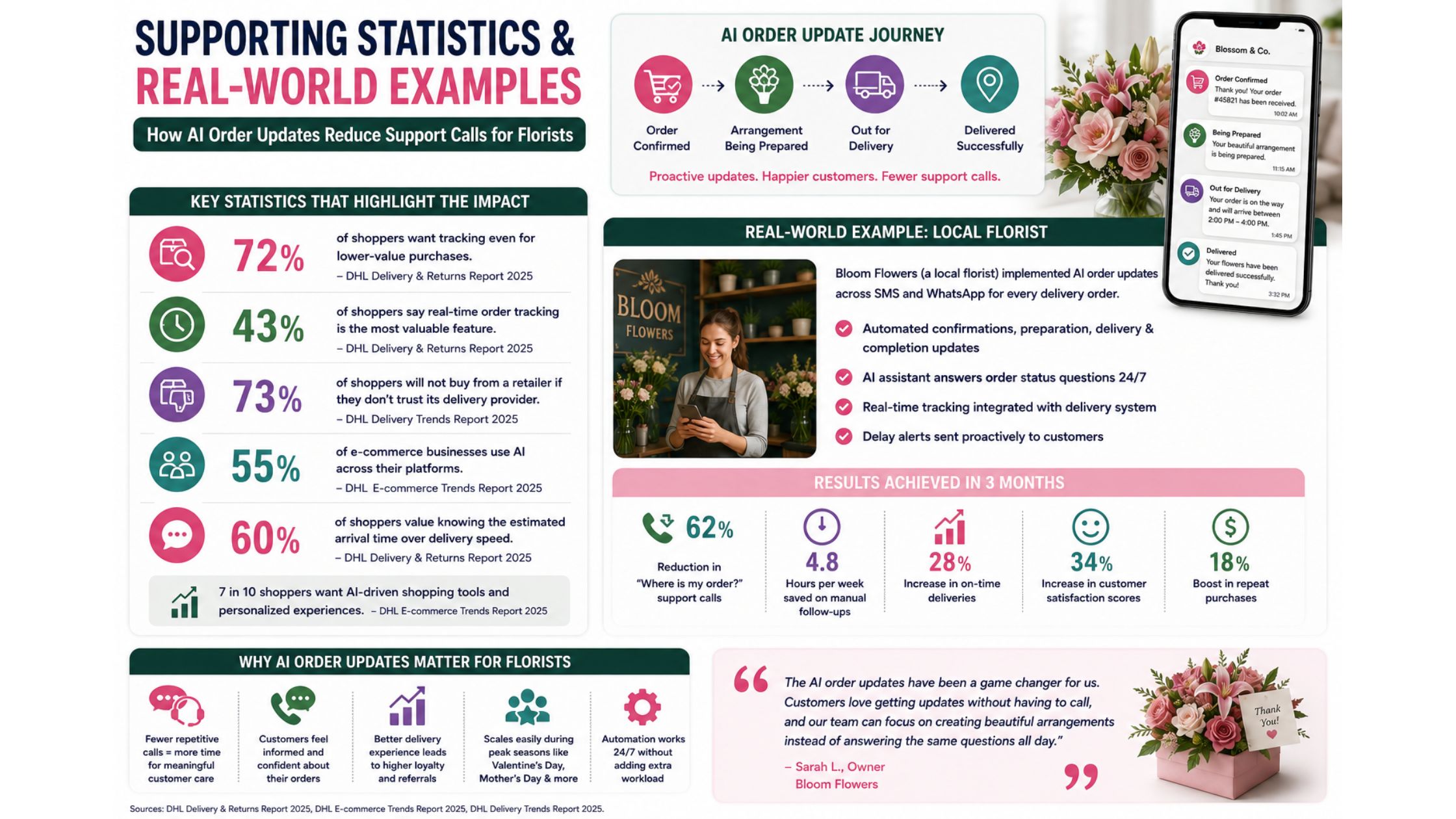
Delivery transparency has become a broader e-commerce expectation. DHL’s delivery and returns research found that 72% of shoppers want tracking even for lower-value purchases, while 60% value knowing the estimated arrival time over delivery speed itself.
AI-powered order updates allow florists to proactively provide this information before customers need to call.
Direct Answer
AI order updates can reduce support calls for florists by automatically sending customers timely information whenever their order moves through important stages, from confirmation and preparation to dispatch and successful delivery.
Instead of requiring customers to contact the flower shop for updates, an automated system can send SMS, email, WhatsApp, or app notifications such as:
Order confirmed → Arrangement being prepared → Out for delivery → Delivery completed
AI can also answer routine order-status questions automatically by retrieving current information from the florist’s order management or delivery system.
For florists, this means fewer repetitive calls, less pressure on front-desk staff, better delivery transparency, and more time to focus on preparing arrangements and resolving genuine customer issues.
Step-by-Step Breakdown
1. Send an instant order confirmation
Customer uncertainty can begin immediately after checkout.
Someone ordering flowers for an important occasion wants to know that the florist actually received the request.
An automated confirmation can immediately provide:
- Order number
- Arrangement ordered
- Recipient name
- Delivery address
- Requested delivery date
- Customer contact information
If anything is incorrect, customers can identify the problem early rather than discovering it shortly before delivery.
This first notification also eliminates a simple but common reason for contacting the shop: confirming whether the order went through successfully.
2. Automatically communicate preparation status
A florist’s order passes through several operational stages before reaching the recipient.
The workflow might look like:
Order received → Flowers allocated → Arrangement prepared → Driver assigned → Out for delivery → Delivered
AI automation can connect these internal stages with customer-facing notifications.
For example, when the florist marks an arrangement as completed, the customer could automatically receive:
“Your arrangement has been prepared and is scheduled for delivery today.”
Customers no longer need to call to check whether their order is progressing.
The business becomes proactive rather than reactive.
3. Provide delivery tracking before customers ask
Delivery is often the stage that generates the greatest uncertainty.
This matters because delivery quality directly influences purchasing decisions. DHL’s 2025 global e-commerce research, based on 24,000 shoppers across 24 markets, found that 81% would abandon a purchase if their preferred delivery option was unavailable.
DHL also reports that 73% of global shoppers will not buy from an online retailer if they do not trust its delivery provider.
For florists, proactive delivery updates can include:
- Driver assigned
- Order dispatched
- Estimated delivery window
- Delivery completed
- Delivery problem detected
The customer receives information automatically rather than contacting the shop.
4. AI can answer “Where is my order?” automatically
Some customers will still ask questions despite receiving notifications.
That does not mean employees need to answer every question manually.
An AI chatbot or messaging assistant can identify order-status requests and retrieve information using:
- Order number
- Phone number
- Email address
- Customer name
A customer might ask:
“Where are the flowers I ordered for Sarah?”
The system can identify the relevant order and respond with the current status.
If the issue is straightforward, no employee intervention is necessary.
If something unusual has occurred, AI can escalate the conversation to a staff member.
This creates a useful division of work: automation handles routine questions while employees handle exceptions.
5. AI personalizes updates to the specific order
Generic notifications are useful, but contextual updates are better.
An AI system can customize messages using information already attached to the transaction.
For example:
“Your anniversary arrangement for Emma is now out for delivery and is expected between 2:00 PM and 4:00 PM.”
This tells the customer:
- Which order is being discussed
- Who is receiving it
- Current status
- Expected timing
The customer gets the information they were most likely to call about in one message.
Personalization is increasingly common in digital commerce. DHL’s 2025 business research found that 55% of global e-commerce businesses use AI across their platforms.
6. Automated alerts can explain delays proactively
Automation is especially valuable when something goes wrong.
Imagine a driver is delayed because of traffic.
Without an automated update, the customer watches the expected delivery time pass and calls the florist.
The employee then has to:
- Find the order.
- Contact the driver.
- Determine the delay.
- Explain it to the customer.
With connected order tracking, the customer can receive a proactive notification explaining that delivery is delayed and providing a revised estimate.
DHL reports that 52% of global shoppers identify long delivery times as a frustration, up from 46% in 2024.
Customers may tolerate a delay more easily when they know what is happening.
Silence creates uncertainty. Updates create visibility.
7. Delivery confirmation eliminates another common call
Florists frequently deliver gifts directly to someone other than the person who placed the order.
That means the purchaser may have no way of knowing whether the flowers arrived.
An automated delivery confirmation solves this problem.
Once the driver marks the delivery complete, the customer can receive:
“Your flower delivery has been completed successfully.”
Depending on the florist’s system and customer consent, the confirmation could also include:
- Delivery time
- Recipient confirmation
- Driver notes
- Delivery photograph
The customer receives closure without calling the shop.
8. AI identifies which inquiries still require humans
The goal of automation should not be to prevent customers from reaching people.
It should prevent employees from spending valuable time answering questions that software can answer accurately.
AI can categorize incoming requests into two groups.
Routine requests
- Order status
- Delivery estimate
- Confirmation request
- Delivery completion
These can often be automated.
Complex requests
- Wrong arrangement
- Damaged flowers
- Recipient unavailable
- Address correction
- Refund request
- Special delivery instructions
These should be escalated to staff.
This approach can make support more efficient because employees have more time for customers who genuinely need assistance.
9. AI updates are especially useful during peak florist periods
Order-status automation becomes even more valuable during high-volume periods such as:
- Valentine’s Day
- Mother’s Day
- Christmas
- Graduation season
- Wedding season
A florist might process several times its normal order volume while receiving a corresponding increase in calls.
Hiring temporary support employees solely to answer delivery-status questions increases operating costs.
Automated updates allow communication capacity to scale alongside order volume.
If the florist processes 500 Valentine’s Day orders, automation can send 500 order confirmations and hundreds of delivery updates without requiring employees to make hundreds of individual calls.
Supporting Statistics and Real-World Examples
The wider e-commerce data strongly supports greater delivery transparency.
DHL’s research found that 72% of shoppers want tracking even for lower-value products, while 43% specifically value real-time order tracking.
Its 2025 research also found that 52% of global shoppers want faster delivery, while delivery and returns remain major factors influencing online purchasing behavior.
The importance of delivery transparency becomes even clearer in specific shopper groups. DHL reports that 88% of cross-border shoppers want end-to-end tracking.
AI adoption is also becoming mainstream in e-commerce. DHL reports that 55% of global e-commerce businesses use AI across their platforms, while its consumer study found that seven in ten shoppers want AI-driven shopping tools.
Practical Florist Example
Consider a local florist processing 600 delivery orders per month.
Suppose 15% of those orders generate a status-related call or message.
That creates:
600 × 15% = 90 support inquiries per month
If each inquiry requires an average of five minutes to investigate and answer, staff spend:
90 × 5 minutes = 450 minutes
That equals 7.5 hours every month answering basic order-status questions.
Now suppose automated confirmations, preparation notifications, delivery updates, and completion messages prevent 60 of those inquiries.
The florist saves approximately:
60 × 5 minutes = 300 minutes
That’s five hours of staff time per month that can instead be spent preparing arrangements, serving in-store customers, coordinating deliveries, or handling more complicated service issues.
These figures are illustrative rather than an industry benchmark, but they show why reducing repetitive order-status contacts can create meaningful operational value.
Best Florist Order Updates to Automate First
Florists do not need to automate everything immediately. The highest-value starting points are usually the moments that create the most customer uncertainty.
Order Confirmation: Immediately reassure customers that their purchase has been successfully received.
Preparation Update: Tell customers that their arrangement is being created or has been completed.
Out-for-Delivery Notification: Confirm that flowers have left the store and provide an estimated delivery window.
Delay Notification: Inform customers proactively when the original delivery estimate changes.
Delivery Confirmation: Let the purchaser know that the flowers reached their destination.
These five updates can address a large percentage of routine order-status questions before they become support requests.
Conclusion
So, how can AI order updates reduce support calls for florists?
AI reduces repetitive inquiries by giving customers the information they need before they have to ask for it.
Order confirmations eliminate uncertainty after checkout. Preparation notifications show progress. Real-time delivery updates answer “Where are my flowers?” questions. Delay alerts prevent customers from wondering what went wrong. Delivery confirmations provide reassurance that an important gift reached its recipient.
The benefits extend beyond fewer phone calls:
- Less repetitive administrative work
- Better delivery transparency
- Faster customer support
- More scalable peak-season operations
- Greater customer confidence
- More staff time for complex issues
For florists, AI order updates are not simply another customer service feature.
They turn order communication from a reactive process into a proactive one.
When customers automatically know what is happening with their flowers, they have fewer reasons to call the shop, while staff have more time to focus on the work that actually requires a human touch.