How can AI waitlist automation fill cancellations for salons before an empty appointment slot turns into lost revenue?
For hair salons, nail studios, spas, barbershops, and other appointment-based beauty businesses, a last-minute cancellation creates an immediate inventory problem. A stylist’s 2:00 PM slot cannot be stored and sold tomorrow. Once that hour passes, the revenue opportunity disappears.
The traditional solution is a manual waitlist. A receptionist sees the cancellation, checks a spreadsheet or booking system, calls several clients, sends a few texts, waits for replies, and eventually finds someone who can take the appointment. By then, the available slot may be only an hour away.
The financial impact can add up quickly. A 2024 Wall Street Journal report noted that salons and other appointment-based businesses have increasingly adopted technology, reminders, payment details, and cancellation policies to reduce losses from missed appointments. It also cited platform data showing meaningful reductions in cancellations and no-shows among barbershops using stronger digital booking processes.
AI waitlist automation attacks the problem from another direction: when someone cancels, the system immediately finds suitable clients, contacts them, manages responses, and books the first qualified customer who accepts.
That turns a cancellation from a likely revenue loss into another booking opportunity.
Direct Answer
Yes. AI waitlist automation can help salons fill cancellations by matching newly available appointments with clients who have already expressed interest in earlier or specific time slots.
Instead of requiring staff to contact the waitlist manually, automation can evaluate factors such as:
- Requested service
- Preferred stylist
- Appointment duration
- Client availability
- Previous booking behavior
- Preferred communication channel
- How recently the client joined the waitlist
The system can then contact suitable clients by SMS, email, or app notification and allow them to claim the appointment immediately.
The key advantage is speed. A cancellation at 10:15 AM can potentially be offered to suitable clients at 10:16 AM rather than sitting unnoticed until a receptionist has time to manage it.
For salons operating with tight schedules and high-value services, recovering even a small number of canceled appointments each week can materially improve chair utilization and revenue.
Step-by-Step Breakdown
1. AI creates a smarter salon waitlist
A traditional waitlist is usually little more than a list of names and phone numbers.
AI can make the list actionable.
When clients cannot find their preferred appointment, the booking system can collect details such as:
- Desired service
- Preferred dates
- Preferred times
- Stylist preference
- Acceptable alternative stylists
- Notice required before an appointment
That information creates a pool of customers who have already demonstrated booking intent.
When a matching appointment opens, the salon does not have to start searching for a new customer. It already has a group of interested clients ready to contact.
2. Cancellations automatically trigger the workflow
Speed matters most when a cancellation occurs close to the appointment time.
Without automation, staff may need to notice the cancellation, find appropriate customers, contact them individually, and manually update the schedule.
With an automated workflow, cancellation itself becomes the trigger.
For example:
2:00 PM: Client cancels a 5:00 PM haircut.
2:01 PM: The system identifies five waitlisted customers who want that service.
2:02 PM: Eligible customers receive availability notifications.
2:06 PM: One client accepts.
2:07 PM: The appointment is confirmed and removed from availability.
The entire process can occur while front-desk employees continue serving customers.
3. AI matches clients to the correct appointment
Sending every cancellation to every waitlisted client would quickly become annoying.
Instead, AI can filter the audience before sending an alert.
Suppose a two-hour balayage appointment becomes available.
A useful matching workflow could check:
- Who wants balayage?
- Who is available that afternoon?
- Who accepts that stylist?
- Who can arrive with sufficient notice?
- Who has recently requested an earlier appointment?
Only suitable customers receive the offer.
This makes notifications more relevant and increases the chance that someone will accept.
Personalization also matters beyond scheduling. McKinsey’s personalization research found that 71% of consumers expect personalized interactions, while 76% become frustrated when personalization does not happen.
4. Automated SMS alerts accelerate responses
Email can work for appointments several days away, but same-day cancellations require faster communication.
SMS is particularly useful because the customer can immediately see the opening and respond.
A message could say:
“An earlier haircut appointment with Maya is available today at 4:30 PM. Reply YES to claim it.”
The principle behind reminders and timely messaging is supported by broader appointment research. A meta-analysis of 28 studies found that SMS reminders improved appointment attendance, with randomized controlled trials producing a pooled odds ratio of 1.62.
Another systematic review found consistent evidence that reminder systems improve attendance and can also encourage people to cancel or reschedule unwanted appointments earlier.
For salons, earlier notice creates something especially valuable: more time to refill the appointment.
5. Clients can claim openings without calling the salon
Finding an interested customer is only half the process.
The booking experience also needs to be fast.
If the customer receives an alert but must call the salon, wait on hold, explain the notification, and ask whether the slot remains available, the opportunity can disappear.
AI waitlist automation can provide a direct booking action.
The customer taps the notification, confirms the appointment, and receives an updated booking confirmation.
Once someone claims the slot, the system automatically stops offering it to other clients.
This creates urgency without requiring staff to coordinate multiple conversations.
6. AI can prioritize the most likely customers first
Not every waitlisted client has the same probability of accepting.
AI can use historical booking data to prioritize clients based on factors such as:
- Previous same-day bookings
- Typical appointment times
- Service history
- Stylist preferences
- Response history
- Distance or branch preference
For example, a customer who regularly books Thursday evenings and has requested an earlier Thursday appointment should rank above someone who normally visits on Saturday mornings.
This improves the quality of the first batch of notifications.
If nobody responds, the system can automatically expand the offer to another group.
7. Automated confirmations reduce secondary no-shows
Filling the cancellation is not enough if the replacement customer also fails to attend.
Once the appointment is claimed, the same system can immediately send:
- Booking confirmation
- Appointment time
- Salon location
- Stylist details
- Cancellation policy
- Preparation instructions
Research into appointment scheduling consistently identifies no-shows as a major source of wasted capacity. One systematic literature review covering 105 studies found an average no-show rate of approximately 23% across the healthcare appointment literature, although rates varied substantially by setting.
That is not a salon-specific benchmark, but it illustrates why appointment-based businesses benefit from combining waitlist filling with confirmations and reminders rather than treating them as separate workflows.
8. AI waitlists reduce front-desk workload
Without automation, filling one canceled appointment might involve contacting five or ten people.
Multiply that across several stylists and multiple cancellations per week, and waitlist management becomes a substantial administrative task.
Automation can handle:
- Detecting openings
- Searching the waitlist
- Matching customers
- Sending notifications
- Processing responses
- Updating appointments
- Sending confirmations
Staff only need to intervene when a customer has a special request.
This allows reception teams to spend more time serving customers currently inside the salon rather than repeatedly calling people who may not answer.
9. AI provides data on why appointment gaps occur
Waitlist automation also creates useful operational data.
Salon owners can monitor:
- Cancellation rates by service
- Most common cancellation times
- Average time required to refill a slot
- Waitlist acceptance rates
- Revenue recovered
- Stylists with highest waitlist demand
- Services with unmet demand
This information can influence staffing and scheduling decisions.
If Saturday color appointments consistently have a long waitlist, the salon may need additional capacity. If Tuesday afternoons repeatedly remain empty, the salon could test promotions or adjust staffing.
AI therefore does more than fill individual cancellations. It helps salons understand demand patterns.
Supporting Statistics and Real-World Examples
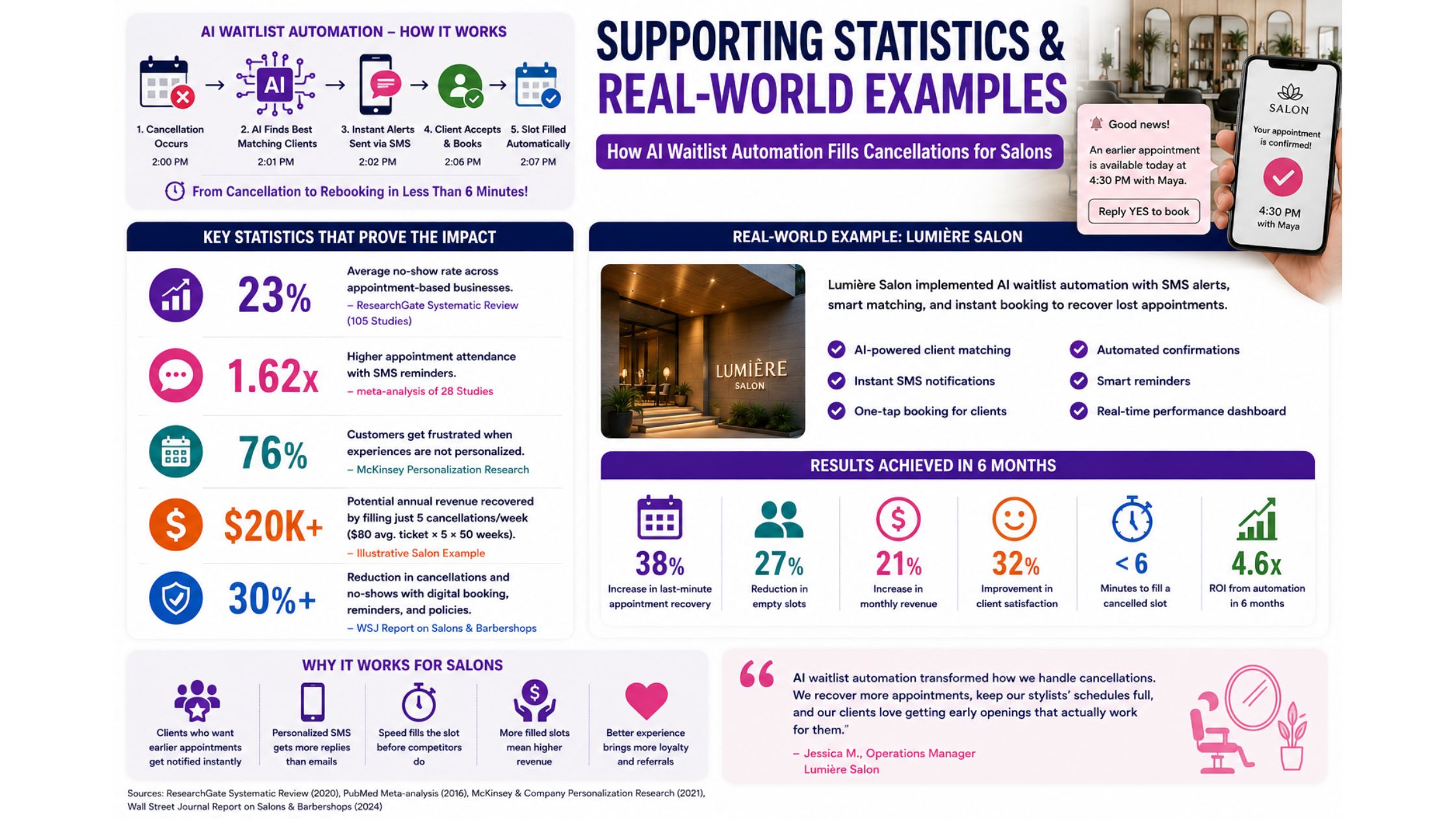
Research from appointment-based industries provides useful evidence for the mechanisms behind salon waitlist automation.
A meta-analysis found SMS reminders increased appointment attendance, while broader evidence reviews concluded reminder systems consistently improve attendance.
A 2024 report on appointment businesses also highlighted how digital booking tools, automated reminders, stored payment information, and cancellation policies are increasingly being used by salons and barbershops to control the financial impact of missed appointments.
Consider a salon with eight stylists that experiences ten late cancellations during an average week.
If the average canceled appointment is worth $80, that represents:
10 cancellations × $80 = $800 in appointment capacity at risk each week.
If automated waitlist workflows refill even five of those appointments, the salon recovers approximately:
5 appointments × $80 = $400 per week.
Across 50 operating weeks, that would represent roughly $20,000 in recovered appointment revenue.
This is an illustrative calculation rather than an industry benchmark, but it demonstrates why cancellation recovery can produce meaningful ROI without generating a single additional lead.
Best Salon Cancellations to Automate First
Salons should begin with services where empty appointment time creates the greatest financial impact.
Good candidates include:
Hair color appointments
Balayage, highlights, coloring, and correction services occupy substantial blocks of stylist time.
Premium treatments
Keratin treatments, extensions, facials, and specialized beauty services often have higher booking values.
Weekend appointments
High-demand Friday and Saturday openings may be easier to refill when clients are notified immediately.
Popular stylists
Clients waiting weeks for a particular stylist may happily accept a last-minute opening.
Repeat maintenance services
Regular customers needing cuts, roots, nails, lashes, or similar maintenance appointments are strong waitlist candidates because their service requirements are already known.
Conclusion
So, how can AI waitlist automation fill cancellations for salons?
It transforms a passive customer list into an active cancellation-recovery system.
When an appointment becomes available, AI can immediately identify suitable customers, rank them by likelihood of accepting, send personalized notifications, process responses, update the booking calendar, and confirm the replacement appointment.
The salon benefits from:
- Fewer empty appointment slots
- Faster cancellation recovery
- Higher chair utilization
- Less manual calling
- Better customer convenience
- More revenue from existing demand
Most importantly, salons do not necessarily need more leads to increase appointment revenue.
Sometimes the opportunity is already sitting on the waitlist.
By connecting cancellation detection, AI matching, automated messaging, and instant booking, salons can turn previously lost appointment hours into bookable inventory and make better use of the demand they already have.