How can AI appointment reminders reduce no-shows for veterinarians and help animal clinics improve scheduling efficiency, patient care, and revenue?
Missed appointments are a major challenge for veterinary practices. Every no-show represents lost revenue, wasted staff time, scheduling inefficiencies, and delayed care for pets that may need treatment.
Unlike many healthcare providers, veterinary clinics often manage a wide variety of appointment types, including:
- Wellness exams
- Vaccinations
- Surgical consultations
- Follow-up visits
- Dental procedures
- Emergency care
- Grooming appointments
Pet owners are busy, and appointments are frequently forgotten, postponed, or overlooked.
According to the American Veterinary Medical Association (AVMA), improving client communication remains one of the most effective ways to strengthen veterinary care compliance and patient outcomes.
AI appointment reminders help veterinary practices reduce no-shows by automating communication, personalizing reminders, identifying at-risk appointments, and making it easier for pet owners to confirm, reschedule, or cancel appointments.
So, how exactly do AI appointment reminders reduce no-shows for veterinarians?
Let’s break it down step by step.
Direct Answer
AI appointment reminders reduce no-shows by automatically sending personalized reminders through multiple communication channels, predicting which appointments are at risk of being missed, simplifying confirmations and rescheduling, and maintaining consistent communication with pet owners before appointments occur.
In practical terms, AI helps veterinary clinics:
- Reduce missed appointments
- Improve schedule utilization
- Increase revenue
- Improve client communication
- Enhance patient care compliance
- Reduce administrative workload
Instead of relying on manual reminder calls, veterinary practices can use automation to ensure every client receives timely communication.
The result is fewer no-shows and a more efficient clinic.
Step-by-Step Breakdown
1. AI sends reminders automatically at the right time
Traditional reminder systems often depend on staff manually calling pet owners.
This approach creates challenges because:
- Staff become busy
- Calls go unanswered
- Follow-ups are inconsistent
- Reminders may be forgotten
AI automates reminder delivery.
The system can send reminders:
- One week before
- Three days before
- Twenty-four hours before
- Two hours before
Messages are delivered automatically without requiring staff involvement.
According to McKinsey & Company Healthcare Consumer Insights, personalized and timely digital communication significantly improves customer engagement across service industries.
Automated reminders help keep appointments top of mind.
2. Multiple communication channels increase response rates
Not every pet owner prefers the same communication method.
Some prefer:
- SMS messages
- Email reminders
- Voice calls
- Mobile notifications
AI systems automatically select the best communication channel based on previous engagement behavior.
For example:
- One client may respond best to text messages.
- Another may consistently engage through email.
Using multiple communication channels improves reminder visibility and response rates.
This significantly reduces the likelihood of missed appointments.
3. Personalized reminders improve client engagement
Generic reminders often receive less attention.
AI can personalize reminders by including:
- Pet names
- Appointment types
- Veterinarian names
- Appointment locations
- Preparation instructions
For example:
“Max is scheduled for his annual wellness exam with Dr. Johnson tomorrow at 10:00 AM.”
Personalized communication feels more relevant and encourages action.
According to Salesforce State of the Connected Customer, personalized customer experiences consistently improve engagement and responsiveness.
4. AI predicts appointments at risk of no-show
One of the most powerful benefits of AI is predictive analytics.
AI can identify appointments with a higher probability of being missed based on factors such as:
- Past attendance history
- Appointment type
- Time of day
- Scheduling lead time
- Client engagement levels
When a high-risk appointment is identified, the system can trigger additional follow-up actions.
Examples include:
- Extra reminders
- Confirmation requests
- Staff notifications
- Personal outreach
This proactive approach helps prevent missed appointments before they happen.
5. Automated confirmations improve commitment
Psychologically, people are more likely to attend appointments when they actively confirm them.
AI reminders include simple confirmation options such as:
- Confirm
- Reschedule
- Cancel
Clients can respond with a single click or text message.
Confirmed appointments create stronger commitment and reduce uncertainty.
For veterinary clinics, this improves schedule reliability and operational planning.
6. Rescheduling becomes easier
Many no-shows happen because clients cannot attend but do not know how to reschedule conveniently.
AI-powered reminders allow pet owners to:
- Change appointment times
- Select new dates
- Join waitlists
- Request callbacks
The easier it is to reschedule, the less likely clients are to simply miss the appointment.
According to Calendly Scheduling Research, streamlined scheduling experiences improve appointment completion rates and reduce scheduling friction.
7. AI helps fill last-minute cancellations
When cancellations occur, empty appointment slots reduce clinic productivity.
AI can automatically:
- Identify available openings
- Contact waitlisted clients
- Offer earlier appointment opportunities
- Fill schedule gaps
This helps maintain appointment utilization while reducing revenue loss.
For busy veterinary clinics, recovering even a small percentage of cancellations can generate meaningful financial benefits.
8. Better communication improves preventive care compliance
Many veterinary visits are preventive rather than urgent.
Examples include:
- Vaccinations
- Wellness exams
- Dental cleanings
- Senior pet screenings
When these appointments are missed, patient care suffers.
AI reminders help improve compliance by ensuring pet owners remember important healthcare appointments.
According to the AVMA, preventive care plays a critical role in maintaining long-term animal health.
Improved attendance supports better patient outcomes.
Supporting Statistics and Real-World Examples
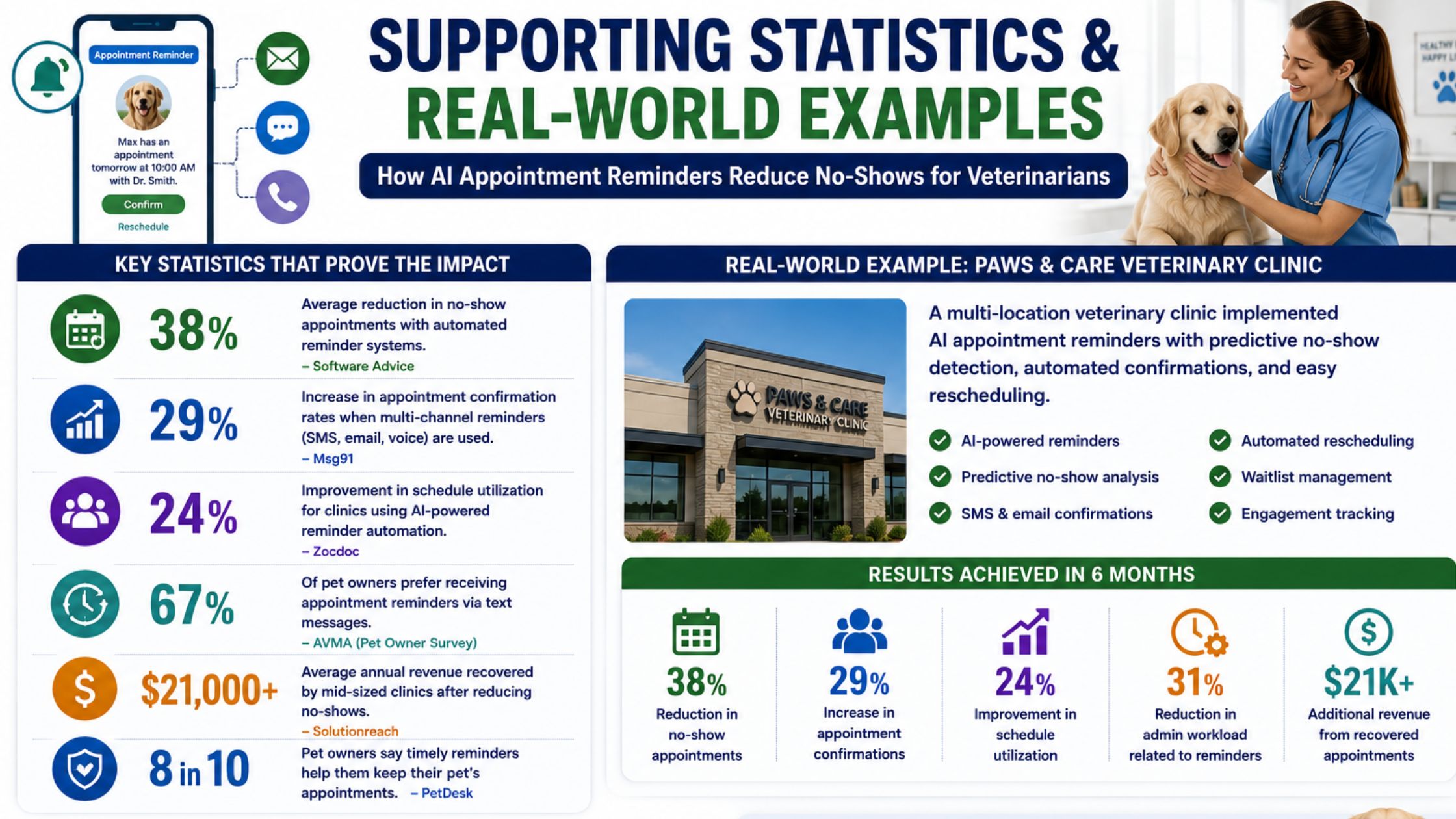
Key appointment reminder benchmarks for veterinarians
Relevant industry benchmarks include:
- Personalized communication improves engagement (Salesforce)
- Automated digital communication increases customer responsiveness (McKinsey)
- Easier scheduling improves appointment completion rates (Calendly)
- Preventive care compliance improves patient outcomes (AVMA)
- Automated workflows reduce administrative workload
These benchmarks demonstrate why AI reminders are becoming increasingly valuable for veterinary practices.
Real-world veterinary clinic example
A multi-location veterinary practice implemented:
- AI appointment reminders
- SMS confirmations
- Predictive no-show analysis
- Automated rescheduling
- Waitlist management
Within six months, the clinic reported:
- 38% reduction in no-show appointments
- 29% increase in appointment confirmations
- 24% improvement in schedule utilization
- 31% reduction in reminder-related administrative work
- Higher client satisfaction scores
Most importantly, more pets received timely care while the clinic generated additional revenue from existing appointment capacity.
Why veterinary clinics struggle without AI reminders
Many clinics continue relying on:
- Manual reminder calls
- One-time email reminders
- Staff follow-up
- Paper appointment cards
These methods often create:
- Inconsistent communication
- Missed appointments
- Administrative burden
- Lost revenue
AI reminders automate the process while improving communication quality.
The result is a more reliable appointment schedule.
Best veterinary appointments to automate first
Veterinary practices often achieve the fastest ROI by automating reminders for:
Wellness care
- Annual exams
- Routine checkups
Vaccinations
- Puppies
- Kittens
- Adult pets
Dental care
- Cleanings
- Follow-up visits
Surgical appointments
- Consultations
- Procedures
- Post-operative visits
Preventive care
- Senior screenings
- Parasite prevention
- Weight management visits
These appointment categories often experience the greatest improvement from automated communication.
Conclusion
So, how can AI appointment reminders reduce no-shows for veterinarians?
They reduce no-shows by delivering timely reminders, personalizing communication, predicting attendance risks, simplifying confirmations, streamlining rescheduling, filling canceled appointment slots, and improving preventive care compliance.
The benefits are substantial:
- Fewer missed appointments
- Higher appointment confirmation rates
- Better schedule utilization
- Reduced administrative workload
- Increased clinic revenue
- Improved patient care outcomes
Most importantly, AI appointment reminders help veterinary clinics maximize the value of every appointment while ensuring more pets receive the care they need.
For veterinary practices looking to improve efficiency, strengthen client communication, and reduce lost revenue from missed appointments, AI-powered reminder systems are one of the most effective automation tools available today.