
How can AI tools improve customer support response times in a way that actually impacts customer satisfaction and business efficiency?
Customer expectations have changed dramatically. According to a 2025 Zendesk CX Trends Report, 72% of customers expect immediate service, and more than half will switch brands after just one poor support experience.
At the same time, support teams are overwhelmed with rising ticket volumes, repetitive queries, and multichannel communication.
This creates a critical operational challenge: response time vs. scalability.
AI tools are now reshaping how support teams operate by reducing response times from hours to seconds, automating repetitive queries, and helping human agents resolve complex issues faster. The result is not just speed, it’s better customer experience, lower operational cost, and higher retention.
So, how exactly do AI tools improve customer support response times?
Let’s break it down.
How do AI tools reduce customer support response times across all layers?
AI tools improve customer support response times by automating repetitive queries, enabling instant responses through chatbots, prioritizing tickets intelligently, assisting human agents with real-time suggestions, and reducing workload through predictive and self-service systems.
In simple terms:
AI reduces the time between customer question → understanding → response → resolution.
This happens across five core layers:
- AI chatbots handle instant first responses
- Natural Language Processing (NLP) categorizes and routes tickets
- AI-powered knowledge bases enable instant self-service
- Agent-assist tools speed up human replies
- Predictive AI reduces future ticket volume
Each layer directly compresses response time.
Step-by-Step Breakdown (Interest → Desire)
1. AI Chatbots provide instant first-response handling
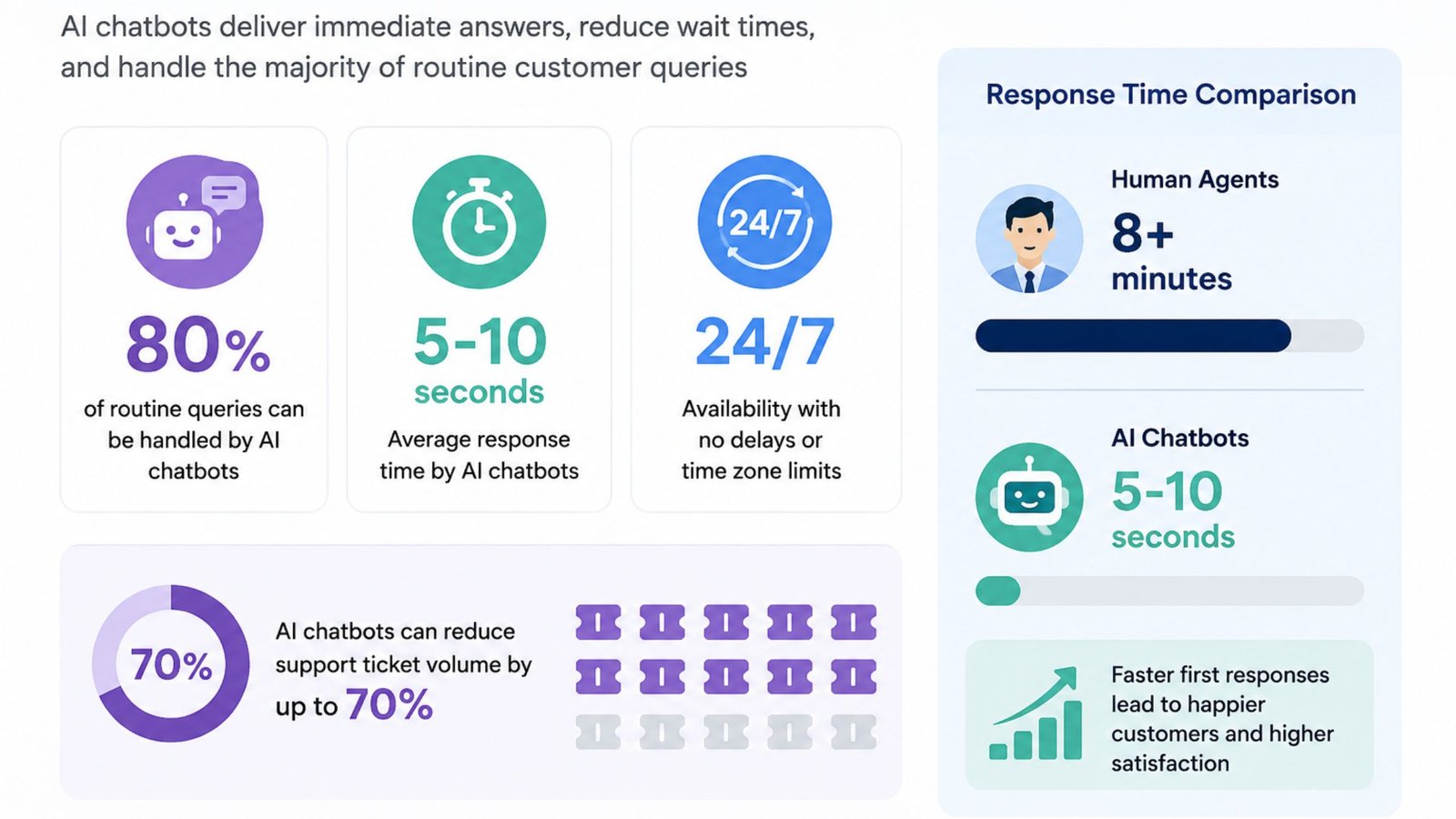
AI-powered chatbots are the first line of defense in modern customer support systems.
Instead of waiting for a human agent, customers receive immediate replies for common queries like:
- Order tracking
- Password resets
- Billing questions
- Basic troubleshooting
According to IBM, AI chatbots can handle up to 80% of routine queries without human intervention.
This reduces first-response time from minutes (or hours) to under 5–10 seconds.
The key advantage is 24/7 availability, eliminating delays caused by time zones or staffing limitations.
2. NLP-powered ticket routing reduces internal delays
Even when human agents are needed, AI significantly speeds up backend processes.
Natural Language Processing (NLP) systems automatically:
- Analyze incoming tickets
- Detect intent and urgency
- Categorize issues
- Assign them to the right department
A McKinsey report shows that AI-driven routing can reduce ticket handling time by 20–40%.
Without AI, tickets often sit in queues or get manually reassigned multiple times. With AI, they go directly to the right agent, immediately.
This eliminates the biggest hidden delay in customer support: misrouting.
3. AI knowledge bases enable instant self-service resolution
One of the most impactful improvements in response time doesn’t involve agents at all.
AI-powered knowledge bases and recommendation engines help customers solve problems themselves by surfacing relevant answers instantly.
Instead of searching through static FAQ pages, AI systems:
- Understand customer queries in natural language
- Retrieve precise answers from knowledge databases
- Continuously improve based on usage patterns
According to Forrester Research, self-service tools powered by AI can deflect up to 65% of incoming support tickets.
This means fewer tickets reach human agents in the first place, dramatically improving overall response times for remaining queries.
4. AI agent-assist tools speed up human replies
For complex queries that require human intervention, AI doesn’t replace agents; it enhances them.
AI-powered agent-assist tools:
- Suggest real-time replies
- Pull relevant knowledge articles instantly
- Auto-fill responses based on context
- Summarize long customer histories
Gartner reports that AI assistance can improve agent productivity by 14–30%, mainly by reducing time spent searching for information.
Instead of spending 5–10 minutes researching a solution, agents can respond in under a minute.
This is especially important in industries like SaaS, fintech, and e-commerce, where speed directly affects conversions and churn rates.
5. Predictive AI reduces incoming support volume
The most advanced use of AI is predictive support, solving problems before they happen.
Machine learning models analyze:
- Customer behavior patterns
- Product usage data
- Historical support trends
This allows companies to:
- Predict common issues before they escalate
- Trigger proactive help messages
- Fix system bugs before users report them
According to Salesforce, proactive AI support can reduce case volume by up to 30%.
Fewer tickets = faster response times for everyone else.
Key AI Customer Support Benchmarks
- 80% of routine queries handled by AI chatbots (IBM)
- 20–40% reduction in resolution time via AI routing (McKinsey)
- 65% ticket deflection through AI self-service systems (Forrester)
- 14–30% increase in agent productivity with AI assist tools (Gartner)
- 30% reduction in case volume using predictive support systems (Salesforce)
Real-world application example
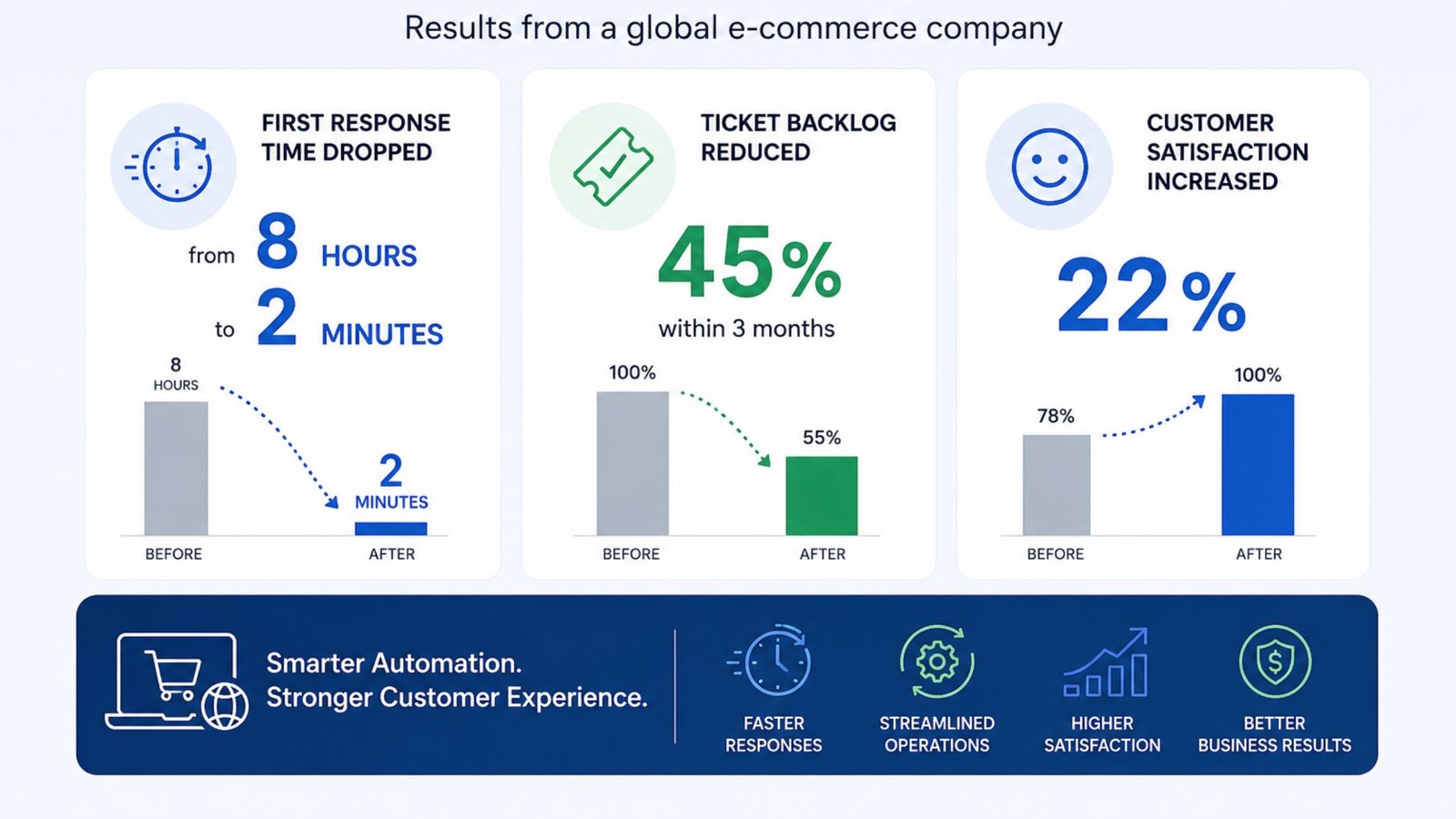
A global e-commerce company implementing AI chatbots and NLP routing reported:
- First response time dropped from 8 hours to under 2 minutes
- Ticket backlog reduced by 45% within 3 months
- Customer satisfaction increased by 22%
This shows that AI does not just improve speed, it transforms the entire support ecosystem.
Why speed matters more than ever
According to HubSpot Research:
- 90% of customers rate “immediate response” as important or very important
- Companies that respond within 5 minutes are 100x more likely to convert leads
So response time is no longer just a support metric; it’s a revenue metric.
Where AI fits into modern customer support systems
A modern AI-enabled support workflow typically looks like this:
- Customer submits query
- AI chatbot attempts instant resolution
- If unresolved → NLP routes ticket to correct team
- Agent-assist tool supports human response
- AI logs interaction and improves future responses
- Predictive system prevents similar issues
This creates a continuous feedback loop that improves speed over time.
Conclusion
So, how can AI tools improve customer support response times?
They do it by removing friction at every stage of the support journey, automating responses, reducing routing delays, enabling self-service, assisting agents in real time, and preventing issues before they happen.
The result is a measurable shift:
- From hours → seconds in first response
- From manual → automated ticket handling
- From reactive → proactive support systems
But the real transformation is not just speed, it’s consistency and scalability. AI ensures that every customer gets a fast, accurate response, regardless of volume or time.
Businesses that adopt AI-driven support systems are not just improving operations; they are fundamentally upgrading customer experience expectations.
If customer support is a growth driver for your business, AI is no longer optional. It’s the baseline for competitive performance.