Can call tracking show which ads actually sign cases for personal injury law firms when most injured clients still pick up the phone, ad budgets run across TV, billboards, search, and social, and the real result only appears weeks later when a retainer is signed?
For personal injury firms, advertising is one of the largest expenses in the business. Firms invest in Google Ads, Local Services Ads, TV spots, radio, billboards, and social media, often at the same time. Each channel reports its own clicks, impressions, or calls.
But clicks and calls are not cases. A campaign that generates hundreds of calls may produce mostly wrong-number inquiries, workers’ comp questions, or cases the firm does not take. Another campaign with fewer calls may bring in the serious auto accident and trucking cases that drive revenue.
The spending is significant. According to the American Tort Reform Association, an advocacy group that tracks legal advertising using Vivvix data, legal services advertising in the United States reached an estimated $2.5 billion in 2024, across nearly 27 million ads. With that much money at stake, guessing which ads work is expensive.
Personal injury call tracking closes the gap between ad spend and signed cases. Each campaign gets a unique phone number, every call is recorded and attributed, and the firm connects those calls to its intake and case management system to see which ads produce signed retainers.
The result is advertising decisions based on cases, not clicks.
Direct Answer
Yes. Call tracking can show which ads actually sign cases for personal injury law firms, but only when call data is connected to intake outcomes and signed retainers, not just counted as raw calls.
A typical call-to-case attribution workflow looks like this:
Ad or campaign → Unique tracking number → Call recorded and attributed → Intake qualifies the caller → Outcome logged in CRM or case management → Retainer signed → Cost per signed case by source
Each stage adds information. The tracking number shows which ad or channel produced the call. The recording and intake notes show whether the caller had a viable case. The case management record shows whether the firm signed it.
Call tracking does not measure everything. Some clients call after seeing several ads, hear about the firm from a friend, or call the main number from memory. Offline channels such as TV and billboards are also harder to attribute precisely. However, combining call tracking with intake data gives a far clearer picture than relying on platform reports alone.
The objective is to know the cost per signed case for each channel, so the firm can move budget toward the ads that bring in valuable clients.
Step-by-Step Breakdown
1. Assign unique numbers to every major channel
Call tracking starts with giving each advertising source its own phone number.
Use separate tracking numbers for Google Ads, Local Services Ads, organic search, Google Business Profile, Facebook ads, TV, radio, and each billboard market or major placement. For offline ads, choose numbers that are easy to remember, since viewers may only see them for a few seconds.
The firm’s main number should still work everywhere. Tracking numbers simply forward to the intake team while recording where each call came from.
2. Use dynamic number insertion for website visitors
Many callers visit the firm’s website before calling.
Dynamic number insertion shows a different tracking number to each visitor based on how they arrived, such as a specific Google Ads campaign, keyword, or social ad. This connects website calls to the exact source, not just “website.”
Make sure the firm’s main number remains consistent in its Google Business Profile and directory listings, since changing it there can affect local search visibility.
3. Record and transcribe calls
Call recordings show what happened on each call: the type of case, the injury, the caller’s situation, and how intake handled it.
AI transcription and keyword detection can flag terms such as “car accident,” “truck,” “slip and fall,” “surgery,” or “hospital,” making it easier to separate potential cases from wrong numbers, solicitors, and existing client calls.
Recording laws differ by state. Some states require all parties to consent, so play a recording disclosure at the start of each call.
4. Define what counts as a qualified lead
Not every call is a lead, and not every lead is a case.
Create clear categories, such as:
- Not a lead: Existing clients, vendors, wrong numbers, spam
- Unqualified lead: Practice areas the firm does not handle, cases outside the jurisdiction, or past the statute of limitations
- Qualified lead: Potential PI case that meets the firm’s criteria
- Signed case: Retainer agreement signed
Consistent categories make reports comparable across channels.
5. Connect call tracking to intake and case management
This is the step that turns call tracking into case attribution.
Integrate the call tracking platform with the firm’s intake software, CRM, or case management system so each call record links to the resulting lead and case. When intake marks a case as signed, that outcome flows back to the original source.
Without this connection, the firm sees calls by channel but not which channels produce signed retainers.
6. Track the full journey, not just the last call
Personal injury clients often interact with a firm several times before signing.
A client may see a billboard, search the firm’s name later, read reviews, and then call from the website. Multi-touch reporting can show the channels that contributed along the way, while first-touch and last-touch views highlight different parts of the journey.
Do not cut a channel just because it rarely gets the final call. Brand campaigns such as TV and billboards often drive the searches that lead to calls.
7. Send signed-case data back to ad platforms
Google Ads and Meta optimize toward the conversions they are given.
If the firm reports every phone call as a conversion, the platforms will chase cheap calls. If it imports qualified leads or signed cases as offline conversions, the platforms can learn which searches and audiences produce real cases.
This approach can improve campaign quality over time, though it requires enough signed-case volume for the algorithms to learn from.
8. Audit intake performance
Call tracking also reveals what happens after the phone rings.
Review missed calls, after-hours calls, hold times, and how quickly intake follows up. Listen to recordings of calls that did not convert. Sometimes the problem is not the ad but the intake process.
A channel that looks weak may be generating good leads that intake is losing.
9. Calculate cost per signed case by source
Once calls are connected to outcomes, the firm can calculate the metric that matters most:
Cost per signed case = channel spend ÷ signed cases from that channel
Also consider case value. A channel with a higher cost per case may still be the best investment if it brings in more serious injuries with higher expected fees.
10. Review results regularly and reallocate budget
Call tracking is only useful if the firm acts on it.
Review results monthly, keeping in mind that PI cases can take weeks to sign. Useful metrics include:
- Calls by channel and campaign
- Qualified lead rate by source
- Signed cases by source
- Cost per qualified lead and cost per signed case
- Missed call rate and intake response time
- Estimated case value by source
Shift budget gradually toward the channels that produce signed cases at an acceptable cost, and test changes before cutting channels entirely.
Supporting Statistics and Real-World Examples
Data shows why personal injury firms need to know which ads produce signed cases, and why intake matters as much as advertising.
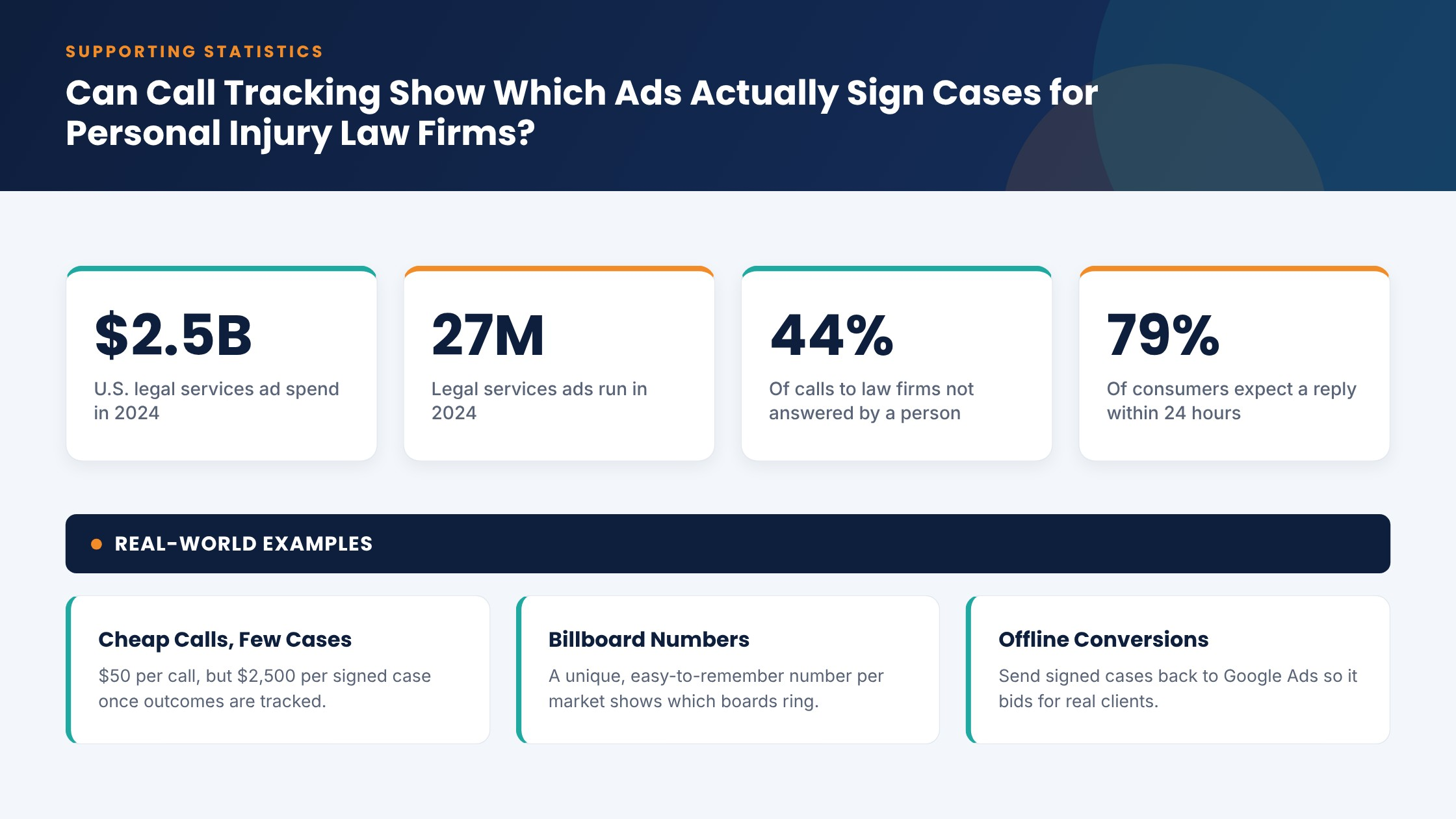
The American Tort Reform Association estimates that legal services advertising in the United States reached about $2.5 billion in 2024, across nearly 27 million ads. Spending rose roughly 39% from 2020 to 2024, and out-of-home advertising such as billboards reached an estimated $541.6 million. ATRA is an advocacy group that opposes much of this advertising, but its spending estimates, based on Vivvix data, show the scale of the investment firms are making.
Intake is the other half of the equation. In a study tied to Clio’s 2019 Legal Trends Report, a third-party research firm contacted 1,000 law firms as potential clients. It found that 44% of calls were not answered by a person, while 79% of surveyed consumers expected a response within 24 hours. The study covered several practice areas rather than personal injury specifically, and it is several years old, but it shows how easily advertising-generated calls can be lost.
Together, these findings show why call tracking matters. Firms spend heavily to make the phone ring, and without tracking calls through to signed cases, they cannot see whether the problem is the ad, the intake process, or both.
These findings do not prove that call tracking will lower cost per case by a specific amount. They show that legal advertising budgets are large and that calls are often lost, which makes attribution and intake visibility valuable.
Practical Personal Injury Firm Example
Consider a firm spending $15,000 per month on each of two channels.
- Channel A: 300 calls and 6 signed cases
- Channel B: 120 calls and 10 signed cases
Judged by calls alone, Channel A looks better:
- Channel A: $15,000 ÷ 300 calls = $50 per call
- Channel B: $15,000 ÷ 120 calls = $125 per call
Judged by signed cases, the picture reverses:
- Channel A: $15,000 ÷ 6 cases = $2,500 per signed case
- Channel B: $15,000 ÷ 10 cases = $1,500 per signed case
Suppose the firm shifts $5,000 per month from Channel A to Channel B, and Channel B continues to sign cases at a similar cost. That could produce roughly three additional signed cases per month for the same total budget, while Channel A loses about two.
These figures are illustrative, not industry benchmarks. Actual results depend on case types, market competition, intake performance, how quickly new budget is absorbed, and how long cases take to sign.
The lesson is that the cheapest calls are not always the cheapest cases. Call tracking connected to intake outcomes shows the difference.
Quick Tactical Setup for Personal Injury Call Tracking
Start by assigning unique tracking numbers to your largest channels, such as Google Ads, Local Services Ads, Google Business Profile, and your main TV or billboard campaigns. Add dynamic number insertion to the website.
Turn on call recording with a disclosure message, and set up clear lead categories: not a lead, unqualified, qualified, and signed case.
Integrate call tracking with your intake or case management system so signed retainers link back to their original source. Import qualified leads or signed cases into Google Ads as offline conversions.
After 60 to 90 days, compare cost per qualified lead and cost per signed case by channel. Review intake recordings for lost opportunities, then shift budget gradually toward the channels that sign cases most efficiently.
Conclusion
Can call tracking show which ads actually sign cases for personal injury law firms?
Yes. Personal injury call tracking shows where every call comes from, and when it is connected to intake and case outcomes, it reveals which ads produce signed retainers rather than just phone activity. Paired with disciplined PPC management, it helps firms invest in the campaigns that grow their caseload.
The most valuable improvements include:
- Clear attribution for every major ad channel
- Recordings that show what callers actually need
- Consistent lead and case categories
- Signed cases linked back to their source
- Better ad platform optimization through offline conversions
- Visibility into intake performance and missed calls
- Cost per signed case by channel
- Budget decisions based on cases, not clicks
Call tracking cannot fix weak intake, slow follow-up, or poor case selection on its own. Its value comes from showing the firm exactly where cases come from and where they are lost.
When a firm can see which ads sign cases, it can stop paying for noise and invest in the campaigns that bring in clients.