Can quiz funnels turn ad clicks into booked consultations for med spas when most people who click an aesthetics ad are curious, unsure which treatment they need, and not yet ready to call?
For med spas, paid social and search ads can generate plenty of clicks. The harder part is turning those clicks into consultations. A visitor who sees an ad for skin rejuvenation may not know whether they need a chemical peel, microneedling, a laser treatment, or injectables. Sending them to a generic booking page asks them to make a decision they do not feel qualified to make.
Many leave. Others fill out a basic contact form and never answer the follow-up call.
The opportunity is large. According to the American Society of Plastic Surgeons, more than 28.5 million minimally invasive cosmetic procedures were performed in the United States in 2024, including nearly 9.9 million neuromodulator injections. Demand exists. The challenge is guiding interested people to the right next step.
Med spa quiz funnels solve this by replacing a cold booking form with a short, engaging set of questions. The quiz helps visitors identify their concerns and goals, recommends a relevant treatment path, and invites them to book a consultation while their interest is high.
The result is more qualified leads, better-informed consultations, and fewer wasted ad clicks.
Direct Answer
Yes. Quiz funnels can turn ad clicks into booked consultations for med spas by engaging visitors with a few simple questions, matching them to a relevant treatment category, and inviting them to book while they feel understood and motivated.
A typical med spa quiz funnel looks like this:
Ad click → Quiz landing page → 4 to 7 questions about concerns and goals → Contact details → Personalized results page → Consultation booking → Reminder and follow-up sequence
Each stage has a clear purpose. The questions build engagement. The results page explains possible options. The booking step converts interest into an appointment. Follow-up recovers people who completed the quiz but did not book.
A quiz funnel does not replace a professional assessment. Results should describe treatments worth discussing, not promise outcomes or diagnose conditions. Some visitors will still leave, and conversion depends on the offer, ad targeting, pricing transparency, and how quickly the team follows up.
The objective is to help undecided visitors take a confident first step, so consultations begin with better information on both sides.
Step-by-Step Breakdown
1. Choose one treatment goal per quiz
A quiz works best when it answers one clear question.
Rather than building one long quiz for every service, create separate quizzes around common concerns, such as smoother skin, fine lines and wrinkles, facial volume, unwanted hair, or body contouring.
This keeps the quiz short, makes the results more relevant, and lets the ad match the quiz exactly. Someone who clicks an ad about fine lines should land on a quiz about fine lines, not a general menu of services.
2. Match the ad to the quiz promise
The ad should set clear expectations about what happens after the click.
Messages such as “Not sure which treatment is right for you? Take our 60-second skin quiz” work because they acknowledge uncertainty and offer a simple next step.
Avoid ads that promise specific results or before-and-after outcomes. Advertising platforms and state regulations may restrict health and cosmetic claims, so ad copy and creative should be reviewed before launch.
3. Keep the quiz short and easy
Every extra question gives visitors another chance to leave.
Most med spa quizzes need only four to seven questions, such as:
- What is your main concern?
- Which area would you like to improve?
- Have you had aesthetic treatments before?
- How soon would you like to start?
- What matters most to you: minimal downtime, natural results, or budget?
Use tap-to-select answers with images or icons where possible. Most visitors from social ads will be on their phones.
4. Ask for contact details at the right moment
The best time to request contact details is after the visitor has answered the questions and wants to see their results.
A short form asking for first name, email, and phone number feels reasonable at that point, because the visitor has already invested time.
Explain why the information is needed and how it will be used. If the med spa plans to send text messages, the form should include clear consent language that complies with regulations such as the TCPA.
5. Show helpful, responsible results
The results page is where trust is built.
Instead of stating that a visitor needs a specific treatment, present two or three options worth discussing at a consultation, with a short explanation of each, typical downtime, and what to expect at the first visit.
Include real provider credentials and photos of the clinic. Before-and-after images should be genuine, used with patient consent, and accompanied by a note that results vary.
The page should end with one clear next step: book a consultation.
6. Make booking immediate
The moment someone sees their results is when they are most motivated.
Embed online booking directly on the results page so visitors can choose a consultation time without leaving. Show available times clearly, and keep the booking form short.
If online booking is not possible, offer a click-to-call button and a promise of a call back within a specific time frame.
7. Follow up quickly with people who did not book
Some visitors will complete the quiz but stop before booking.
An automated follow-up sequence can send their results by email, answer common questions about the recommended treatments, and invite them to book. A text message or call from the front desk within the same day can recover many of these leads.
Each message should add value, such as explaining what happens during a consultation or addressing concerns about pain, downtime, or cost.
8. Segment leads by readiness
Quiz answers reveal how ready each visitor is.
Someone who wants to start within two weeks and has had treatments before is likely ready to book. Someone exploring options for later this year may need more education first.
Use these answers to route urgent leads to the front desk for a quick call, while placing longer-term leads into a nurture sequence with educational content and seasonal offers.
9. Prepare providers before the consultation
Quiz answers are valuable for the consultation itself.
Pass the visitor’s concerns, goals, and previous treatment history to the provider before the appointment. This saves time, makes the patient feel heard, and helps the provider focus on the most relevant options.
Any health-related information collected through the quiz should be handled securely and in line with HIPAA where it applies.
10. Measure booked consultations, not quiz starts
Med spas should judge quiz funnels by consultations and treatments, not clicks or quiz completions.
Useful metrics include:
- Click-to-quiz-start rate
- Quiz completion rate
- Contact capture rate
- Consultation booking rate
- Consultation show rate
- Consultation-to-treatment conversion rate
- Cost per booked consultation
- Revenue per quiz lead over 6 and 12 months
Test one change at a time, such as a different first question, a shorter form, or a new results page layout.
Supporting Statistics and Real-World Examples
Industry data shows why med spas benefit from a better path between an ad click and a consultation.
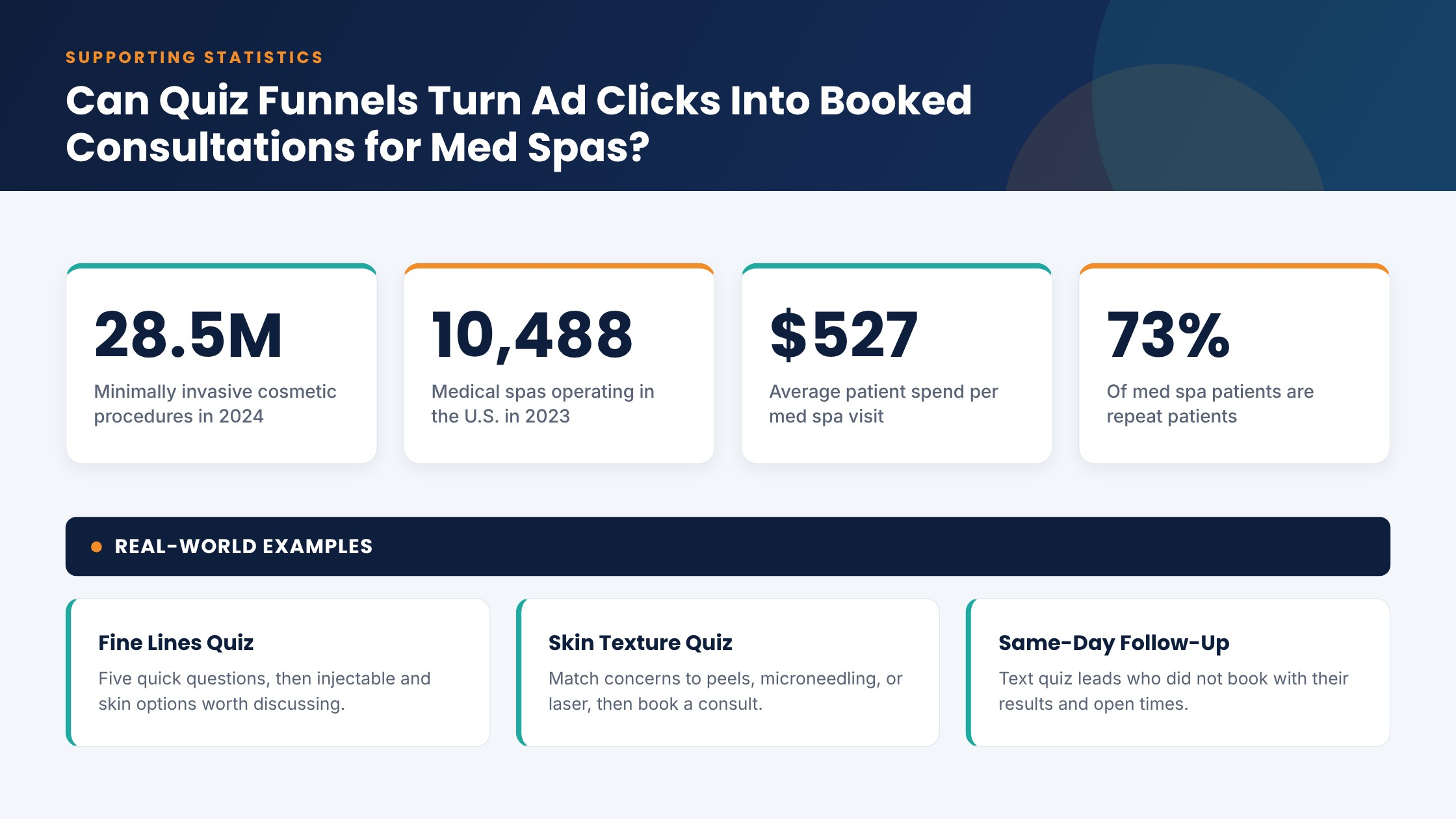
The American Society of Plastic Surgeons reported more than 28.5 million minimally invasive cosmetic procedures in the United States in 2024, up 1.5% from the previous year. Neuromodulator injections alone reached 9,883,711, up 4%, while hyaluronic acid fillers reached 5,331,426. Demand for aesthetic treatments is steady, but patients have many providers to choose from.
Competition is growing too. The American Med Spa Association’s 2024 State of the Industry recap counted 10,488 medical spas in the United States in 2023, up from 8,899 the year before. The same report found an average spend of $527 per visit and that 73% of med spa patients are repeat patients.
That repeat rate matters. A new patient won through a quiz funnel is not worth one visit. If the first experience goes well, they are likely to return, which makes each booked consultation more valuable than its first invoice suggests.
These findings do not prove that quiz funnels will produce a specific booking rate. They show that demand is strong, competition is rising, and each new patient can generate repeat revenue, which is why converting more ad clicks into consultations matters.
Practical Med Spa Example
Consider a med spa whose ads generate 2,000 clicks per month.
Suppose half of those visitors start the quiz and half of those complete it and share their contact details.
2,000 clicks × 50% × 50% = 500 quiz leads.
Suppose 15% of quiz leads book a consultation and 70% of those attend.
500 leads × 15% = 75 consultations booked; 75 × 70% = about 52 consultations attended.
If half of attended consultations become paying patients:
52 × 50% = 26 new patients.
At an average spend of $527 per visit:
26 new patients × $527 = $13,702 in first-visit revenue.
Because many patients return for maintenance treatments, the value of those 26 patients over the following year can be several times higher.
These figures are illustrative, not industry benchmarks. Actual results depend on ad targeting, offer, pricing, quiz design, local competition, follow-up speed, and provider availability.
The lesson is that a quiz funnel does not need dramatic conversion rates to pay off. Small improvements at each stage compound into more patients from the same ad spend.
Quick Tactical Setup for Med Spa Quiz Funnels
Start with one high-demand concern, such as fine lines and wrinkles or skin texture, and one ad campaign that points directly to a matching quiz.
Write four to seven tap-to-select questions, ask for contact details before showing results, and design a results page with two or three treatment options, provider credentials, and embedded consultation booking.
Set up same-day follow-up by text and email for people who complete the quiz without booking, and pass quiz answers to the provider before each consultation.
After the first month, review quiz completion, booking, show, and treatment rates, plus cost per booked consultation. Improve the weakest stage before launching quizzes for other services.
Conclusion
Can quiz funnels turn ad clicks into booked consultations for med spas?
Yes. Med spa quiz funnels give undecided visitors a simple, engaging way to explore their options and take the next step. Paired with well-built sales funnels, they turn curiosity into consultations and give providers better information before the first visit.
The most valuable improvements include:
- Higher engagement from ad traffic
- More qualified leads with useful context
- Results pages that build trust and guide decisions
- Immediate booking while interest is high
- Faster follow-up for people who do not book
- Better-prepared consultations
- Clear tracking from ad click to treatment
- More patients from the same ad budget
A quiz funnel cannot replace skilled providers, transparent pricing, or a great patient experience. Its value comes from guiding interested people to the right conversation.
When visitors feel understood and can book in a few taps, they have a strong reason to choose your med spa over the next ad they see.