
How can AI invoice automation reduce delays for construction companies when payment cycles often involve multiple stakeholders, approval stages, purchase orders, subcontractors, suppliers, and project managers?
Construction businesses frequently experience payment delays not because invoices are incorrect, but because the invoice process itself is complicated.
A typical construction invoice may need to move through several steps:
Subcontractor submits invoice → Project manager reviews work completion → Documents are verified → Purchase orders are matched → Approval is requested → Payment is released
Any missing information, manual data-entry error, misplaced document, or delayed approval can slow the entire process.
For contractors, these delays create more than administrative frustration. Late payments can affect cash flow, supplier relationships, payroll planning, material purchasing, and the ability to keep projects moving.
The construction industry already faces significant payment challenges. According to the Associated General Contractors of America (AGC), contractors frequently report delayed payments, with many businesses experiencing payment uncertainty due to complex project relationships and administrative processes.
AI invoice automation can help by capturing invoice data, identifying missing information, matching invoices with project records, routing approvals, detecting errors, and creating faster payment workflows.
Instead of replacing accounting teams, AI reduces repetitive manual work so employees can focus on exceptions, vendor relationships, and financial decisions.
Direct Answer
Yes. AI invoice automation can reduce payment delays for construction companies by accelerating invoice processing, improving accuracy, and creating a more transparent approval workflow.
Traditional invoice processing often requires employees to manually:
- Open invoices
- Enter vendor details
- Record invoice amounts
- Check purchase orders
- Verify project information
- Search for approval status
- Follow up with stakeholders
AI-powered invoice automation can handle many of these repetitive steps automatically.
For example:
A subcontractor submits an invoice for completed electrical work.
The AI system can:
- Extract invoice details.
- Match the invoice against the purchase order.
- Compare billed work against project records.
- Identify missing documents.
- Send the invoice to the correct approver.
- Notify responsible team members if approval is delayed.
The result is a shorter invoice cycle and fewer bottlenecks.
According to McKinsey, automation technologies can significantly improve finance operations by reducing manual processing, improving accuracy, and increasing visibility into financial workflows.
For construction companies managing hundreds of invoices across multiple projects, these improvements can directly affect operational efficiency.
Step-by-Step Breakdown
1. Capture invoice data automatically
Construction companies receive invoices from many sources:
- Material suppliers
- Equipment rental companies
- Subcontractors
- Consultants
- Service providers
These invoices may arrive as PDFs, emails, scanned documents, or digital files.
Manual entry creates several risks:
- Incorrect amounts
- Duplicate entries
- Missing project codes
- Incorrect vendor information
- Delayed processing
AI invoice automation uses technologies such as optical character recognition (OCR) and machine learning to extract information automatically.
The system can identify:
- Vendor name
- Invoice number
- Date
- Amount
- Tax information
- Payment terms
- Purchase order references
- Project details
This removes one of the biggest causes of invoice delays: waiting for someone to manually enter information.
2. Match invoices with purchase orders and project records
Construction invoices often cannot be approved until someone confirms that the billed work matches what was ordered or completed.
A manual review might require employees to search through:
- Contracts
- Purchase orders
- Work orders
- Delivery receipts
- Project management systems
- Completion reports
AI can automatically compare invoice information against existing records.
For example:
Purchase order:
500 concrete blocks at $8 each
Invoice received:
500 concrete blocks at $8 each
The system identifies a match and moves the invoice forward.
If the invoice shows:
600 concrete blocks at $8 each,
the system can flag the difference before payment.
This reduces unnecessary back-and-forth between accounting teams, project managers, and vendors.
3. Identify missing invoice information before approval
Incomplete invoices are a common reason payments get delayed.
Examples include:
- Missing purchase order number
- Incorrect project reference
- Missing approval documentation
- Incorrect billing address
- Missing supporting receipts
Without automation, accounting teams may discover these issues days after receiving an invoice.
AI can review invoices immediately and identify potential problems.
For example:
“Invoice received from ABC Plumbing. Project code missing. Approval cannot proceed until updated.”
This gives vendors and internal teams faster visibility.
Instead of discovering problems during final approval, companies can address them at the beginning of the process.
4. Route invoices to the correct approver
Construction projects often involve multiple approval levels.
A small material invoice may require project manager approval.
A large subcontractor payment may require approval from:
- Project manager
- Finance department
- Owner representative
- Construction executive
Manual routing creates delays when invoices sit in the wrong inbox.
AI automation can use predefined rules:
Invoice type + project + amount = approval path
For example:
- Under $5,000 → Project manager approval
- $5,000 to $50,000 → Project manager + finance approval
- Over $50,000 → Executive approval
The invoice automatically reaches the correct people.
This reduces waiting time caused by unclear ownership.
5. Provide real-time invoice status tracking
One common frustration in construction payment processes is not knowing where an invoice stands.
A subcontractor may ask:
“Has my invoice been approved?”
A project manager may ask:
“Which invoices are waiting for my review?”
An accounting employee may spend time searching through emails to answer these questions.
AI invoice systems create visibility.
Teams can see:
- Invoice received
- Review completed
- Approval pending
- Payment scheduled
- Payment completed
This reduces unnecessary internal communication.
It also improves vendor relationships because suppliers have clearer expectations.
6. Reduce duplicate invoices and payment errors
Construction companies handle thousands of invoices across long projects.
Duplicate submissions can happen because:
- Vendors resend invoices
- Different employees receive the same document
- Previous invoices are difficult to locate
AI can compare invoice numbers, vendor details, dates, and amounts to identify possible duplicates.
This protects cash flow and prevents unnecessary payments.
AI can also detect unusual patterns.
For example:
“A supplier invoice amount is significantly higher than previous invoices.”
That does not automatically mean the invoice is incorrect.
Instead, it creates an opportunity for human review.
7. Accelerate subcontractor payment cycles
Subcontractors rely heavily on predictable payments.
Delayed payments can create tension between general contractors and subcontractors.
According to the National Association of Home Builders (NAHB), payment delays and cash flow challenges remain important concerns throughout construction supply chains.
Faster invoice processing can improve relationships by reducing administrative delays.
When subcontractors know invoices move through a predictable process, they spend less time following up and more time focusing on project delivery.
A smoother payment workflow can become a competitive advantage when attracting reliable trade partners.
8. Connect invoice automation with project management systems
Construction financial workflows rarely exist separately from project operations.
Invoice approval often depends on information from:
- Project schedules
- Completed milestones
- Material deliveries
- Change orders
- Labor progress
AI invoice automation becomes more effective when connected with project management platforms.
For example:
A contractor completes a construction milestone.
The project system updates completion status.
The invoice system receives confirmation.
The invoice moves toward approval automatically.
This creates a connection between field activity and financial operations.
9. Use AI to prioritize urgent invoices
Not every invoice requires the same urgency.
A delayed payment to a small supplier may have different consequences compared with delaying payment to a critical material provider.
AI can help prioritize invoices based on:
- Due date
- Supplier importance
- Contract terms
- Project impact
- Late-payment risk
This helps finance teams focus attention where it matters most.
Instead of processing invoices only by arrival order, companies can manage them according to operational impact.
10. Improve financial forecasting with invoice data
Construction companies need accurate cash-flow visibility.
Future payments affect:
- Material purchasing
- Payroll planning
- Equipment decisions
- Project budgeting
AI invoice automation creates cleaner financial data because invoices are processed consistently.
Companies can better understand:
- Upcoming obligations
- Outstanding approvals
- Vendor payment timelines
- Project expenses
This improves decision-making beyond simply paying invoices faster.
McKinsey highlights that finance automation can help organizations move from manual transaction processing toward more strategic financial management by improving data availability and operational visibility.
Supporting Statistics and Real-World Examples
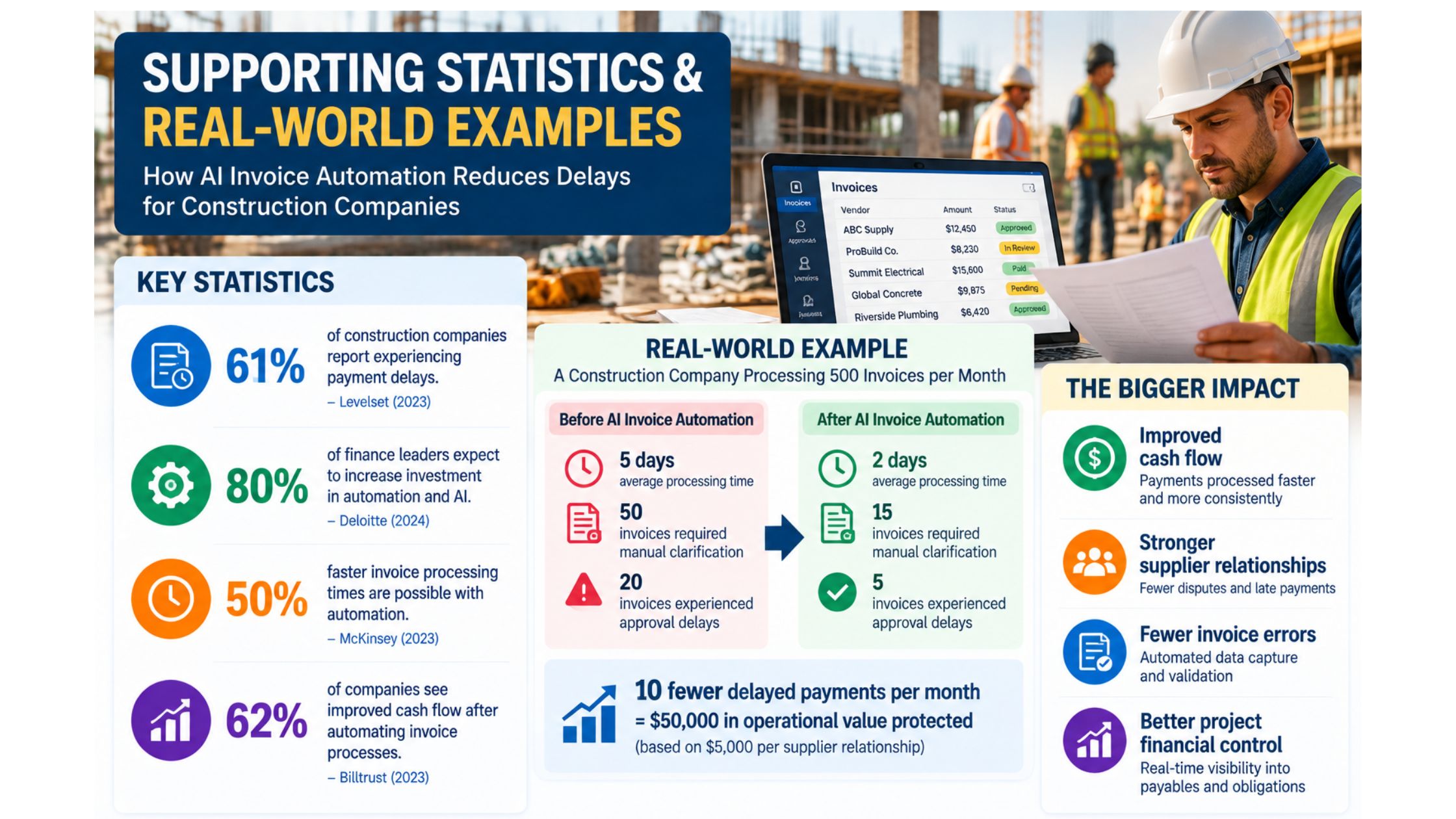
Construction payment delays often come from process complexity rather than unwillingness to pay.
The Construction Payment Report from Levelset has repeatedly highlighted that contractors experience delayed payments because of approval processes, paperwork issues, and disputes.
This makes invoice workflow improvements particularly valuable.
The broader automation market also demonstrates the opportunity.
McKinsey reports that automation in finance functions can reduce repetitive manual tasks and improve processing efficiency by combining AI, workflow automation, and better data management.
Deloitte’s research on finance transformation similarly notes that organizations are increasingly adopting intelligent automation to improve transaction processing, reporting, and operational efficiency.
Practical Construction Company Example
Consider a construction company processing:
500 invoices per month
Before automation:
- Average processing time: 5 days
- 50 invoices require manual clarification
- 20 invoices experience approval delays
The company introduces AI invoice automation.
The system:
- Extracts invoice data automatically
- Matches invoices with purchase orders
- Flags missing information
- Routes invoices correctly
- Sends approval reminders
After implementation:
- Average processing time reduces to 2 days
- Fewer invoices require manual review
- Approval bottlenecks become visible
Suppose faster processing helps the company prevent 10 delayed supplier payments each month.
If each avoided delay protects a $5,000 supplier relationship or operational disruption:
10 × $5,000 = $50,000 in operational value protected monthly
These numbers are illustrative, not an industry benchmark. Actual improvements depend on invoice volume, existing processes, software integration, project complexity, and team adoption.
The important benefit is not only faster payments.
It is creating a predictable financial workflow.
Quick Tactical Setup for Construction Companies
Start with the invoice types that create the most administrative work.
Connect supplier invoices, purchase orders, project management records, and accounting systems.
Create automated workflows for:
- Invoice capture
- Duplicate detection
- Approval routing
- Missing information alerts
- Payment reminders
- Status tracking
Measure:
- Average invoice processing time
- Approval turnaround time
- Number of delayed invoices
- Duplicate invoice detection
- Vendor payment cycle time
Begin with one project or department before expanding company-wide.
AI works best when combined with clear approval rules and accurate project data.
Conclusion
So, how can AI invoice automation reduce delays for construction companies?
It removes unnecessary manual steps from the payment process.
By automatically capturing invoice information, matching documents, identifying errors, routing approvals, tracking status, and improving financial visibility, AI helps construction businesses move invoices from submission to payment more efficiently.
The benefits include:
- Faster invoice approvals
- Fewer payment delays
- Reduced administrative workload
- Better supplier relationships
- Improved cash-flow visibility
- Fewer invoice errors
- Stronger project financial control
AI will not replace project managers, accountants, or financial decision-makers.
Instead, it allows those professionals to spend less time searching for documents and chasing approvals and more time managing projects, controlling costs, and making better financial decisions.
For construction companies managing complex projects, faster invoice processing is not just an accounting improvement.
It can become an operational advantage.