How can AI stock alerts prevent shortages for pharmacies when medication demand, supplier availability, prescription patterns, seasonal illnesses, and national drug shortages can change faster than traditional inventory systems can respond?
For pharmacies, a stockout is more serious than an empty retail shelf. When a medication is unavailable, patients may experience treatment delays, pharmacy teams may spend additional time searching for alternatives, and pharmacists may need to coordinate with prescribers or suppliers.
Medication shortages remain a significant challenge. The American Society of Health-System Pharmacists reported 227 active U.S. drug shortages as of June 2026. Although this was substantially below the record 323 active shortages recorded in the first quarter of 2024, shortages of controlled substances and chemotherapy products remained significant concerns.
The FDA also describes drug shortages as a significant public-health threat because they can delay or sometimes prevent critically needed care. During 2025, FDA centers worked with manufacturers to prevent 330 potential drug shortages, demonstrating how valuable early warning and intervention can be.
Individual pharmacies cannot prevent manufacturing disruptions, but they can improve how quickly they recognize inventory risks within their own operations.
AI stock alerts can analyze inventory levels, dispensing patterns, supplier lead times, historical demand, seasonal trends, and shortage information to identify products at risk of running out before the shelf reaches zero.
That gives pharmacy teams time to respond.
Direct Answer
Yes. AI stock alerts can help pharmacies prevent avoidable stockouts by continuously monitoring medication inventory and identifying when available stock may not cover expected demand.
A basic inventory system might generate an alert when stock falls below 20 units.
AI can make the decision more contextual.
For example:
Medication A: 40 units available
Normal daily demand: 5 units
Recent daily demand: 9 units
Supplier lead time: 4 days
Expected demand before replenishment: 36 units
Risk: High
Although 40 units might appear sufficient under a fixed minimum-stock rule, AI can recognize that recent demand has accelerated and that the pharmacy could approach a shortage before the next shipment arrives.
The World Health Organization identifies quantification and forecasting as essential stages of effective medicines supply management, alongside procurement, storage, and distribution.
AI stock alerts bring those principles into a continuously monitored pharmacy workflow.
Step-by-Step Breakdown
1. Connect AI alerts to real inventory data
An alert is only useful when the underlying inventory data is accurate.
The system should ideally monitor information such as current stock, dispensing history, incoming purchase orders, supplier availability, expiration dates, reorder points, lead times, and backorders.
This creates a live picture of inventory rather than relying exclusively on periodic manual counts.
Suppose a pharmacy has 75 units of a medication.
Looking at that number alone provides little information.
If the pharmacy normally dispenses five units per week, inventory may be adequate. If it suddenly dispenses 20 units per day, the same 75 units represent a significant supply risk.
AI helps evaluate inventory in relation to expected consumption.
2. Forecast demand before setting reorder alerts
Fixed reorder thresholds can be useful, but they treat demand as relatively stable.
Medication demand is not always stable.
AI can analyze historical dispensing patterns to estimate future requirements.
For example:
Average weekly demand: 70 units
Forecast next week: 92 units
Current available stock: 60 units
Incoming order: 20 units
The system can recognize an expected shortfall of approximately 12 units before it happens.
WHO has emphasized the importance of early-warning indicators in pharmaceutical procurement and supply management. Its guidance specifically describes monitoring indicators designed to help prevent both stockouts and overstocking.
AI allows those warning signals to become more dynamic.
3. Account for seasonal demand changes
Pharmacy demand can change with the season.
Flu activity may increase demand for certain products. Allergy seasons can change purchasing patterns. Local disease outbreaks can create sudden increases in particular prescriptions or OTC products.
ASHP’s 2025 shortage statistics, for example, specifically noted that influenza activity had increased demand for oseltamivir and could affect pharmacy availability.
AI can compare current dispensing velocity with historical seasonal patterns.
Instead of waiting until inventory falls below a static threshold, the pharmacy could receive an alert such as:
“Demand for this product is running 28% above the normal seasonal rate. Current inventory may not cover projected requirements through the next supplier delivery.”
That provides staff with a reason for the alert, not simply a low-stock warning.
4. Include supplier lead times in stock-risk calculations
Knowing how much inventory remains is only half of shortage prevention.
The pharmacy also needs to know how quickly replacement stock can arrive.
Suppose two medications each have 30 units remaining.
Medication A: Supplier lead time is one day.
Medication B: Supplier lead time is seven days.
The shortage risk is completely different.
AI stock alerts can combine consumption forecasts with supplier lead times to calculate when an order needs to be placed.
This becomes especially important when normal lead times begin increasing.
If a product that usually arrives in two days suddenly requires five days, the system can adjust the reorder recommendation before inventory becomes critical.
5. Monitor national shortage information
Some pharmacy stock problems begin far beyond the individual pharmacy.
Manufacturing quality problems, limited suppliers, production interruptions, natural disasters, and distribution problems can all affect medication availability.
ASHP reported that 48% of new shortages in the first half of 2026 involved sole-source products, meaning only one manufacturer supplied the affected product.
Pharmacy inventory systems can incorporate reliable external shortage information so staff know when a medication in their inventory is facing broader supply pressure.
ASHP maintains current drug-shortage information covering active shortages, discontinued products, resolved shortages, and related availability information.
The FDA also monitors the medical product supply chain for disruptions that could lead to shortages.
Combining internal inventory data with external shortage information creates a stronger warning system than monitoring either source alone.
6. Prioritize alerts based on urgency
A pharmacy does not need hundreds of identical notifications.
Too many alerts can create alert fatigue.
AI can rank inventory risks based on factors such as predicted days of supply, dispensing velocity, supplier lead time, incoming inventory, national shortage status, and operational importance.
For example:
Critical: Predicted stockout within 48 hours.
High: Stock may run out before next supplier delivery.
Moderate: Demand increasing faster than forecast.
Monitor: Inventory approaching normal reorder level.
This helps staff focus first on medications requiring immediate attention.
AI should support professional judgment rather than automatically making clinical decisions.
7. Detect unusual demand spikes early
One of AI’s most useful functions is anomaly detection.
Suppose a pharmacy normally dispenses 15 units of a particular medication per day.
Over the last three days, daily demand rises to:
Day 1: 24 units
Day 2: 31 units
Day 3: 35 units
Inventory may still appear healthy, but the pattern suggests that the normal forecast is no longer reliable.
AI can flag the change:
“Dispensing volume is significantly above the recent baseline. Review inventory and upcoming replenishment.”
The pharmacy gets an opportunity to respond before the product becomes scarce.
8. Prevent overstocking at the same time
Shortage prevention does not mean ordering as much inventory as possible.
Medicines may have expiration dates, storage requirements, cash-flow implications, and demand uncertainty.
WHO’s supply-management guidance specifically treats stockouts and overstocking as related inventory-management problems that should both be monitored.
AI can therefore identify two different risks:
Shortage risk: Demand is likely to exceed available supply.
Excess-stock risk: Inventory substantially exceeds expected consumption before expiry or the next planning period.
The objective is better balance.
Pharmacies should maintain appropriate inventory and safety stock without creating unnecessary excess.
9. Alert staff when purchase orders may not arrive in time
Placing an order does not eliminate shortage risk.
A pharmacy may have:
Current inventory: 40 units
Incoming purchase order: 100 units
A traditional system might consider the issue resolved.
But what happens if the supplier delays the shipment?
AI can monitor expected delivery dates against projected consumption.
If inventory is likely to reach zero before the shipment arrives, the system can notify staff:
“Current stock is projected to run out two days before the expected replenishment date.”
The pharmacy team can then investigate supplier availability or other appropriate options.
10. Learn from previous stockouts
Every shortage provides useful operational data.
After an item becomes unavailable, the pharmacy can examine:
- What was the expected demand?
- What was actual demand?
- Was the supplier delayed?
- Did the reorder threshold trigger too late?
- Was there an external shortage?
- Was inventory data inaccurate?
- Did demand suddenly increase?
AI models can incorporate these outcomes into future forecasts.
For example, if a particular medication repeatedly experiences demand spikes during the same season, next year’s alerts can begin earlier.
This creates a continuous improvement loop:
Forecast → Monitor → Alert → Act → Measure → Improve
Supporting Statistics and Real-World Examples
Current shortage data shows why pharmacies need earlier inventory visibility.
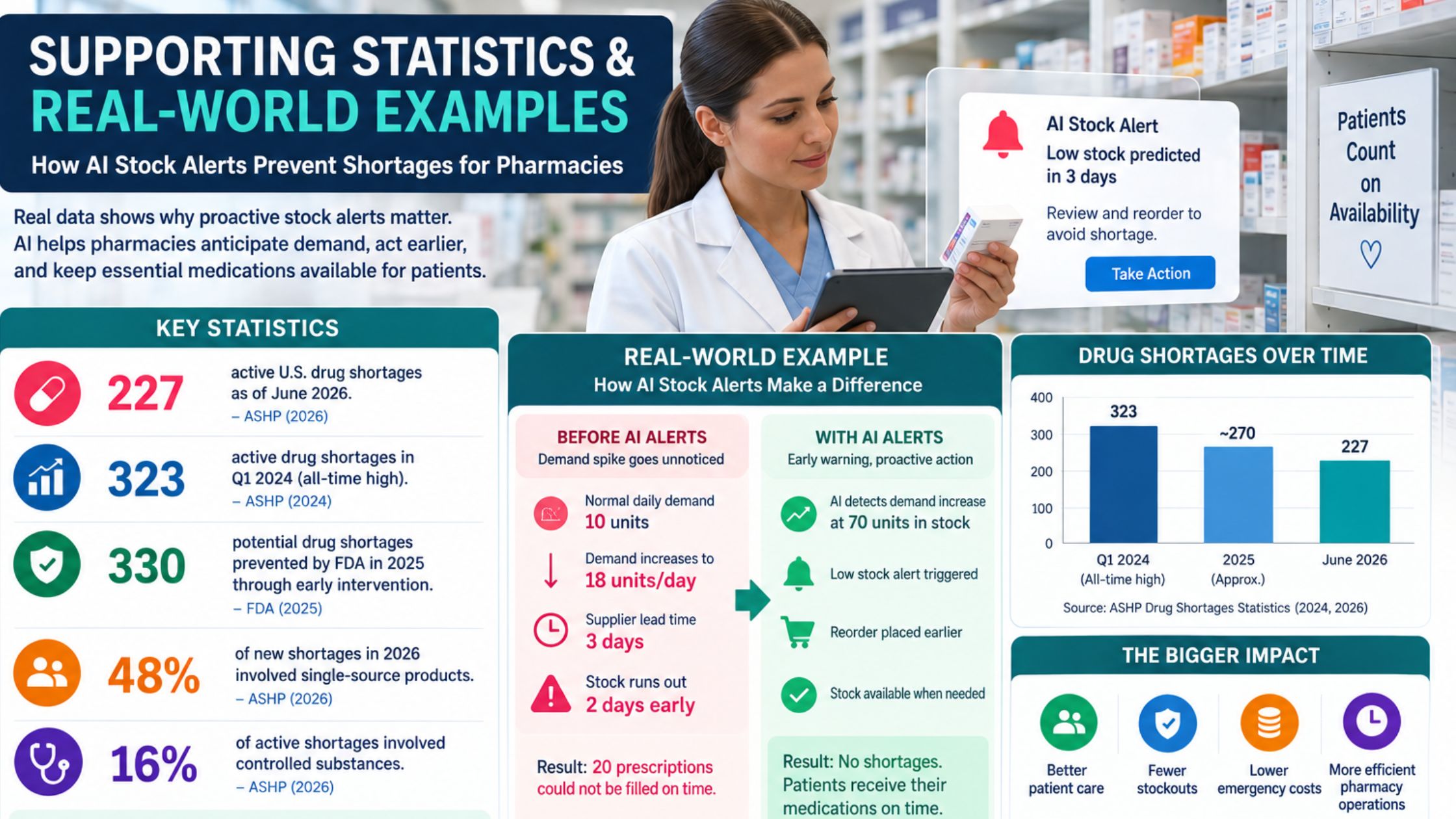
ASHP reported 227 active drug shortages in June 2026. Sixteen percent involved controlled substances, and just under half of new shortages in 2026 involved products supplied by a single manufacturer.
The situation has improved from the 323 active shortages recorded in the first quarter of 2024, which ASHP described as an all-time high.
However, fewer active shortages do not necessarily mean fewer affected patients. ASHP specifically cautions that a single shortage can affect large numbers of people.
The FDA’s 2025 report provides another important benchmark. FDA’s drug and biologics centers worked with manufacturers to prevent 330 potential drug shortages during 2025, while only four new shortages were identified under FDA’s reporting framework that year. The agency attributes early manufacturer notifications as one factor giving it additional time to intervene.
That principle translates well to pharmacy inventory management: the earlier a potential shortage is identified, the more time there is to respond appropriately.
WHO also warns that shortages and stockouts can increase medicine costs, contribute to poorer patient outcomes, create risks from inappropriate substitution, and increase opportunities for substandard or falsified products to enter supply chains.
Practical Pharmacy Example
Consider a community pharmacy that regularly stocks 600 medication and health-product SKUs.
One medication normally sells approximately:
10 units per day
The pharmacy maintains 80 units and typically reorders when inventory reaches 40.
Supplier delivery normally takes three days.
Under normal demand, the system works.
Then local demand suddenly increases to 18 units per day.
At 40 units remaining, the pharmacy now has only:
40 ÷ 18 = approximately 2.2 days of supply
But replenishment takes three days.
The traditional reorder threshold triggers too late.
An AI stock-alert system identifies the increase before inventory reaches 40 units.
At 70 units remaining, it detects that recent dispensing velocity has risen from 10 to 18 units per day.
With a three-day supplier lead time, expected consumption before replenishment is:
18 × 3 = 54 units
The system generates an early warning.
The pharmacy now has additional time to review the situation and take an appropriate inventory-management action.
This example is illustrative, not a clinical or industry benchmark. Actual pharmacy inventory decisions must account for regulatory requirements, medication characteristics, supplier rules, dispensing patterns, clinical considerations, and pharmacist judgment.
Quick Tactical Setup for Pharmacies
Start with products that experience frequent stockouts, unpredictable demand, long supplier lead times, or recurring seasonal fluctuations.
Connect dispensing history, current inventory, incoming orders, supplier lead times, expiration information, and trusted shortage data.
Then establish risk-based alerts rather than a single low-stock threshold.
Track four operational metrics: stockout rate, days of supply, forecast accuracy, and emergency replenishment frequency.
Review false alerts as carefully as missed shortages. If staff constantly receive warnings that require no action, they may begin ignoring important ones.
AI should make pharmacy inventory monitoring more focused, not noisier.
Conclusion
So, how can AI stock alerts prevent shortages for pharmacies?
They identify inventory risk earlier.
Instead of waiting for a medication to reach a fixed minimum quantity, AI can evaluate how quickly stock is being used, how much demand is expected, when replenishment will arrive, whether demand is changing, and whether external shortages may affect availability.
That can help pharmacies achieve:
- Earlier stockout warnings
- Better demand forecasting
- Smarter reorder timing
- Faster response to demand spikes
- Better supplier planning
- Less unnecessary overstocking
- Improved visibility into days of supply
- More consistent product availability
AI cannot solve national drug shortages or guarantee that every medication will always be available.
What it can do is help pharmacies distinguish between a shortage that appears suddenly and one that their own data could have warned them about days earlier.
For pharmacy inventory management, those extra days can make the difference between reacting to an empty shelf and acting while there is still time.