How can AI inventory forecasting reduce waste for bakeries when daily demand for bread, cakes, pastries, doughnuts, cookies, and other fresh products can change so quickly?
Bakeries face a difficult inventory problem. Customers expect shelves to look fresh and well stocked, but many bakery products have extremely short selling windows. Produce too little and the bakery loses sales. Produce too much and unsold products become waste at the end of the day.
The same problem affects ingredients. Cream, milk, fruit, eggs, fillings, yeast, and other inputs can expire when purchasing does not accurately match expected production.
Food waste is already a significant financial problem. ReFED estimates that U.S. foodservice businesses generated 12.5 million tons of surplus food in 2024, valued at approximately $157 billion. Overproduction alone accounted for around 1.49 million tons of foodservice surplus.
AI inventory forecasting gives bakeries a more precise way to approach this problem.
Instead of relying only on intuition or last week’s sales, AI can analyze historical transactions, weekdays, weather, holidays, promotions, seasonality, local events, current inventory, and other variables to predict what customers are likely to buy.
The result is not simply better forecasting. It can mean fewer unsold pastries, smarter ingredient purchasing, fewer stockouts, and better margins.
Direct Answer
Yes. AI inventory forecasting can reduce waste for bakeries by predicting future product demand and helping teams decide how much to bake, prepare, and purchase.
Traditional forecasting might tell a bakery:
“We normally sell 100 croissants on Saturdays.”
AI forecasting can go further:
“Based on recent Saturday sales, current trends, weather, seasonality, and upcoming local events, expected croissant demand this Saturday is approximately 118 units.”
The bakery can then adjust its production plan accordingly.
IBM defines AI demand forecasting as using artificial intelligence to estimate future product or service demand by combining historical and real-time information with relevant external factors. The goal is to help businesses minimize excess inventory while reducing stockouts.
For bakeries, that balance is particularly important because excess inventory can quickly become unsellable.
Step-by-Step Breakdown
1. Connect forecasting to actual point-of-sale data
The first step is giving the forecasting system reliable sales information.
A bakery should ideally track:
- Product sold
- Quantity
- Date and time
- Day of week
- Location
- Discounts
- Promotions
- Returns or waste
AI can then look for patterns that may be difficult to identify manually.
For example, the system might discover that chocolate croissants consistently sell 18% more on Friday mornings than Tuesday mornings.
Or it may identify that large cakes sell more frequently near weekends while individual pastries perform better during weekday commuter periods.
The objective is to stop treating every day as if demand were identical.
2. Forecast demand at individual product level
A bakery should not forecast “pastries” as one category if individual products behave differently.
Croissants, cinnamon rolls, muffins, doughnuts, sourdough loaves, cupcakes, and cheesecakes can have completely different sales patterns.
AI can forecast demand at SKU or product level.
For example:
Sourdough: 55 expected sales
Croissants: 110 expected sales
Blueberry muffins: 38 expected sales
Chocolate muffins: 62 expected sales
Cheesecake slices: 24 expected sales
This gives production teams a much clearer daily target.
McKinsey has reported that AI-driven forecasting approaches can reduce forecasting errors by approximately 20% to 50% in supply-chain applications.
Those results are not bakery-specific guarantees, but they illustrate why improving forecasts can materially affect inventory decisions.
3. Include weather in bakery demand predictions
Historical sales alone cannot explain every demand change.
Weather can influence what customers buy and when they visit.
A cold rainy morning may change demand for hot drinks and certain bakery products. Extremely poor weather could reduce walk-in traffic entirely.
AI forecasting can incorporate weather forecasts alongside previous sales patterns.
IBM notes that modern AI forecasting can use external information such as weather forecasts, economic indicators, social trends, and real-time data rather than relying exclusively on historical transactions.
A bakery therefore gains a forecast based on what is likely to happen tomorrow, not simply what happened on the same weekday last month.
4. Account for holidays, events, and promotions
Bakery demand often spikes around predictable occasions.
Examples include:
- Valentine’s Day
- Mother’s Day
- Christmas
- Easter
- Weddings
- Graduation periods
- Local festivals
- Sporting events
- Promotional campaigns
An ordinary Tuesday and Valentine’s Day Tuesday should obviously not receive identical production plans.
AI can learn from previous event-driven demand and adjust forecasts.
Suppose a bakery normally sells 20 decorated cupcakes on Tuesdays but sold 95 during Valentine’s week last year.
That information should influence this year’s production forecast.
The same principle applies to marketing campaigns.
If the bakery launches a social promotion for cinnamon rolls, the forecasting system can account for the expected increase instead of allowing marketing and inventory decisions to operate separately.
5. Convert sales forecasts into production quantities
Forecasting becomes valuable only when it changes what the bakery produces.
Suppose AI predicts:
Expected croissant demand: 120
The bakery might prepare 126 rather than producing the usual 160 “just to be safe.”
If actual demand is close to the forecast, the bakery avoids producing dozens of unnecessary items.
Google Cloud describes a similar approach for perishable retail products, where machine-learning demand forecasting can help businesses determine the right quantity of products required each day and improve replenishment decisions.
For bakeries, this can translate directly into daily bake sheets.
Instead of staff guessing quantities, they receive recommended production numbers before preparation begins.
6. Forecast ingredient requirements from expected production
Finished-product forecasting can also improve ingredient inventory.
Suppose tomorrow’s forecast requires:
- 120 croissants
- 60 muffins
- 45 sourdough loaves
- 20 cakes
If recipes are digitized, the system can translate those quantities into required ingredients.
The bakery can estimate how much it needs of:
- Flour
- Butter
- Milk
- Eggs
- Sugar
- Chocolate
- Fruit
- Cream
- Yeast
This creates a connection between customer demand and purchasing.
Instead of ordering ingredients based on rough weekly assumptions, the bakery purchases closer to predicted consumption.
This is especially useful for perishable ingredients where excess inventory can quickly become waste.
7. Use current inventory before ordering more
AI forecasting should not operate separately from inventory records.
Suppose next week’s predicted production requires 80 kilograms of flour.
The bakery already has 32 kilograms.
The purchasing requirement becomes approximately 48 kilograms plus an appropriate safety buffer, rather than another full 80-kilogram order.
The same principle becomes more valuable with perishable ingredients.
If the bakery already has cream approaching its use-by date, production planning could prioritize products that use that ingredient when commercially sensible.
IBM notes that AI forecasting helps organizations optimize inventory levels because businesses can align purchasing and production more closely with expected demand.
8. Identify which products generate the most waste
AI should not only predict sales. It should learn from waste.
A bakery can record:
Product: Almond croissant
Produced: 80
Sold: 61
Waste: 19
Repeated over several weeks, patterns become visible.
Perhaps almond croissants are consistently overproduced on Mondays.
Meanwhile:
Product: Cinnamon roll
Produced: 50
Sold: 50
Stockout: 1:30 PM
Now the bakery has two different opportunities.
Produce fewer almond croissants and more cinnamon rolls.
ReFED specifically recommends waste tracking for foodservice businesses because tracking can inform production, menu planning, and inventory management.
Forecasting becomes stronger when actual waste is fed back into future production decisions.
9. Adjust production throughout the day
Not every bakery needs to make its entire day’s inventory before opening.
If products can be prepared in multiple batches, AI can support dynamic production.
Imagine the morning forecast predicts 150 croissants.
The bakery initially produces 100.
At 10:30 AM, the system compares:
Forecast sales by 10:30: 62
Actual sales: 81
Demand is running significantly above forecast.
The system can recommend increasing the second batch.
The reverse can happen on a slow day.
This allows bakeries to react before overproduction occurs rather than discovering the mistake when the shop closes.
10. Use forecasts to discount products before they become waste
Forecasting can also identify products that are unlikely to sell before closing.
Suppose the bakery has 30 pastries remaining at 4 PM, but expected demand before closing is only 12.
Waiting until closing means potentially wasting 18 products.
Instead, the business could trigger a targeted late-day promotion, bundle, or markdown.
ReFED has identified markdown applications as a food-waste solution across retail and foodservice. Its modeling estimates markdown applications could deliver $2.62 billion in annual net financial benefit across applicable sectors while diverting significant quantities of food from waste.
The goal is simple: sell excess products while they still have commercial value.
Supporting Statistics and Real-World Examples
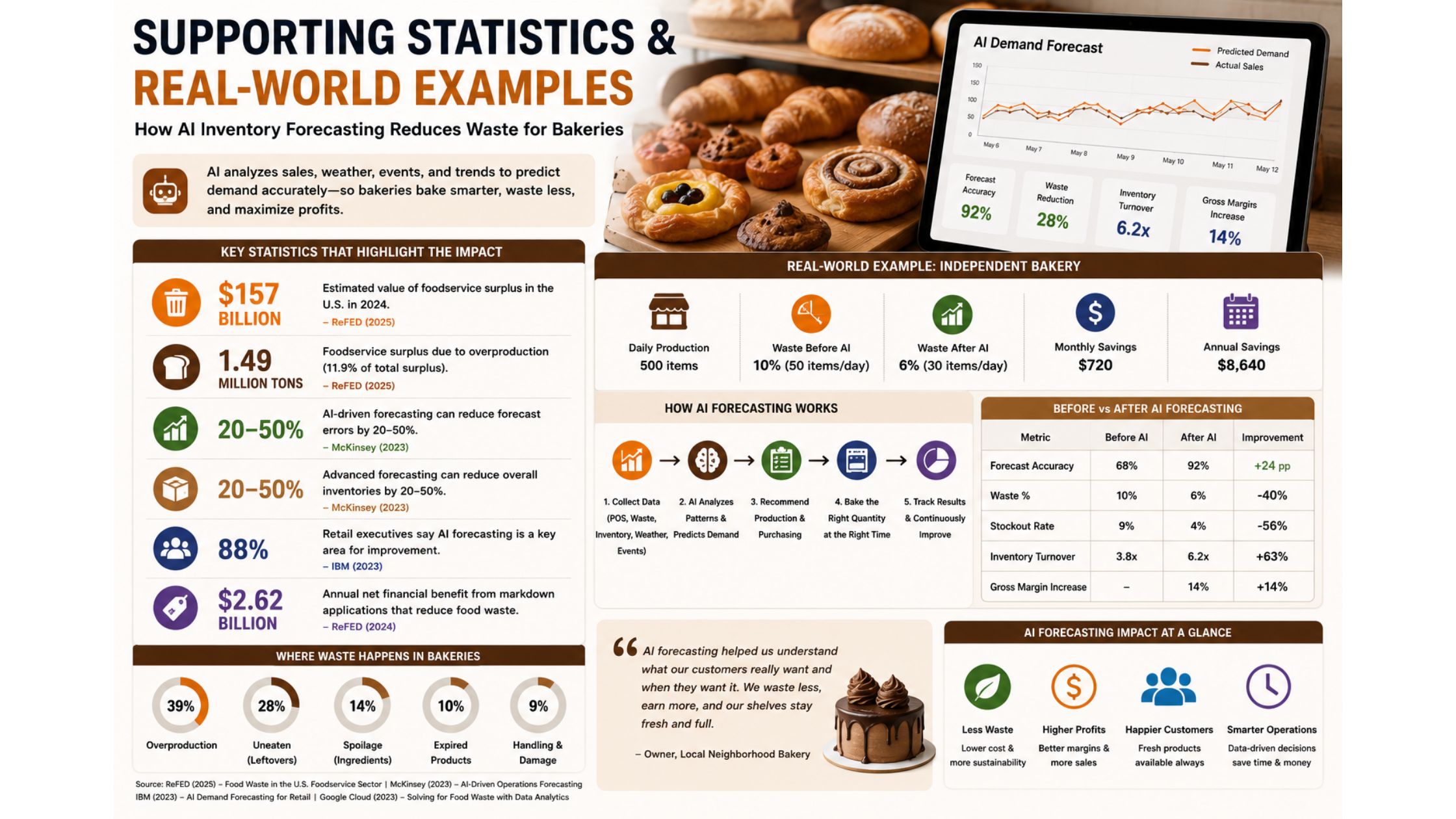
The scale of food waste makes even small forecasting improvements meaningful.
ReFED estimates that foodservice generated 12.5 million tons of surplus food in 2024, with approximately 12.4 million tons becoming food waste. Around 9.73 million tons went to landfill. The estimated value of foodservice surplus was $157 billion.
Overproduction is a major contributor. ReFED estimates approximately 1.49 million tons, or 11.9% of foodservice surplus, resulted from overproduction.
Better forecasting can directly address that problem because it targets the question at the centre of bakery production: how much should we make?
McKinsey reports that AI-driven supply-chain forecasting can reduce forecast errors by 20% to 50%, while other McKinsey analysis has estimated that advanced forecasting approaches can reduce overall inventories by 20% to 50% in some applications.
IBM also notes that 88% of retail executives identify demand forecasting as a key area where AI could drive improvement.
There are real-world examples in perishable food retail. Google Cloud describes how Swiss retailer Coop developed machine-learning forecasting to improve demand planning based on seasonality and expected customer demand. Google Cloud has also documented Fortenova Group using machine-learning forecasts for fruits and vegetables, combining historical sales, promotions, inventory information, and other data to produce daily forecasts that help store managers order more accurately and reduce waste.
Practical Bakery Example
Consider a bakery producing 500 fresh items per day.
Suppose approximately 10% remain unsold.
That means:
500 × 10% = 50 wasted items per day
If the average ingredient and direct production cost is $1.20 per item:
50 × $1.20 = $60 daily waste cost
Across 30 days:
$60 × 30 = $1,800 per month
The bakery introduces AI forecasting using POS history, weekday patterns, promotions, weather, holidays, and waste records.
If improved planning reduces average unsold inventory from 50 products to 30:
20 fewer wasted products × $1.20 = $24 saved per day
Over 30 days:
$24 × 30 = $720 in potential monthly production-cost savings
That equals $8,640 annually before considering additional benefits such as fewer stockouts and better purchasing.
These figures are illustrative, not an industry benchmark. Actual savings depend on product mix, margins, ingredient costs, forecasting accuracy, and operational execution.
Quick Tactical Setup for Bakeries
A bakery does not need to forecast every possible variable immediately. Start by connecting POS sales, product-level production quantities, ingredient inventory, and daily waste records. Build forecasts around the bakery’s highest-volume or highest-waste products first.
Then introduce additional variables such as weather, holidays, promotions, local events, and online orders.
Track forecast quantity against actual sales and waste every day. The system should continuously learn from the difference between predicted and actual demand.
The most useful KPI is not simply forecast accuracy. The bakery should monitor waste percentage, stockout rate, ingredient spoilage, gross margin, and sales lost because products were unavailable.
Conclusion
So, how can AI inventory forecasting reduce waste for bakeries?
It helps bakeries make production and purchasing decisions based on expected demand instead of intuition alone.
AI can analyze historical sales, current inventory, waste, weather, seasonality, promotions, events, and customer behavior to estimate what products are likely to sell and in what quantities.
That can help bakeries:
- Reduce overproduction
- Lower ingredient spoilage
- Improve daily production quantities
- Prevent unnecessary purchasing
- Reduce stockouts
- Identify consistently wasteful products
- React to unexpected demand
- Protect margins
Food waste will never disappear completely from a fresh bakery operation. Demand can change unexpectedly, products can fail quality checks, and businesses still need sensible safety buffers.
But the choice does not have to be between empty shelves and excessive waste.
AI inventory forecasting gives bakeries a better middle ground: produce closer to what customers are actually likely to buy, purchase closer to what production actually requires, and learn from every item that remains unsold.