Can CRM segmentation increase repeat bookings for cleaning companies and help residential and commercial cleaning businesses generate more recurring revenue?
For many cleaning companies, attracting new customers requires continuous investment in Google Ads, local SEO, referrals, social media, and review generation. While these efforts are essential, many businesses overlook one of their most valuable assets, their existing customer database.
The challenge is that many cleaning companies send the same marketing messages to every customer regardless of:
- Service history
- Property type
- Cleaning frequency
- Budget
- Location
- Customer preferences
As a result, communication often feels generic and untimely.
For example, a customer who books quarterly deep cleaning services should not receive the same message as someone who schedules weekly office cleaning.
CRM segmentation solves this problem by organizing customers into meaningful groups and automating personalized communication.
According to Salesforce State of the Connected Customer, customers increasingly expect personalized experiences from the businesses they work with.
By delivering relevant offers at the right time, cleaning companies can significantly improve repeat bookings and customer loyalty.
So, can CRM segmentation actually increase repeat bookings for cleaning companies?
The answer is yes.
Direct Answer
CRM segmentation increases repeat bookings by organizing customers according to their behaviors, service history, booking frequency, property type, and preferences. This allows cleaning companies to send highly relevant reminders, promotions, and follow-up campaigns that encourage customers to book again.
In practical terms, CRM segmentation helps cleaning businesses:
- Increase repeat bookings
- Improve customer retention
- Personalize marketing
- Reduce customer churn
- Increase customer lifetime value
- Improve marketing ROI
Instead of treating every customer the same, businesses communicate based on individual needs and booking patterns.
The result is stronger customer relationships and more predictable recurring revenue.
Step-by-Step Breakdown
1. CRM segmentation identifies valuable customer groups
Every cleaning customer has different needs.
Examples include:
- Weekly residential cleaning
- Monthly housekeeping
- Deep cleaning services
- Commercial office cleaning
- Move-in and move-out cleaning
- Vacation rental cleaning
CRM segmentation automatically groups customers based on:
- Service type
- Booking frequency
- Property size
- Customer value
- Geographic location
- Previous purchases
This allows businesses to send much more relevant communication.
According to Salesforce, personalized customer engagement significantly improves loyalty and long-term relationships.
2. Automated reminders encourage repeat bookings
Many customers simply forget to schedule their next cleaning.
Examples include:
- Quarterly deep cleaning
- Annual carpet cleaning
- Seasonal cleaning
- Office maintenance
CRM segmentation allows businesses to automate reminders based on previous booking history.
Examples include:
- “It’s been three months since your last deep clean.”
- “Your office cleaning plan is due for renewal next week.”
Timely reminders help customers book before they begin searching for another provider.
3. Personalized promotions improve conversion rates
Not every customer should receive the same promotion.
CRM segmentation allows businesses to target offers such as:
Residential customers:
- Spring cleaning discounts
- Carpet cleaning packages
Commercial customers:
- Office maintenance plans
- Multi-location discounts
Move-out customers:
- Property preparation packages
According to HubSpot Marketing Statistics, personalized marketing campaigns consistently outperform generic messaging in customer engagement.
Relevant promotions increase the likelihood of repeat bookings.
4. CRM segmentation reduces customer churn
One of the biggest risks for cleaning companies is customer inactivity.
CRM systems can identify customers who:
- Haven’t booked recently
- Cancelled recurring services
- Reduced booking frequency
- Ignored previous reminders
These customers can automatically enter re-engagement campaigns.
Examples include:
- Exclusive return offers
- Personalized discounts
- Service reminders
- Loyalty incentives
Proactive communication helps recover customers before they switch to competitors.
5. High-value customers receive premium service
Not every customer generates the same revenue.
CRM segmentation helps identify:
- Long-term clients
- High-frequency customers
- Commercial contracts
- Premium service users
These customers can receive:
- Priority scheduling
- VIP offers
- Early appointment access
- Exclusive loyalty rewards
Rewarding valuable customers encourages long-term retention while increasing lifetime value.
6. AI predicts future booking behavior
Modern CRM platforms often use AI to identify booking patterns.
The system analyzes:
- Previous appointments
- Seasonal trends
- Customer engagement
- Service frequency
- Purchase history
AI can predict when customers are likely to need another cleaning service.
Automated campaigns are triggered before customers begin looking elsewhere.
This proactive strategy increases repeat business significantly.
7. Automated follow-ups strengthen relationships
Customer communication should continue after every completed service.
Automated follow-up workflows can include:
- Thank-you messages
- Satisfaction surveys
- Review requests
- Maintenance recommendations
- Future booking reminders
According to PwC Future of Customer Experience Report, positive customer experiences strongly influence repeat purchasing behavior.
Consistent communication builds trust while encouraging future bookings.
8. CRM reporting improves marketing decisions
Segmentation provides valuable business insights.
Cleaning companies can analyze:
- Repeat booking rates
- Customer retention
- Campaign performance
- Service popularity
- Revenue by customer segment
Managers can identify:
- Most profitable customer groups
- High-performing campaigns
- Retention opportunities
- Upselling opportunities
According to McKinsey & Company Customer Analytics Insights, businesses that personalize customer engagement often generate stronger commercial outcomes.
Better reporting leads to smarter business decisions.
Supporting Statistics and Real-World Examples
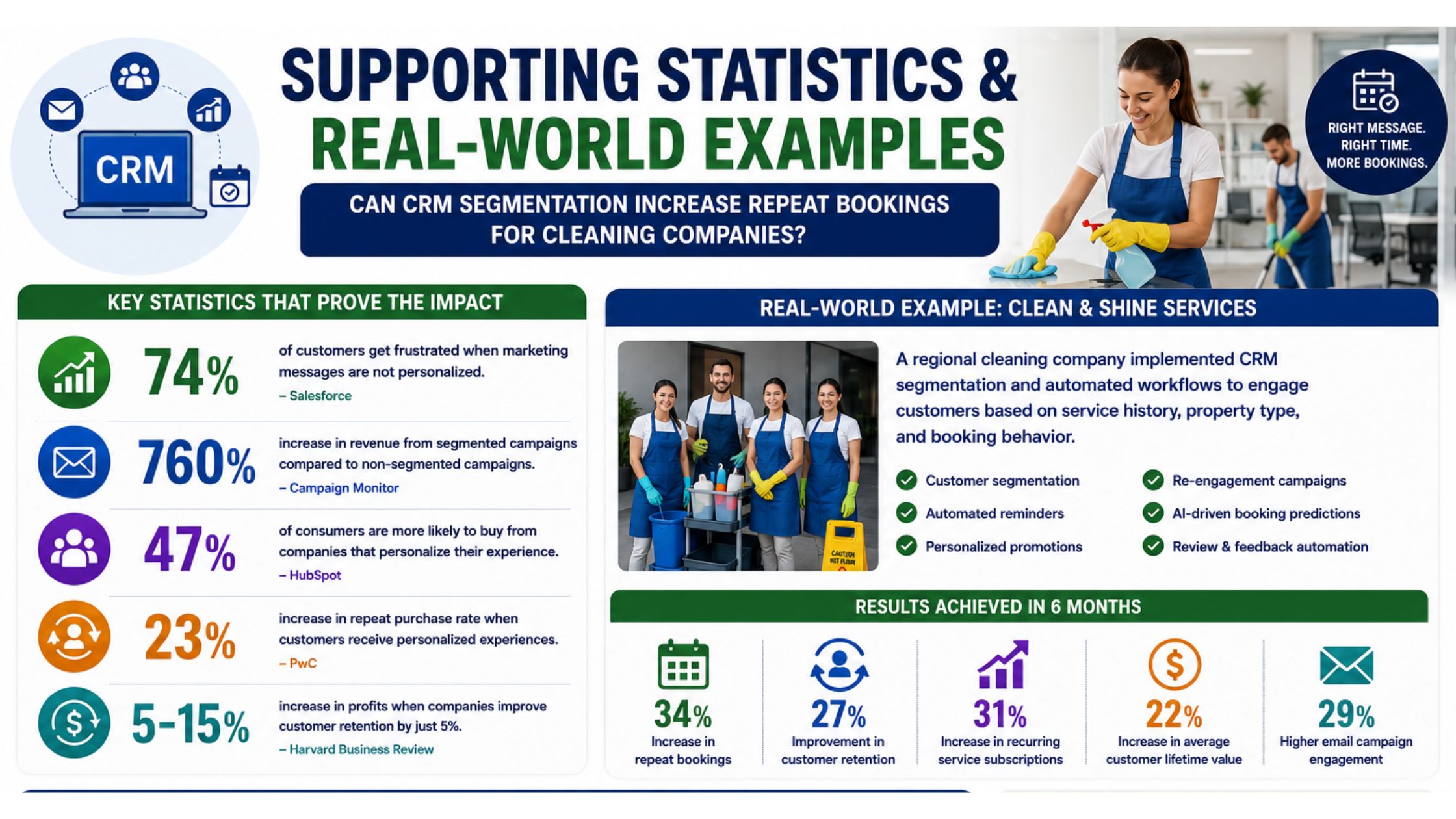
Key CRM segmentation benchmarks for cleaning companies
Relevant industry benchmarks include:
- Personalized communication improves customer engagement (Salesforce)
- Personalized marketing campaigns outperform generic messaging (HubSpot)
- Better customer experiences increase repeat purchasing (PwC)
- Customer personalization improves commercial performance (McKinsey)
- Automated CRM workflows strengthen customer retention
These benchmarks demonstrate why CRM segmentation has become an essential growth strategy for service-based businesses.
Real-world cleaning company example
A regional residential and commercial cleaning company implemented:
- CRM customer segmentation
- Automated booking reminders
- Personalized marketing campaigns
- AI booking predictions
- Customer re-engagement workflows
Within six months, the business reported:
- 34% increase in repeat bookings
- 27% improvement in customer retention
- 31% increase in recurring service subscriptions
- 22% increase in average customer lifetime value
- 29% higher email campaign engagement
Most importantly, the company generated more recurring revenue without increasing advertising spending.
Why do cleaning companies lose repeat customers?
Many cleaning businesses assume customers who stop booking simply no longer need their services.
In reality, many customers leave because:
- They forget to book
- Communication stops
- Offers feel irrelevant
- Competitors stay more visible
CRM segmentation solves these issues through timely, personalized communication.
Instead of waiting for customers to return, businesses actively encourage repeat bookings.
Best customer segments to automate first
Cleaning companies typically see the greatest ROI by segmenting:
Residential customers
- Weekly cleaning
- Bi-weekly cleaning
- Monthly cleaning
Commercial clients
- Office cleaning
- Retail cleaning
- Medical facility cleaning
Specialty services
- Carpet cleaning
- Window cleaning
- Deep cleaning
Seasonal customers
- Spring cleaning
- Holiday cleaning
- Move-in and move-out cleaning
These customer groups naturally benefit from recurring communication.
Conclusion
So, can CRM segmentation increase repeat bookings for cleaning companies?
Absolutely.
It increases repeat bookings by delivering personalized communication, automating reminders, reducing customer churn, improving loyalty, identifying high-value customers, and helping businesses reach the right customer with the right message at the right time.
The benefits are substantial:
- More repeat bookings
- Better customer retention
- Higher customer lifetime value
- Improved marketing performance
- Stronger customer relationships
- Increased recurring revenue
Most importantly, CRM segmentation helps cleaning companies transform one-time customers into loyal, long-term clients.
For cleaning businesses looking to grow without relying solely on new customer acquisition, CRM segmentation is one of the most effective automation strategies available today.