
B2B pharmaceutical sales operates on a trust timeline that no other industry quite replicates.
A procurement lead at a hospital group, a formulary committee member at a managed care organisation, or a medical director evaluating a new therapeutic compound is not making a decision in weeks.
They are making a decision in months, sometimes quarters, after navigating a layered approval process that involves clinical evidence review, pharmacoeconomic assessment, regulatory compliance verification, and institutional procurement policy.
The sales representative who arrives before that process has begun, builds credibility throughout it, and is present at the moment the decision window opens is the one who wins the contract.
Most B2B pharmaceutical sales teams invest heavily in the front end of this process, attending conferences, generating leads at symposia, and capturing contact details from whitepaper downloads and webinar registrations.
They invest considerably less in the infrastructure that nurtures those contacts through the evaluation cycle.
The result is a pipeline full of leads that were once warm and have since gone cold, not because the prospect lost interest, but because no systematic communication kept the relationship alive between the initial contact and the moment the buying window opened.
In 2026, email drip campaigns are the infrastructure that closes this gap, and for B2B pharmaceutical companies that deploy them with the right content architecture and stakeholder intelligence, the impact on sales qualified lead volume is not incremental. It is multiplicative.
The Compliance-Aware Content Architecture That Builds Trust Before the Sales Conversation
Pharmaceutical marketing operates within a regulatory environment that places specific obligations on the content of any communication directed at healthcare professionals and procurement decision-makers.
An email drip campaign in this sector cannot simply deploy the persuasion frameworks that work in SaaS or professional services. Every clinical claim must be referenced. Every comparative statement must be supported by approved evidence.
Every communication must include the required safety and labelling information relevant to the product category.
This compliance layer is not a constraint on the effectiveness of an email drip campaign in B2B pharmaceuticals.
It is the mechanism that builds the foundational trust that makes the campaign perform.
A healthcare procurement lead who receives a sequence of clinical communications that are rigorously evidenced, transparently referenced, and demonstrably compliant with industry standards experiences a very different brand impression than one who receives aggressive promotional content that would be more at home in a consumer marketing campaign.
The content architecture of a high-performing pharmaceutical drip campaign is structured around this trust-building imperative.
The early sequence delivers regulatory and clinical credibility content: peer-reviewed study summaries, pharmacoeconomic data presented with full methodology transparency, real-world evidence from comparable institutional settings, and manufacturing and quality standards documentation that addresses the supply chain reliability concerns that procurement leads carry into every evaluation.
This sequence does not attempt to close a sale. It attempts to earn the right to be considered, which in B2B pharmaceuticals is a far more valuable outcome from the first 30 days of contact.
Stakeholder Routing as the Multiplier of Qualified Lead Volume
The reason email drip campaigns multiply rather than simply increase sales qualified lead volume in B2B pharmaceuticals is the stakeholder routing capability that a well-architected campaign delivers.
A single institutional lead, such as a hospital trust that expressed interest at a medical conference, contains within it multiple potential buying influencers who each evaluate the product from an entirely different professional framework.
The medical director evaluating a new oncology compound is reading the same email database as the pharmacy and therapeutics committee chair, the chief procurement officer, and the outcomes-based contracting specialist who will eventually structure the commercial agreement.
Each of these individuals needs a different content experience to move from initial awareness to active evaluation, and a single undifferentiated email sequence addresses none of them with the specificity that their role-based decision criteria require.
A stakeholder-routed drip campaign segments these contacts by role and deploys separate, role-specific sequences simultaneously.
The medical director receives clinical outcome data, mechanism of action content, and therapeutic positioning relative to the current standard of care.
The procurement lead receives health technology assessment summaries, total cost of treatment analyses, and supply reliability documentation.
The formulary committee member receives comparative effectiveness evidence, patient pathway impact assessments, and prescribing protocol recommendations.
When every stakeholder in the institutional buying process is receiving communication that speaks directly to their specific decision criteria, the internal consensus process that a B2B pharmaceutical sale requires accelerates dramatically.
The lead that was previously stalled because procurement and medical were not aligned on the same evaluation timeline moves forward because the drip campaign has been simultaneously preparing both sides of the internal conversation.
The Engagement Scoring Model That Identifies Sales Readiness
The most operationally significant function of an email drip campaign in B2B pharmaceuticals is not the content it delivers.
It is the behavioural data it accumulates about each prospect’s level of engagement with that content, and the engagement scoring model that translates this data into a sales qualified lead signal.
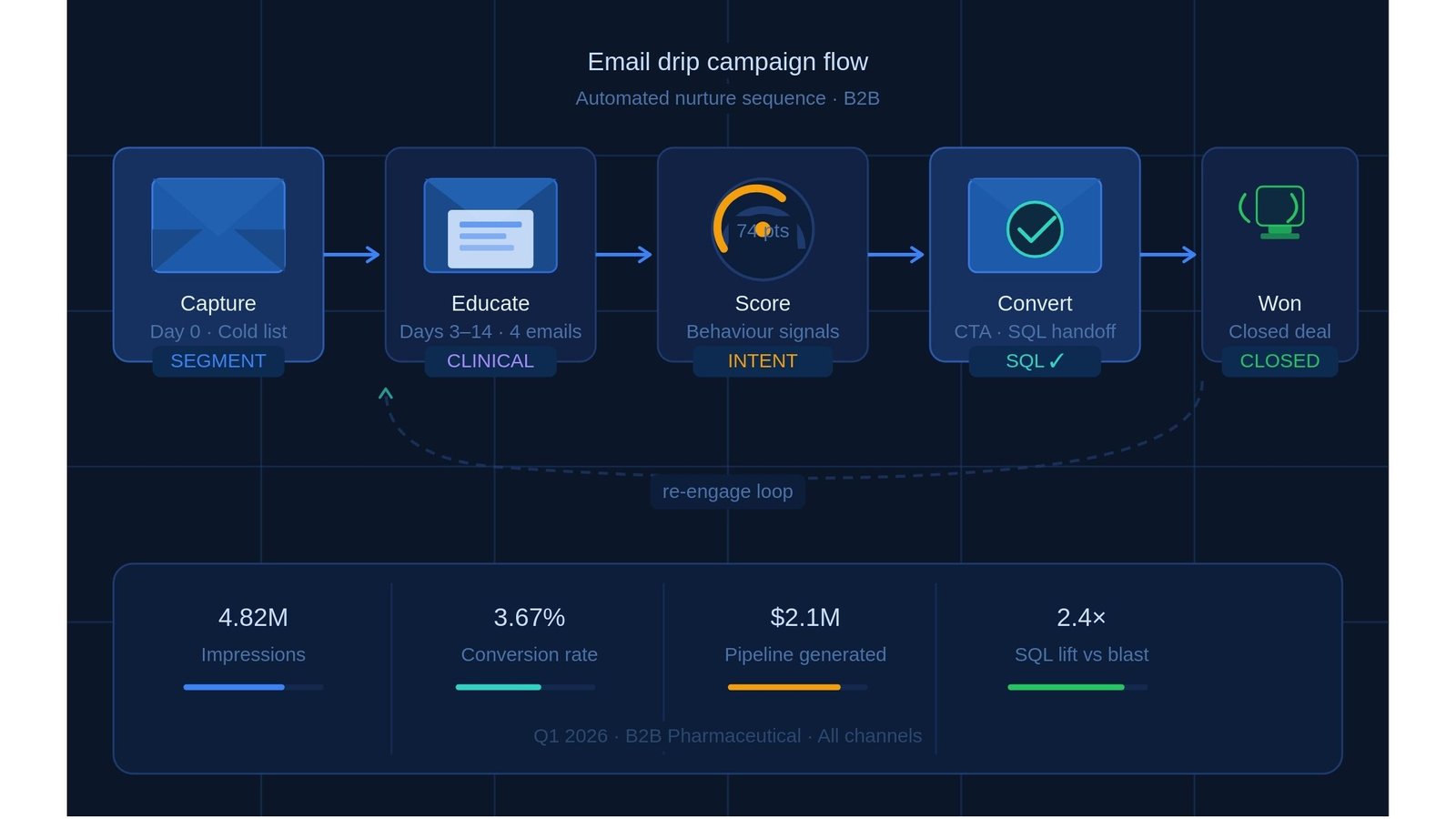
A procurement lead who downloads a pharmacoeconomic model, opens the formulary submission template email, clicks through to the health technology assessment summary, and visits the manufacturing standards page within the same 72-hour period is exhibiting a cluster of behaviours that signals active evaluation mode.
They are no longer casually aware of the product. They are building the evidence dossier that will support an internal proposal.
This is the moment at which the account should move from the drip campaign to direct sales engagement, and it is a moment that a sales team managing 200 accounts manually would almost certainly miss.
The engagement scoring model that sits beneath a properly configured drip campaign captures every one of these behavioural signals, assigns a weighted score based on the relative intent-strength of each action, and surfaces a sales qualified lead alert at the threshold that indicates genuine purchase consideration.
The sales representative who receives this alert does not arrive cold. They arrive with a complete picture of which content the prospect has consumed, which product areas they have focused on, which stakeholder roles within the institution have been engaging, and what stage of the evaluation process the institution has reached.
This intelligence transforms the first direct sales conversation from a discovery call into a strategic consultation.
The Long-Cycle Nurture Function That No Sales Team Can Replicate Manually
B2B pharmaceutical sales cycles for formulary inclusions, institutional supply agreements, and therapeutic area partnerships regularly extend beyond 12 months from initial contact to signed agreement.
A sales team managing the relationship-maintenance obligations of a pipeline this long across hundreds of accounts simultaneously faces a human bandwidth problem that no volume of headcount can solve economically.
An email drip campaign solves this bandwidth problem structurally.
A prospect who attended a medical symposium 14 months ago, expressed interest in a pipeline compound that was at Phase III at the time, and has since returned to the website three times to check trial progress is being nurtured by the drip campaign through every month of that interval without consuming a single hour of sales team time.
When the compound receives approval and the institutional selling process begins, this prospect has been receiving consistent, credible, and relevant communication throughout the entire waiting period.
They are not starting from zero. They are starting from a position of informed familiarity that a competitor without a drip infrastructure cannot replicate through last-minute outreach.
This long-cycle nurture function is the dimension of email drip campaigns that B2B pharmaceutical companies most frequently undervalue in their marketing investment calculations, because its returns are not visible in the short-term pipeline metrics that dominate quarterly reviews.
They are visible in the conversion rate difference between institutional accounts that entered the sales process through a drip-nurtured pathway and those that entered through cold outreach, a difference that is consistently large enough to justify the entire campaign infrastructure on the strength of a single major account conversion.
Building a Compliant Data Architecture That Scales Across Markets
B2B pharmaceutical companies operating across multiple national markets face an additional layer of complexity in their email drip campaigns that makes the managed infrastructure of a well-designed programme particularly valuable.
The data governance obligations that govern pharmaceutical marketing communications vary significantly between markets, with GDPR in European markets, the Sunshine Act reporting requirements in the United States, and equivalent frameworks in Asian and emerging markets each placing different obligations on how contact data is collected, stored, segmented, and used in direct marketing communications.
A drip campaign architecture that is built with these compliance requirements embedded from the outset, with consent management, data residency, and opt-out handling built into the campaign infrastructure rather than retrofitted onto it, is not simply a legal risk management exercise.
It is the foundation of the institutional credibility that a B2B pharmaceutical company must maintain with the healthcare system contacts who evaluate their products.
A communication that arrives without proper consent management or without the required unsubscribe mechanism in a regulated market does not simply generate a compliance risk. It damages the precise institutional trust that every other element of the campaign has been investing to build.
Schedule a free consultation to explore what a compliant, stakeholder-routed email drip campaign architecture would look like for your B2B pharmaceutical business. You will receive a complete audit of your current lead nurture process and the sales qualified lead volume it is failing to produce, a custom drip sequence framework built around your product portfolio and key institutional buyer profiles, and a 90 day deployment roadmap designed to multiply your sales qualified lead output while meeting the compliance requirements of every market you operate in, entirely obligation-free.
– Blog written by Pranit Kamble