Can account-based marketing win distributor accounts for specialty manufacturers when distributors already carry thousands of products, protect their existing supplier relationships, and rarely add a new line without a strong business case?
For specialty manufacturers, distribution partners can unlock growth that a direct sales team cannot reach alone. One regional or national distributor can put a product in front of hundreds of contractors, retailers, or industrial buyers.
Winning that partnership is difficult. Line card decisions involve product managers, purchasing, sales leadership, branch managers, and sometimes executives. Each has different concerns: margin, inventory risk, demand, training requirements, and conflict with existing suppliers. A single sales rep emailing a single buyer rarely reaches all of them.
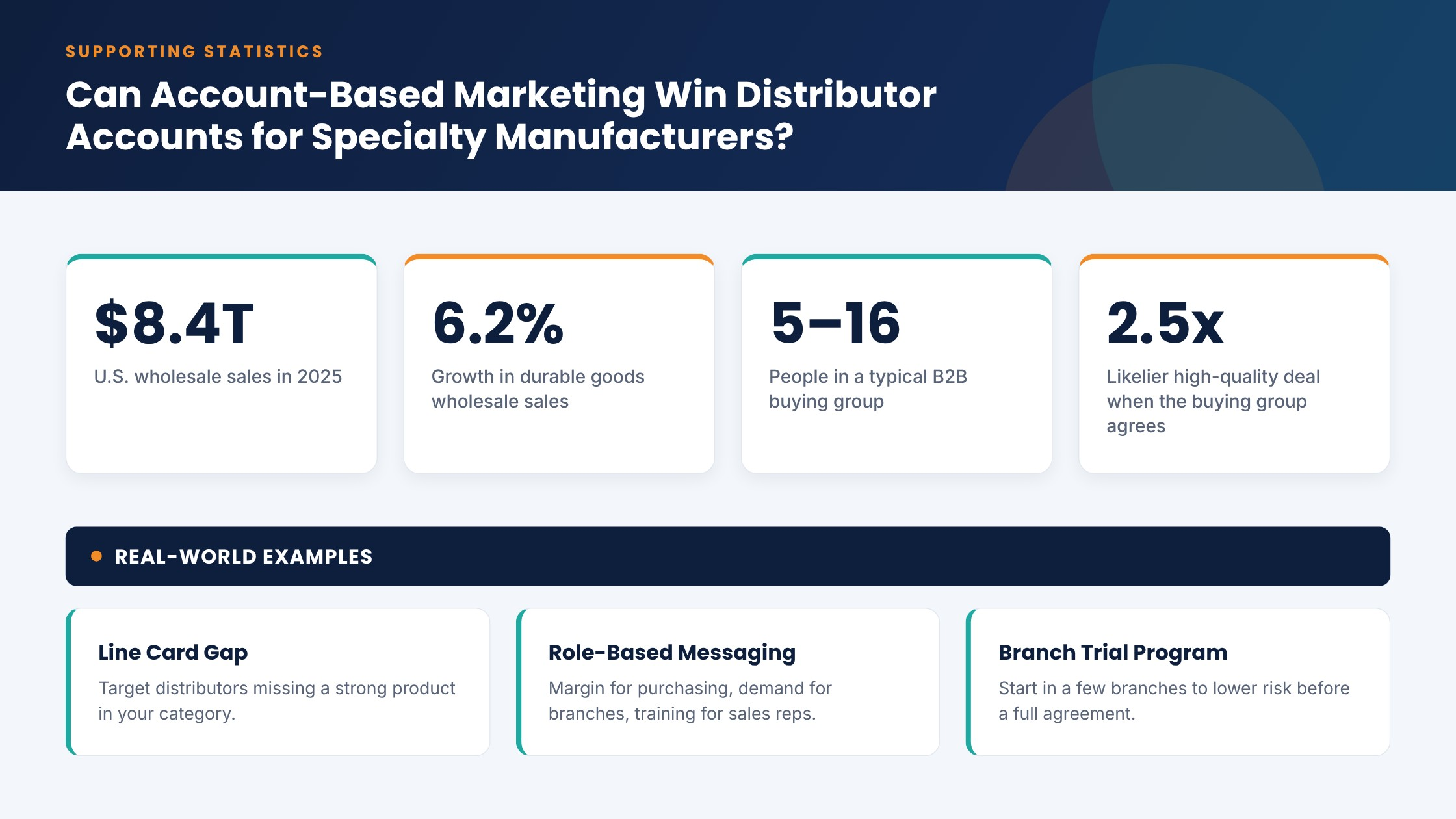
The opportunity is large. According to Modern Distribution Management’s report on Census Bureau data, U.S. wholesale sales exceeded $8.4 trillion in 2025, with durable goods sales up 6.2%. Distribution remains one of the main ways manufactured products reach buyers.
ABM for specialty manufacturers changes the approach. Instead of broad campaigns, the manufacturer selects a short list of target distributors, maps everyone involved in the decision, and delivers tailored messages, content, and sales outreach to each of them.
The result is a more focused, credible case for why each distributor should carry the product line.
Direct Answer
Yes. Account-based marketing can win distributor accounts for specialty manufacturers by focusing effort on a small number of high-fit distributors, reaching every person who influences the line card decision, and showing each of them why the product will make the distributor money.
A typical ABM process for winning distributor accounts looks like this:
Target distributor list → Buying group mapping → Distributor-specific business case → Coordinated ads, email, and sales outreach → Discovery meeting → Line review or trial program → Distribution agreement → Launch support
Each stage has a clear goal. Research identifies who matters. Personalized content earns attention. Coordinated outreach builds familiarity across the buying group. The business case and trial program reduce the distributor’s risk.
ABM does not guarantee a new partnership. Distributors may decline because of existing supplier commitments, limited shelf or warehouse space, low expected demand, or timing. However, ABM gives a specialty manufacturer a structured way to build credibility with the right people before the line review, rather than hoping a cold pitch reaches the decision-maker.
The objective is to make adding your product line an easy, low-risk decision for every stakeholder involved.
Step-by-Step Breakdown
1. Build a short list of high-fit distributors
ABM starts with focus. Instead of contacting every distributor in the industry, select a small number that fit the product and the manufacturer’s growth plan.
Useful criteria include:
- Customer base: The distributor sells to the contractors, plants, or retailers who buy your product.
- Geography: Their branches cover the regions where you want to grow.
- Line card gaps: They lack a strong product in your category, or carry a weaker alternative.
- Specialization: They have technical sales staff who can explain a specialty product.
- Size and capacity: Large enough to matter, but not so large that your line will be ignored.
A list of 10 to 30 target distributors is often enough to start.
2. Map the distributor’s buying group
A new line card decision rarely belongs to one person.
For each target distributor, identify the people who influence the decision, such as:
- Category or product managers
- Purchasing and vendor managers
- VP of sales or sales leadership
- Branch or regional managers
- Inside and outside sales representatives
- Operations and warehouse leaders
- Owners or executives at smaller distributors
Use LinkedIn, the distributor’s website, trade association directories, and conversations with existing customers to build this map.
3. Understand what each distributor needs
Distributors add products that help them grow profitably.
Before reaching out, research each target. Look at their line card, recent acquisitions, branch expansions, end markets, and any gaps where customers may be asking for products they do not carry.
Also understand their concerns. Common objections include margin, minimum order quantities, inventory risk, channel conflict with existing suppliers, and the time required to train sales teams.
4. Build a distributor-specific business case
Generic product brochures rarely win distributor accounts.
Create a short business case tailored to each target distributor. It should explain the end customers who are already asking for the product, expected margin, demand in their territory, how the product complements their current line card, and what support the manufacturer will provide.
Where possible, include proof such as sales results with other distributors, end-user demand data, or examples of contractors already buying the product directly.
5. Tailor messages to each role
Each person in the buying group cares about something different.
- Product managers: Line card fit, differentiation, and competitive gaps
- Purchasing: Pricing, terms, minimums, and lead times
- Sales leaders: Revenue opportunity and easy-to-sell features
- Branch managers: Local demand and customer requests
- Sales reps: Training, samples, and spiffs or incentives
- Executives: Strategic growth and long-term partnership value
Tailored messages help each stakeholder see what is in it for them.
6. Coordinate ads, email, and sales outreach
ABM works best when channels support each other.
Targeted LinkedIn ads can build familiarity with employees at selected distributors. Personalized email sequences can share the business case and relevant content. Sales reps can follow up with calls, LinkedIn messages, or visits.
The goal is for the buying group to recognize the brand and understand the value before the first serious meeting, rather than hearing about the product for the first time in a cold call.
7. Use trade shows and industry events strategically
Distribution industries still rely heavily on in-person relationships.
Before a trade show, invite target distributor contacts to a booth meeting, product demo, or private dinner. Use ads and email to build anticipation. After the event, follow up quickly with notes and next steps tailored to the conversation.
Events become far more productive when they are part of an ABM plan rather than a standalone expense.
8. Reduce the distributor’s risk
Adding a new product line involves risk. The manufacturer can make the decision easier.
Options include:
- Trial programs in a limited number of branches
- Lower initial stocking commitments
- Co-op marketing funds
- Demand generation directed at end users in the distributor’s territory
- Product training for inside and outside sales teams
- Referral of existing direct customers to the distributor
These commitments show that the manufacturer is invested in the distributor’s success.
9. Support the launch after the agreement
Winning the account is only the beginning. If the product does not sell, the distributor may drop the line.
After signing, continue the ABM approach with branch-level training, co-branded marketing, end-user campaigns that drive demand to the distributor, and regular performance reviews.
A successful launch with one distributor also becomes proof for the next target.
10. Measure account progress, not just leads
ABM should be measured by progress with target accounts, not the number of leads generated.
Useful metrics include:
- Percentage of target distributors engaged
- Number of buying group contacts reached per account
- Meetings and line reviews secured
- Trial programs started
- Distribution agreements signed
- Time from first contact to agreement
- Sales through each new distributor in the first 12 months
Review progress account by account, and adjust messages and outreach where engagement stalls.
Supporting Statistics and Real-World Examples
Research shows why specialty manufacturers need a more deliberate approach to winning distributor partners.
The distribution market is large and still growing. Modern Distribution Management, reporting U.S. Census Bureau data, found that U.S. wholesale sales reached $8.442 trillion in 2025, up 4.8% from 2024. Durable goods wholesale sales grew 6.2% to $4.1 trillion. Distributors have strong reasons to add products that help them capture more of that demand, but they choose carefully.
Decisions are also made by groups, not individuals. Gartner research reported by Computer Weekly found that B2B buying groups range from five to 16 people across as many as four functions. Groups that reach consensus are 2.5 times as likely to report a high-quality deal. Gartner’s research covers B2B buying broadly, not distributor line card decisions specifically, but the pattern is familiar to any manufacturer that has pitched a distributor.
That is the core argument for ABM. When several people must agree, a manufacturer that informs and aligns the whole group has a better chance than one that pitches a single buyer and hopes the message spreads.
These findings do not prove that ABM will win a specific number of distributor accounts. They show that distribution is a large, growing channel and that complex group decisions favor coordinated, account-focused outreach.
Practical Specialty Manufacturer Example
Consider a manufacturer of specialty industrial sealants that wants to expand through regional distributors.
It selects 20 target distributors that serve its core customers and lack a strong product in its category.
Over six months, the ABM program engages contacts at 12 of them and secures meetings with 6.
20 target distributors → 12 engaged → 6 meetings.
Three distributors agree to trial programs in selected branches, and two sign full distribution agreements.
If each new distributor purchases $400,000 of product per year:
2 distributors × $400,000 = $800,000 in new annual revenue.
Because distribution agreements often last for years, the long-term value can be several times higher, especially if successful trials expand to more branches.
These figures are illustrative, not industry benchmarks. Actual results depend on product fit, margin, competition, distributor priorities, sales cycle length, and the support the manufacturer provides after signing.
The lesson is that ABM does not need to win many accounts to pay off. A small number of well-chosen distributor partnerships can transform a specialty manufacturer’s reach.
Quick Tactical Setup for ABM for Specialty Manufacturers
Start with 10 to 20 target distributors that serve your best end customers and have a clear gap in your product category.
Map three to seven decision-makers at each distributor, research their line card and end markets, and build a one-page business case for each.
Launch coordinated outreach: targeted LinkedIn ads to employees at those distributors, a personalized email sequence by role, and sales follow-up. Offer a low-risk next step, such as a branch-level trial or product training session.
After 90 days, review engagement by account, meetings secured, and trial programs started. Refine messages for accounts that are not responding before adding new distributors to the list.
Conclusion
Can account-based marketing win distributor accounts for specialty manufacturers?
Yes. Account-based marketing helps specialty manufacturers focus on the distributors that matter most, reach every person involved in the line card decision, and present a business case built around each distributor’s goals.
The most valuable improvements include:
- A focused list of high-fit distributors
- Clear mapping of every decision-maker
- Business cases tailored to each distributor
- Messages matched to each stakeholder’s concerns
- Coordinated ads, email, events, and sales outreach
- Lower-risk trial programs that ease adoption
- Launch support that keeps the line on the card
- Measurement by account progress, not lead volume
ABM cannot compensate for a weak product, uncompetitive margins, or poor fulfillment. Its value comes from making sure the right people at the right distributors understand why your product deserves a place on their line card.
When every stakeholder sees clear demand, healthy margins, and real manufacturer support, adding your line becomes an easy decision.